
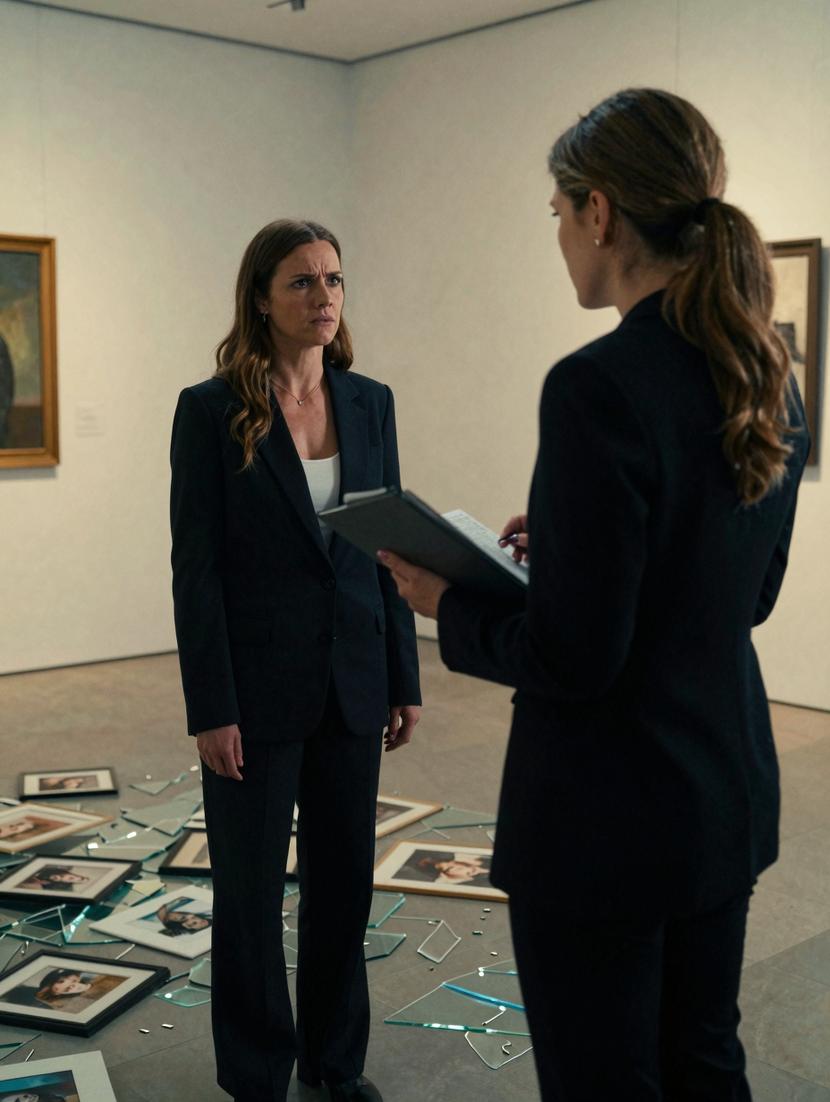
The shattering crash of glass rippled across the quiet gallery as my mother’s furious sweep sent my framed photographs hurtling to the tiled floor. Guests scattered like startled birds, their whispers swallowed by the echoing silence that fell. Heavy breaths from my mother filled the room, harsh and ragged, while my father’s intense glare pinned me in place. “Ungrateful child!” Mom spat, her manicured fingers trembling with barely contained fury. “All we want is for you to do what’s right! Lucas needs Silverwood Lake more than you do!”
I’m Isabela. Thirty-two years old. And what was meant to be my moment of triumph — my debut photography exhibit celebrating the soul of our grandfather’s cherished Silverwood Lake house through the seasons — had erupted into another bitter family battle fueled by Lucas’s insatiable entitlement.
“The lakehouse isn’t a bargaining chip,” I said quietly, eyes locked on my father as his face flushed crimson with disbelief. “Grandfather left it to me for a reason.”
Lucas’s name hung heavy in the air, igniting tension as Dad stepped forward over the shards. “Your brother has a family! Three kids who deserve space to grow! What do *you* need it for? More of your impractical pictures?”
Those “impractical pictures” had sold for thousands. But they never saw. Never understood. Lucas was the golden son — the business titan with a perfect life — and I was their artistic disappointment who refused to fit the mold.
“Sign the papers,” Mom demanded, extracting a sleek folder from her designer bag, voice icy. “Transfer’s already prepared. Just sign. Erase this humiliation.”
My hand brushed the heavy canvas messenger bag slung across my shoulder — inside, the real game-changer: an environmental report I’d commissioned months ago. Data and proof that would upend every greedy plan.
“No,” I declared, unwavering. “Silverwood Lake stays with me. It’s what Grandfather wanted.”
Her hand lashed out, toppling another display stand. Glass shattered again — memories crushed with it. Each photo had been a labor of love: waiting for dawn’s perfect light, for elusive moments with the vulnerable wildlife we all ignored.
“Grandfather had no idea what Lucas would become,” Dad growled, fury barely contained. “He’s built an empire in real estate, you know! He could develop that property, turn it into something valuable instead of letting it rot!”
Rot. Because they never visited. Never saw what I had painstakingly built — a wildlife sanctuary thriving on the north shore, artist retreats fostering creativity in summers. They never noticed their golden boy’s empire was built on shortcuts and greed.
“Lucas hasn’t set foot on the property since Grandfather died,” I said gently, gathering shattered photos. “He only saw dollar signs. Condos. Not the otters, the loons, the wetlands I’ve protected.”
“Development *means* progress,” Mom snapped, voice sharp and dismissive. “Your silly art won’t put food on the table. When will you grow up and do something useful?”
I almost laughed — such blindness to the endangered species nesting there, the wetlands under government protection, and tomorrow’s state environmental order that would lock everything down.
“I’m already doing something meaningful,” I said, lifting a battered photo of loons at sunrise, the mist curling over the lake. “Just not the kind you understand.”
A thundering slam silenced the room as Dad’s palm hit the wall. The remaining photographs trembled. “Sign those papers tonight or you’re out! No more family support, no connections. Gone!”
I looked at them both — my manipulators, who’d spent years shaping Lucas into their ideal while branding me a failure, who now tore apart my work because control slipped through their fingers.
“That’s your choice,” I said, voice steady, retrieving my bag. “But my answer is no.” Pausing at the door, I added, “I have a meeting with the State Environmental Protection Board tomorrow morning. I need rest.”
Their faces warped — fury giving way to shock. “Environmental Protection Board?” Mom’s uncertain voice cracked. “What on earth are you talking about?”
I stepped over the wreckage they’d wrought. “You’ll see soon enough. And tell Lucas — he should be there too.”
Outside, the cool evening air wrapped around me as Mom’s sharp cry chased my retreating figure. “Isabela, come back now!”
But I didn’t stop. Years of dismissal, underestimation, and scorn had forged a quiet strength inside me. Tomorrow, they’d discover what I’d truly done with that “empty” Silverwood Lake house. Tomorrow, they’d learn why Grandfather entrusted *me* with his legacy — and I had the photographs to prove every precious moment.
—
**Part 1: The Verdict**
The environmental board’s meeting room buzzed quietly as I entered, early enough to spot Lucas in an immaculate suit, huddled with his development team, their heads bowed over plans now destined for the trash. My parents sat nearby, shooting glances sharp enough to freeze.
I placed my refurbished laptop and the thick evidence folder on the glossy table, a lifeline I’d painstakingly prepared overnight from backups — my trump card.
“This is nonsense,” Lucas muttered loud enough to catch. “Some birds and plants won’t stop progress. Investors are waiting.”
The board filtered in, led by Elena Rodriguez, a formidable woman I’d partnered with for months. She was particularly drawn to my wetland documentation.
“Good morning,” Elena began, voice crisp. “We convene to review the environmental assessment of the Silverwood Lake property and its development implications.”
I stood, connecting my laptop to the projector. The first slide—a pair of endangered sandhill cranes nestled in the marsh—filled the screen.
“As you see, this land sustains critical habitat for protected species. I spent the last year meticulously recording their presence and behaviors.”
More images appeared: rare orchids blooming in the wetlands, fragile fish darting in crystalline waters, otters frolicking along the shoreline. Each photo was dated, geotagged, with detailed notes.
“This is preposterous!” Dad erupted, standing. “Those photos could be anywhere! Isabela’s fabricating stories again!”
Elena raised a brow. “Mr. Harrison, our scientists have verified each finding. Ms. Harrison’s documentation is exemplary.”
I pressed on, unfolding how the property served as a vital wildlife corridor connecting nature preserves. Lucas’s grand plans would shatter that fragile balance.
“Furthermore,” I said, revealing Grandfather’s original documents, “he clearly designated this land for conservation in his will.” I slid his detailed notes onto the table.
Lucas leapt up. “The will just left her the land! No conditions!”
A quiet smile curved my lips as I nudged the papers toward Elena. “No. Grandfather knew its worth. That’s why he trusted me.”
Mom’s face drained, realization crashing down. Their schemes, their pressure, the broken attempts to bend me—useless.
“Based on these findings,” Elena declared, “and state law, Silverwood Lake is hereby designated a protected wildlife sanctuary. No development shall proceed.”
Chaos erupted. Lucas’s team scrambled frantically. Dad demanded a word with authority. Mom sat frozen, eyes locked on me as if seeing me anew.
“You rigged this!” Lucas accused, storming over. “You’ve destroyed everything! Do you realize how much money I’ve poured into this?”
I met his raging gaze, calm and clear. “Maybe you should have visited Silverwood Lake in the past five years. You’d have seen what *really* lives here.”
“This isn’t the end!” Dad threatened. “We’ll appeal! Get a new assessment!”
“Try all you want,” I said, packing up. “Every survey will reveal the same truth. This isn’t a property for development. It’s a sanctuary—just as Grandfather intended.”
Elena approached with documents of her own. “Ms. Harrison, would you consider establishing a permanent research station here? Your work’s invaluable.”
I nodded eagerly. “Absolutely. I can show you prime observation sites.”
I caught Mom flinch at Elena’s professional respect—the very respect they’d always denied me. My photography no longer a mere hobby but a shield for something priceless.
Exiting the meeting, Lucas’s bitter words haunted me: “This is your fault. If you weren’t spoiled… ”
I smiled inwardly. They still missed it. This was never about revenge. It was about safeguarding beauty and legacy. Silverwood Lake would remain exactly as Grandfather envisioned—pure, protected, eternal. And my art? It had proved to be more powerful than any dollar could ever buy.
—
**Six Months Later**
I stood on the deck of Silverwood Lake’s house, the morning mist weaving around a family of sandhill cranes as they taught their chicks to feed. My camera clicked softly, immortalizing the tranquil moment.
The sanctuary had blossomed beyond dreams. Universities sent eager students for research. My photographs had caught national attention; National Geographic was interested in our story of preservation.
“Ms. Harrison!” a young researcher called out, excitement in her voice. “That rare orchid you spotted last year is expanding to new areas!”
I smiled, recalling how my parents once dismissed this place as deserted and wasted. Now it thrummed with life, purpose, and new discoveries.
My phone buzzed—a text from Mara. “The kids miss the lake. Can we visit this weekend? Just us, without Lucas.”
Since the board’s ruling, family lines had shifted. Lucas refused all contact, but Mara secretly loved the lakehouse and shared my passion. Her children had caught the reverence for the wild.
“Of course,” I replied. “Baby otters are exploring the shore. Tell them to bring cameras.”
Mom had taken longer to grasp all this. Last month, she appeared unexpectedly, her sleek Mercedes incongruous among muddy research vehicles.
“I don’t get you,” she confessed, watching me photograph an elusive butterfly. “You could’ve made millions through development.”
“Look,” I said, guiding her gaze through the lens at the delicate wings. “This butterfly exists only in a handful of places. Do you know its worth?”
She was silent, really seeing for the first time. “It’s beautiful,” she whispered. “Grandfather cared about things like this.”
“I know,” I said softly. “That’s why he trusted me.”
This morning, the familiar rumble of Dad’s BMW pulled beside my cabin. He stepped out slowly, dressed casually but out of place among the scientists and equipment.
“Isabela,” he began, hesitant, “Mom said you have a presentation today.”
I nodded. “It’s our first educational program for local schools. Teaching kids conservation and wildlife photography.”
He looked around, absorbing the research gear and photo displays. “Your brother’s youngest, Tommy, won’t stop talking about the photos you showed him. Says he wants to be a wildlife photographer.”
“He’s got a good eye,” I smiled, remembering Tommy’s joy capturing his first heron. “Want to see what we’re working on?”
Dad hesitated but agreed. I led him to the renovated boathouse, now a research station adorned with photos and data.
“You did all this?” His voice was low, awe creeping in.
“This is what I’ve done while you thought I was wasting time,” I said quietly. “This is what Grandpa saw.”
He was quiet a long time, absorbing each image — the rare frog’s life cycle, the delicate balance of it all. Finally, he looked up, the weight of years in his eyes.
“I was wrong,” he admitted, every word heavy with effort. “About this land. About your work. Grandfather would be proud.”
The words landed softly, like the mist on the lake.
“Want to stay for the presentation?” I asked. “The kids would love to see their grandfather’s legacy.”
He nodded, a genuine smile breaking through years of strain.
That afternoon, watching Dad help Tommy adjust his camera to capture deer at the forest’s edge, I realized how much had changed. Silverwood Lake wasn’t just a sanctuary for wildlife — it was healing us too.
Lucas remained estranged, too proud to admit defeat. Yet his children returned regularly, learning to view the world through lenses of wonder rather than profit. Mom tended a butterfly garden she’d quietly started, her enjoyment a secret. Dad was discovering success in ways beyond money.
As the sun dipped below the horizon, painting the sky in hues no development could capture, I pressed the shutter one last time. In the frame stood Dad and his grandchildren, crouched in the grass, cameras ready — witnesses to nature’s quiet magic.
It wasn’t the future anyone had planned. But it was better than anything we could have built. Silverwood Lake was now exactly what Grandfather intended: a sanctuary not just for wildlife, but for hearts willing to truly see.
Sometimes, the most precious legacies can’t be sold or built. They must be preserved, protected, and shared with those who have eyes to witness their rare beauty.


