
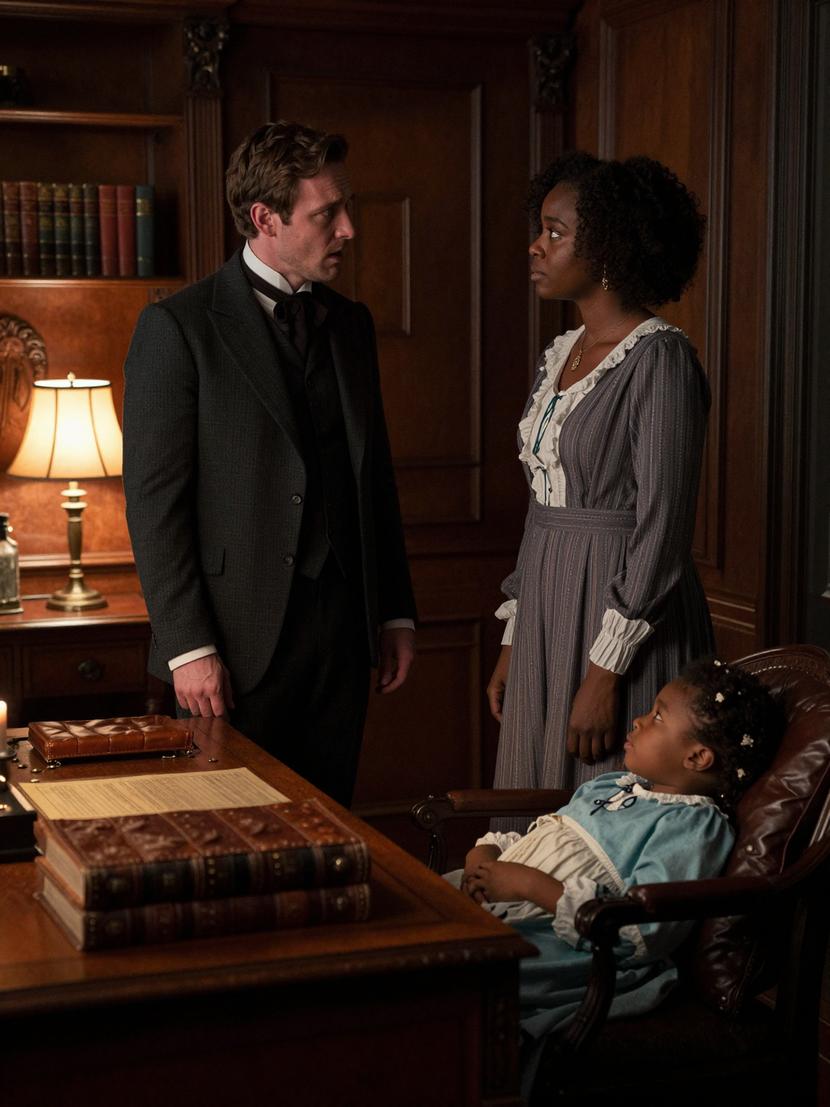
Within the cold, stately halls of Hawthorne manor, a silent dread hung heavily in the air—unspoken yet deeply felt by all who dwelled there. Little Ava Kensington, the sole light of the manor, was slipping away, her life thinning like the last fragile thread of dawn.
The prognosis from the doctors was stark, clinical in its finality: three months. Perhaps even less. A sentence that fractured the fragile hope lingering in Edward Kensington’s heart. A titan of industry, Edward was a man who bent markets, decisions, and fortunes to his will—but now he faced the helplessness of a father powerless before his daughter’s fate.
Hawthorne manor was nothing short of magnificent—immaculate marble floors glistening under crystal chandeliers, walls steeped in silence so deep it pressed against your soul rather than comforted it. That silence saturating every corner was heavy with guilt and dread, settling over the grand dining table, curling quietly at the edges of Ava’s bed.
Despite the wealth that filled the manor—private physicians, cutting-edge medical devices, a carousel of devoted nurses, the gentle hum of music therapy, and walls painted tenderly in hues Ava favored—nothing could revive the sparkle in the child’s distant gaze. Her bright eyes were veiled behind a glass curtain, unreachable, as if the vibrant world outside held no claim to her.
After the tragic passing of his wife, Edward became a shadow of the commanding leader once featured on countless business covers. Meetings slipped by unattended, calls unanswered. The empire would endure; it had to. But Ava’s life demanded his undivided attention.
A relentless routine consumed his days: before the first light of morning, preparing a breakfast Ava barely touched, meticulously administering her medicines, journaling every minuscule twitch and breath—clinging desperately to any hope that recording the moments could tether them against the relentless march of time.
Ava’s voice was almost gone—occasional nods, faint shakes of her head, or sometimes silence so complete she seemed a fragile shadow beside the window, transfixed by light not meant for her.
Edward’s voice, though, never faltered. He spun stories long into the night, tales of distant travels, invented fairy tales, whispered promises of futures that slipped just beyond their grasp. Yet, a cavernous void remained, an aching gulf neither knew how to cross.
Then came Clara Whitman.
Clara arrived without fanfare or forced cheer, carrying a quiet serenity—a calm born from the depths of grief. Only months before, she had lost her own newborn, leaving her world hollow—a silent nursery filled with imagined cries and a cradle that never rocked.
Drawn by an ad seeking a caregiver for a frail child at a grand manor, requiring only patience—no special experience—Clara felt the weight of fate and desperation collide within her. Applying was less a choice than a lifeline, an unspoken plea for redemption from her own sorrow.
Edward met her with the weariness of a man long battleworn: strict rules of distance, respect, and discretion laid bare. Clara accepted silently, retreating to her visitor room at the manor’s far end, suitcase in hand, a fleeting presence trying not to disturb the shadows.
Days began with observation. Clara tidied, replenished supplies, unveiled curtains to invite light, arranged pale blossoms, straightened pastel blankets. She didn’t rush to Ava, instead learning the language of absence, understanding that no words could heal such profound loneliness.
What startled Clara the most wasn’t Ava’s ghostly pallor or the delicate wisps of hair reclaiming her scalp. It was the hollow vastness behind those vacant eyes—the emptiness mirroring Clara’s own shattered soul.
Choosing patience, Clara refrained from forced affection. She placed a music box near Ava’s bedside; the soft melody coaxed a faint turning of the head—a fragile, tentative flicker of life.
From the threshold, Clara read aloud in a steady, gentle voice, becoming a quiet presence rather than an intrusion.
Edward noticed, though he struggled to name the change. Clara filled the manor not with noise but with an embracing warmth, a subtle balm.
One evening, Edward found Ava clutching the music box, her tiny fingers wrapped around it as if daring to wish for a distant hope. In that wordless moment, Edward summoned Clara into his study, his gratitude simple and raw: ‘Thank you.’
Weeks tiptoed by, trust weaving slowly between the fractured threads of their fragile family.
During a gentle brushing of Ava’s newly sprouted hair, the fragile peace shattered. Ava’s body trembled; she grasped Clara’s shirt hem and whispered, voice dreamy yet sharp, ‘It hurts… don’t touch me, Mommy.’
Clara froze—not just at the pain, but at the word. ‘Mommy.’ Ava hardly spoke, and this was no accidental slip. It bore the weight of memory and fear.
Softly putting down the brush, Clara replied, ‘Okay. We’ll stop for now,’ sheltering the storm within.
Sleepless that night, Clara wrestled with questions. Edward had told her Ava’s mother was gone—so why did that word trigger such tension? Why did Ava recoil as if expecting a harsh scream?
In the days that followed, Clara noted unsettling patterns: sudden startled shivers at approaching footsteps, stiffening at raised voices, and alarming declines following certain medications.
Answers awaited hidden in the manor’s supply room. There, behind locked doors, Clara uncovered aged cabinets packed with faded labels, vials inscribed with unfamiliar names, some marked with ominous red warnings—medications dating back years, all bearing Ava Kensington’s name.
She photographed and burned through the night researching these substances—each revelation chilling and stark.
These were not treatments; they were experiments laced with grievous risks—drugs banned elsewhere, doses dangerously high.
What lay beneath was not care, but a perilous gamble with a child’s life.
Fear surged, but above all burned a fierce protective flame. Clara withheld this from Edward—for now. She had witnessed him, broken and vigilant beside Ava’s bed; yet, Ava was imperiled, and crucially, she trusted Clara.
She began methodically documenting every medication, reaction, and schedule. Observing nurses, comparing vials from the washroom to those stored away. The most terrifying discovery was an ongoing repetition—medications that should have ceased were still administered.
The manor itself seemed to hold its breath on the day Edward unexpectedly entered Ava’s room, finding her finally at rest, leaning softly against Clara. His sharp voice fractured the quiet: ‘What are you doing, Clara?’
Rising swiftly, Clara tried to explain, but Edward’s hurt and confusion bred suspicion. Then Ava panicked.
Throwing her tiny arms around Clara, she pleaded through trembling screams, ‘Mommy… don’t let him scream.’
The silence that followed was no longer the manor’s worn quiet—it was a reckoning.
Frozen in place, Edward saw anew that Ava wasn’t just ailing—she was terrified. And she didn’t run to him.
He moved swiftly toward Clara, a man reeling from his own blindness.
That night, barricaded in his study, Edward poured over Ava’s medical records—line by agonizing line—unveiling a map of deception.
Not hope. Threat.
The very next morning, Edward halted several medications. When questioned, he offered no answers. Clara received silence, too.
Yet, within the unspoken, something luminous began to stir.
Ava’s eyes brightened. She nibbled at food. Asked for stories. Secret, shy smiles bloomed like fragile flowers in winter.
Clara could no longer carry this hidden burden alone. On her day off, she carefully extracted a vial and sought out Dr. Nora Hayes at a private care clinic, a trusted ally.
Dr. Hayes listened without judgment and dispatched the medication for lab testing.
Days later, the verdict arrived: Clara was right. This was no medicine for children—the dosage was cruelly excessive.
The report described ravaged organs, extreme exhaustion, and the stifling of natural functions. Danger, not cure.
One name surfaced again and again in the prescriptions: Dr. Silas Mercer.
Clara confronted Edward with the truth—calm, precise, unflinching.
His face blanched, hands trembling. ‘I trusted him,’ he murmured, disbelief cracking hope’s last shard.
What followed was not fury, but a chilling silence—a decision forged in quiet resolve.
Together, Edward and Clara unearthed histories of other children, old wounds and hushed stories. Their shared vow was clear: silence would be complicity.
They brought the case to the district prosecutor’s office.
As investigations peeled back connections to pharmaceutical companies and clandestine trials, the story burst into public consciousness—headlines, cameras, media frenzy. Shadows followed: whispers accusing Edward of neglect, rumors painting Clara as an infiltrator, anonymous threats meant to fracture their resolve.
Edward’s rage burned fiercely.
Clara stood unwavering.
‘If they’re afraid,’ he said one night, ‘it’s because we are touching raw truth.’
Amid the turmoil beyond the manor’s gates, a quiet miracle unfolded within.
Ava returned—slowly, painfully—not with magic, but with steadfast courage.
She ventured timidly into the orchard garden. Soft laughter bubbled when Edward brought her favorite treats. Her drawings transformed; no longer stark, they flourished with vibrant colors—holding hands, open windows, blossoms of hope.
When the trial convened in the trial chamber, rows of weary parents filled the seats. This was not simply a tale of a wealthy heiress and a brave housekeeper—but the collective story of countless families drained by sleepless nights and broken promises.
Clara testified with quiet strength, tears absent but conviction palpable. Edward followed, owning his failures without excuse.
On day three, Ava’s drawing—a bald girl held by two loving hands, sealed with a shaky script reading ‘Now I feel safe’—was submitted as evidence.
The chamber fell into reverent silence.
Suddenly, everything was clear.
This was never about paperwork. It was about life.
The verdict came swiftly: guilty on all counts. No cheers—only a profound relief that felt like exhaling after a long-held breath. Dr. Mercer was convicted, while sweeping reforms were announced to curb unchecked experimental treatments, especially for children.
The system faced its reckoning.
Back within the walls of Hawthorne manor, the air shifted—the manor breathed anew. Music, footsteps, laughter, and the scribble of pencils on paper filled the space.
Ava began attending the local academy—initially shy, but growing proud as friendships blossomed. Her talent shone; teachers marveled at her vibrant creations.
The once silent girl found her voice in color.
At an academy event, Ava stepped onto the stage clutching an envelope. Clara watched, unaware of the moment to come.
Taking a deep breath, Ava’s clear voice echoed:
‘Clara has always been more than a caretaker. She is my mother in every way that truly matters.’
A social worker then announced the adoption was official.
Overcome, Clara hid her tears, and when Ava ran into her arms, applause erupted like waves. Edward’s own tears flowed freely—no longer needing to hide his vulnerability.
Years passed.
Ava grew—scarred but radiant, a light no darkness could dim. Edward transformed into a present, loving father. Clara shed the title of employee long ago.
They were family.
One quiet afternoon, in a downtown atelier, Ava unveiled her first art exhibition. Her canvases told stories of hospital beds, stark white windows, entwined hands, shadows blurring into color.
Facing an attentive crowd, she spoke with unflinching clarity:
‘People think my strength came from medicine. But my first strength was Clara’s heart. She loved me when I was hardest to love. She stayed when I didn’t know how to ask for help.’
The audience rose, filled with awe and gratitude.
Clara squeezed Ava’s hand. Edward smiled, a proud serenity lighting his face—a man who had finally realized that true wealth lies not in fortune, but in those we choose to protect.
That night, returning to Hawthorne manor, the house felt transformed—not vast, not flawless, but alive.
And Clara understood, deep within her soul, that life does not always restore what was lost—but sometimes grants the chance to love anew, to become a sanctuary, to break the silence that wounds.
All of it had started with a whispered word in a silent room—a word destined to unearth the truth and shatter the silence forever.


