
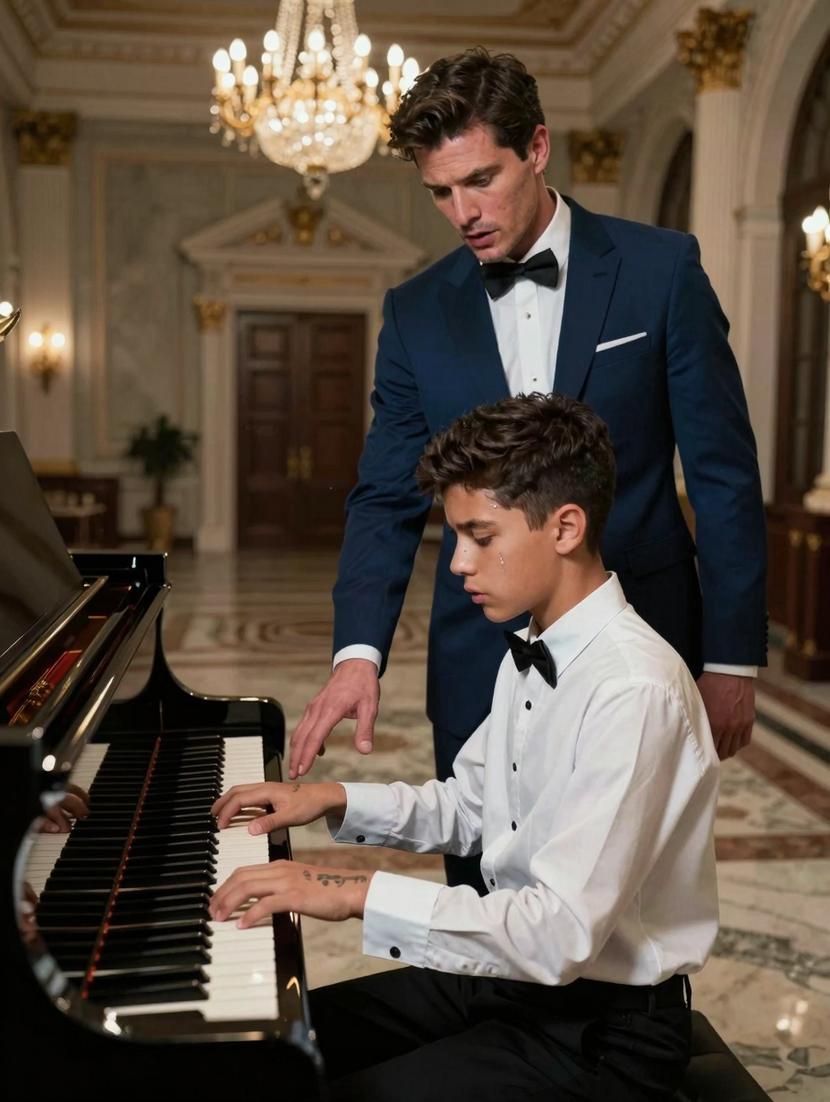
The chandelier’s crystals hung like captured starlight, their shimmering glow scattering golden shards across the marble floor of the grand hall. Soft laughter wove through the air, mingling with smooth murmurs and the delicate chime of crystal glasses—a symphony of wealth that needed no introduction, for luxury breathed in every corner, draped over velvet seats and embroidered gowns like an unspoken promise.
By the far wall sat a glossy black grand piano, silent yet regal, as if it waited patiently for a rightful owner to awaken its soul. Near it, almost invisible amid the glittering crowd, stood a slender boy in a crisply ironed waiter’s uniform. He couldn’t have been more than fifteen, his worn shoes hinting at long journeys, while his youthful hands carefully balanced a silver tray adorned with sparkling glasses.
No one noticed how long Mateo’s eyes lingered on the piano, his gaze heavy with longing that pulsed louder than the party’s hum. To the guests, he was just a background figure—quiet, efficient, soon forgotten. But deep inside him, every faint note from the distant orchestra stirred memories that pulled at his heart.
He took a slow, steadying breath, summoning courage he’d hoarded all evening.
Step by cautious step, as if afraid to break the fragile spell, he moved closer to the piano. Nearby, a tall man dressed in an impeccably tailored navy suit laughed with a cluster of well-heeled companions. His watch gleamed ostentatiously—worth more than Mateo’s family could dream of.
Mateo’s voice broke the murmur, small and tentative but full of an unshakable truth. “May I… play this piano?”
The laughter halted abruptly, the man’s gaze slicing through the crowd to rest on the boy. A smirk curled at his lips.
“You? Have you even touched a piano before?” His voice rang, clear and dismissive.
Guests chuckled—not cruelly, but with a dismissive ease reserved for impossibilities. Heat rose in Mateo’s cheeks, and the old reflex whispered—from a lifetime of fading into shadows—lower your eyes, say sorry, step back, vanish.
But this time something fiercer held him rooted.
No words. No defenses. Just a single, steady nod.
He set the silver tray gently on a nearby table. The soft clink of metal on wood seemed to silence everything around.
Without waiting for permission, Mateo slid onto the piano bench.
A ripple of surprise spread through the room—curiosity tinged with skepticism.
His hands hovered inches above the keys, as if greeting an old friend after years apart. The hall seemed to exhale, caught in the hush before the storm.
As his sleeve shifted, a faded guitar-shaped tattoo on his wrist peeked out—simple but unmistakably real.
The man in the suit’s amused expression faltered, eyes locking onto the tattoo with sudden recognition. His smile vanished.
Then, Mateo pressed a key.
A single note burst clear and true—a luminescent, trembling drop in the silence. Then another, and another, weaving a spell that stilled conversations and arrested wandering eyes. The melody was raw and alive, steeped not just in beauty but in longing, in memories buried deep, in hopes whispered to a darkened room.
Guests turned slowly. Glasses paused mid-air. Even the distant servers halted, spellbound.
The music swelled, filling the cavernous hall as if the grand piano had waited a lifetime for these fingers. Every note sang with a confidence that obliterated youth and inexperience. This was no mere talent. This was a birthplace.
Close to the piano, the man felt his chest tighten with an impossible recognition—a ghost from years ago.
Long ago, a video had quietly circulated within private music circles: a child no older than eight playing with breathtaking genius on a battered roadside keyboard. The performance was raw, unpolished, unforgettable. Afterward, the child vanished. No name. No story. Only a scrawled symbol beside the keyboard—a small guitar.
The man’s voice dropped to a whisper, barely audible. “Wait… are you the one?”
Mateo’s fingers never faltered, but his eyes flickered with an answer.
The last note lingered, a question poised delicately in the charged silence that followed.
Then, slow and sure, applause began—a single clapping hand, then another, swelling into a tide that swept through the hall like a sudden summer storm. Guests stood mesmerized, some shouting with admiration, others simply wide-eyed, trying to grasp the miracle they had just witnessed.
Mateo lowered his hands gently from the keys, his expression flickering between fear and vulnerability, like he had bared a hidden soul.
The man approached, his mocking sneer vanished, replaced by something softer, almost reverent.
“What’s your name?” he asked quietly.
Mateo hesitated, then whispered, “…Mateo.”
To the crowd, the name meant little. But the music lingered like proof of a rare truth.
“Where did you learn to play like this?” the man pressed.
Mateo glanced at the piano, then down at his hands. “My mom,” he said softly. “Before she got sick.”
His words, simple as they were, draped the room in a sudden weight of silence.
“I played in the subway after she couldn’t teach anymore,” he continued. “Someone recorded it. Then we had to move. I stopped playing for a while.”
“Why?” the man asked, voice low and troubled.
Mateo’s eyes fell. “Playing didn’t pay for medicine.”
The truth hit harder than any chord.
Around them, opulence felt suddenly fragile, almost ashamed.
The man swallowed past an old bitterness and regret. “I’m sorry.”
Mateo shook his head gently. “It’s okay. You didn’t know.”
And in that moment, the man understood something profound: greatness can emerge from anywhere. It bends rules and ignores privilege. Sometimes, the most extraordinary soul in the room is the one pouring drinks unnoticed.
“Mateo,” the man said cautiously, “would you… play again? Not as a waiter, but as a musician?”
Mateo looked up, uncertain. “For everyone?”
“For the world,” came the sincere reply.
Months later, that same haunting melody filled a far grander hall—brighter, larger, filled with people gathered for one purpose alone.
On stage, the grand piano gleamed like a beacon.
Beside it sat a young man no longer invisible.
Mateo’s fingers danced over the keys, pouring forth the same soul-stirring music that night in the mansion.
But this time, there was no laughter—only awed silence.
And somewhere in the crowd, the man who had once mocked him quietly wiped away tears, grateful that he had been proven so profoundly wrong.
Because sometimes, the smallest question—
“Can I play this piano?”
—marks the first step on a path the world almost missed.


