
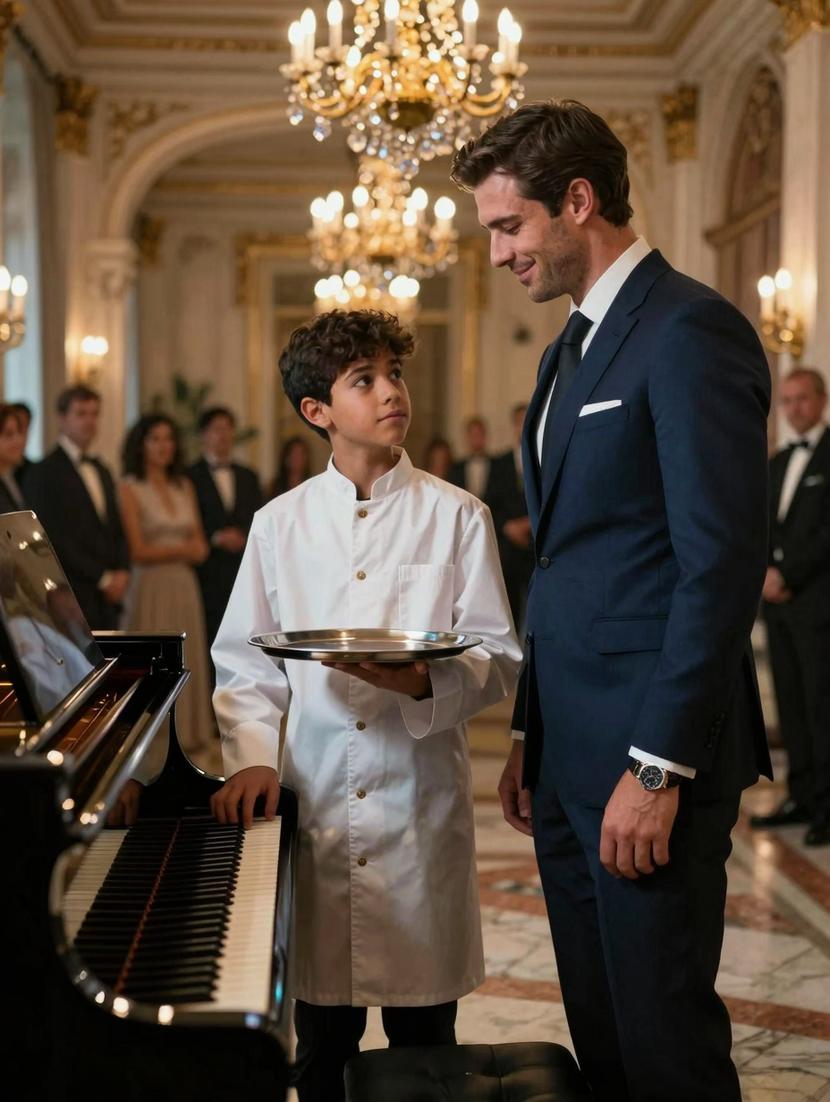
The chandeliers hanging in the grand hall sparkled like frozen constellations, their golden glimmers flickering softly over the pristine marble beneath. Laughter floated like a delicate melody, weaving through the murmurs of whispered conversations and the delicate clink of crystal glasses set gently on gleaming tables.
This was the kind of night where opulence needed no introduction. It breathed in the silks, shimmered in the jewels, and lingered in every effortless smile that graced the room.
Against the far wall, a glossy black grand piano stood silently, majestic and expectant—like a guardian poised to awaken only for the one who deserved it.
Nearby, almost blending into the glittering crowd, stood a slender teenage boy in a flawless, crisply pressed waiter’s coat. No older than fifteen, his shoes shone despite the frayed edges showing years of quiet wear. His hands—steady, practiced, yet unmistakably youthful—balanced a silver tray adorned with sparkling glasses catching the light.
No one in the bustling assembly noticed how long his gaze lingered on the piano.
To everyone else, he was just another silent attendant: moving softly, speaking when necessary, vanishing swiftly when not. But beneath his calm exterior, a fierce pulse echoed louder than the lively party around him. Each tender note of the background music called to him, stirrings of a memory pulling him closer.
He swallowed hard, gathering the courage that had been building quietly all evening.
Step by cautious step, as if the moment itself might shatter like glass, he edged closer to the piano. Not far off, a tall man in a sharply tailored navy suit laughed with his guests, his expensive watch catching the light—likely worth more than the boy’s family earned in a lifetime.
His voice emerged soft, tentative, yet true. “May I… play this piano?”
Laughter halted like a sudden breeze. The man swung his eyes down, sweeping over the waiter’s uniform, the tray, then settling on the boy.
A slow, sardonic smirk tugged at his lips.
“You?” he scoffed, loud enough for others to hear. “Have you ever even touched a piano before?”
A few guests chuckled lightly—no malice, just easy disbelief—the kind of laughter meant for the plainly impossible.
Heat rose in the boy’s cheeks. For a heartbeat, the familiar old instinct returned: keep your eyes down, apologize, step back, vanish.
But something fiercer rooted him in place.
He didn’t argue. Didn’t justify. Didn’t plead.
He only nodded once, determined, and gently set the silver tray on a nearby table.
The soft clink of metal against wood sounded louder than any music in the hall.
Without a word, he settled onto the piano bench.
A ripple stirred through the crowd—curiosity, amusement, mild impatience all mingling in the air.
Slowly, he lifted his hands, fingers suspended over the keys like a reunion long delayed.
The room seemed to hold its breath.
As the sleeve of his jacket slipped back, a faded tattoo peered out—a small, unassuming guitar etched on his wrist.
The man’s amused smile froze in place.
His eyes locked on the mark.
For the very first time that evening, his expression softened into something unreadable.
The boy pressed a single key.
A pure, clear note blossomed. Then another. And another.
Within moments, what began as a tentative whisper of sound erupted into a living, breathing melody—so rich, so overflowing with life—that the conversations died away unnoticed.
This was music that carried more than beauty.
It wove longing and memory, hope and sorrow—every unspoken emotion flowing from the boy’s fingertips.
Guests turned, glasses halted midway to lips, even distant servers paused as the hall filled with the sweep of sound.
The piano’s voice claimed the space, as if it had been waiting all along for this moment.
Near the keys, the well-dressed man felt an unexpected tightening in his chest—this was recognition. Impossible, undeniable.
Years ago, a whispered video traveled quietly through music’s hidden circles: a child no older than eight playing with breathtaking brilliance on a battered street keyboard. That raw, haunting performance had mesmerized anyone who heard it.
Then the child had simply vanished.
No name. No story. Only a small symbol drawn in marker beside the keyboard—a delicate guitar.
The man’s voice dropped to a hushed tremor, barely audible. “Wait… are you the one?”
Without missing a beat, the boy played on.
But deep in his eyes, the answer shone clearly.
The final note hung in the air like a question no one dared break.
Silence engulfed the room—profound and absolute.
Then, gradually, a single hand began to applaud.
Another. And another.
Within seconds, the grand hall erupted into cheers that felt too immense for the quiet boy on the bench.
People rose, some cheering, others simply transfixed, struggling to grasp the miracle they had witnessed.
Gently, the boy lowered his hands from the keys.
For a moment, a flicker of fear returned—as if he had laid bare too much of himself.
The man stepped forward, all mockery drained from his expression.
“What’s your name?” he asked, voice now soft and sincere.
The boy hesitated, then whispered, “Mateo.”
The name meant little to the crowd.
But the music hung in the air—proof of something extraordinary.
“Where did you learn to play like that?” the man asked.
Mateo glanced at the piano, then traced his own hands with a quiet reverence.
“My mother,” he said softly. “Before she got sick.”
Simple words—but the silence that followed deepened their weight.
“I used to play in the subway after… when she couldn’t teach anymore,” Mateo continued. “Someone recorded it. But then we had to move. For a while, I stopped playing.”
“Why?” the man pressed gently.
Mateo’s eyes fell.
“Because playing didn’t pay for medicine.”
The truth settled like a heavy shadow.
Around them, the grandeur suddenly felt fragile, almost ashamed.
The man swallowed hard, wrestling with a familiar but long-buried feeling: regret.
“I’m sorry,” he said quietly.
Mateo shook his head, a gentle forgiveness in his smile.
“It’s okay. You didn’t know.”
In that moment, the man understood something vital:
Talent can bloom anywhere.
Greatness does not bow to wealth.
And sometimes—the person unnoticed, quietly serving drinks—is the one with the extraordinary soul.
“Mateo,” the man said carefully, “would you… play again? Not as a waiter. As a musician.”
Mateo looked up, uncertainty flickering.
“For everyone?” he asked.
“For the world,” the man replied.
Months later, that same haunting melody filled a new hall—larger, brighter, packed with people all present for one reason.
Onstage, a grand piano gleamed.
Beside it, a young performer no longer invisible.
When Mateo’s fingers danced across the keys, the music breathed the same depth and soul as that unforgettable night.
But this time, there was no laughter.
Only rapt attention.
And somewhere in the crowd, the man who had once doubted quietly wiped tears from his eyes—grateful beyond words that he had been wrong.
Because sometimes, the smallest question—“Can I play this piano?”—ignites a life the world almost let slip away.
And sometimes…the one nobody sees is the one everyone was waiting for.


