
My name is Hannah Carter. I’m 32, and the last five years have been a battle for the land my grandfather left me—a sprawling 100-acre farm that was more than just property; it was my heartbeat, my sanctuary. I built it from the ground up into a flourishing organic produce business, supplying fresh, vibrant ingredients to half the restaurants in town and providing jobs to 15 amazing people who believed in my vision. But to my family, it was merely “land,” an asset—one that my sister Emily had set her sights on for her dream home.
Part 1: The Sunday Brunch Ultimatum
The morning sun streamed through the windows, illuminating the pristine brunch table where my family gathered. My father’s voice soon shattered the fragile calm.
“You don’t need all of this land, Hannah,” he thundered, his words shaking the delicate china. “Emily has three children to think about.”
My grip tightened around my coffee mug, the warmth barely grounding me as I stared across at them—my parents and Emily—plotting again to rob me of what belonged to me.
“I’m not having this discussion again,” I declared, locking eyes with my father. “Grandpa entrusted me with this land for a purpose. For five years I’ve nurtured it, gave it my heart and soul.”
Emily, always the picture of perfection with her flawless family, cut in dramatically. “But my kids need space to grow! Your nieces and nephew deserve a childhood with wide backyards!”
“And what about what I deserve?” I interrupted sharply, surprising even myself with the fire in my voice. “I’ve put every cent I had, every ounce of energy, into this farm—this community—it’s my life.”
Mom reached across the table, her smile tight and insincere, cloaked in concern. “Honey, you’re single. You don’t have a family needing room. Emily does.”
“I do have a family,” I said fiercely. “My employees, my customers—this entire community depends on what I’ve built here. Just because I’m not married doesn’t mean my work means less.”
Dad slammed his hand down, rattling the table, forcing everyone’s gaze to snap back. “This isn’t about your little garden project, Hannah! It’s about family—doing what’s right!”
I stood, chair scraping the floor, my voice cold steel. “My ‘little garden project’ feeds half the restaurants in town. I employ fifteen people. I will not give it up because Emily dreams of a bigger backyard.”
Emily sniffed, clutching her designer purse. “You’re being selfish.”
I met her stare. “Your children have a four-bedroom house and plenty of yard. That doesn’t give them the rights to my land.”
My father’s face flushed an ominous shade I recognized from dark memories of my childhood. “We’ve promised Emily she can build her dream home here. The contractors arrive next week!”
My blood turned ice water. “You what?”
Mom’s voice dropped to an eerily calm whisper. “It’s already arranged, Hannah. The deposit’s been paid. Emily’s house will stand right where your greenhouse is now.”
Hands trembling, I pulled out my phone and opened my security app. There they were—crisp images of suited men marking my greenhouses, trespassing without my consent.
“Leave,” I said low and steady. “Every single one of you. Now.”
Emily rolled her eyes. “This is happening with or without your blessing. Dad’s already set it in motion.”
I turned to my father, the man who’d always favored Emily, who dismissed my dreams as childish since forever. “One step onto my land, without my permission, and I’ll call the police.”
He loomed over me, a giant from my past. “Ungrateful. I’m your father! This is family land!”
“No,” I corrected him with unwavering calm. “This is my land. Legally, morally, and every way that matters. Leave.”
They left, but Dad’s final words burned through the silence. “We’ll see about that.”
I should have known it was far from over.
Part 2: The Bulldozer and the Bombshell
The next morning shattered all peace. I woke to the guttural roar of heavy machinery. Slipping on my slippers, I ran outside—and froze in horror.
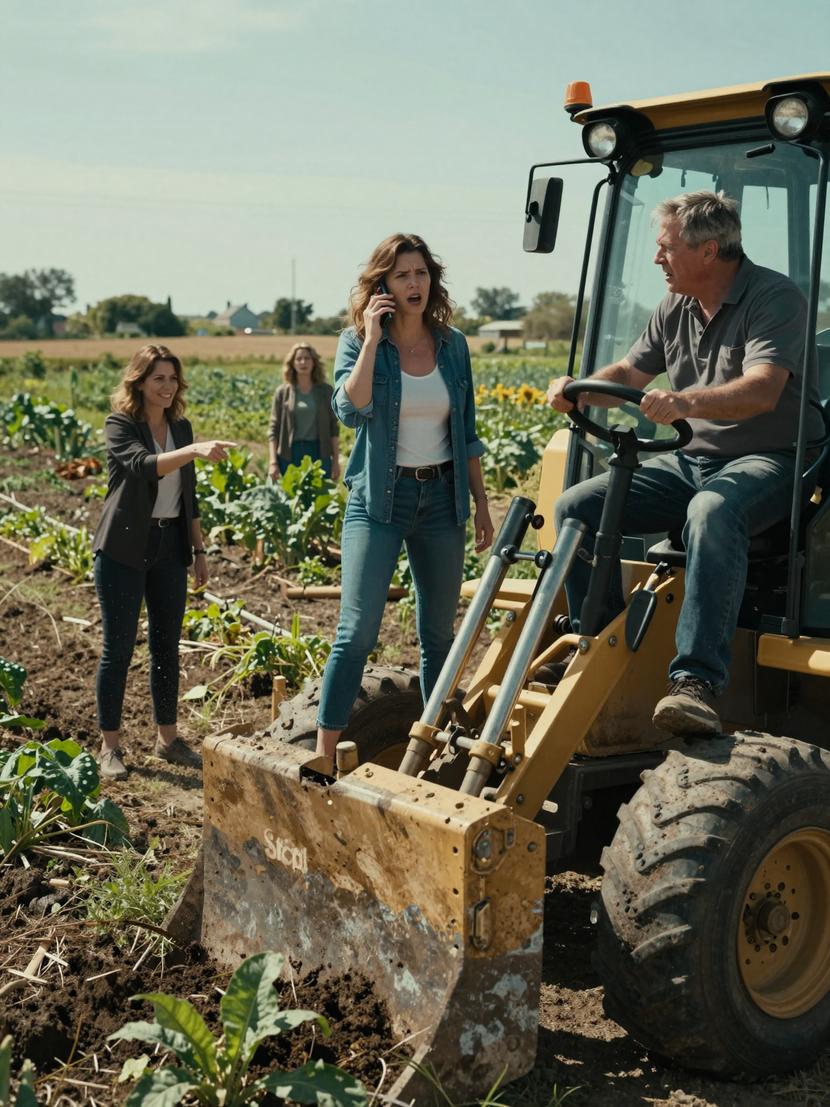
Dad was at the controls of a bulldozer, aggressively erasing my beloved organic gardens. Emily hovered nearby, pointing where the new house would rise, while Mom watched over the ruin of five years of love and toil.
“Stop!” I screamed, barreling toward them. “What are you doing?”
“Making room for your sister’s future!” Dad yelled over the engine, careless as he smashed through another crop row. “You had your chance to be reasonable!”
Hands shaking, I hit record on my phone, documenting every devastating moment. Then, hands steadying, I dialed the police.
“Calling the cops on your own father?!” Mom shrieked, lunging for my phone.
“Watch me,” I said, stepping away. “And I have security cameras capturing this entire crime.”
Emily’s confident smirk faltered. “You’re bluffing.”
I reopened the app, showing live angle after angle, catching their every illegal move. “Grandpa taught me to protect what’s mine. These cameras have been silently watching since you sent those contractors to trespass last week.”
The wail of sirens cut through the chaos. Dad shut down the bulldozer, looking pale and defeated.
“You’ve crossed a line,” I said, voice breaking but firm, as the police approached.
Their faces shifted—the cold mask cracking as reality dawned. But I knew this battle wasn’t over. My family had never been quitters when it came to getting what they wanted—the coveted land.
What they didn’t suspect was the legacy Grandpa left me wasn’t just fertile soil. He also left a secret weapon. The upcoming court battle would reveal exactly how expertly I’d been prepared.
Part 3: The Civil Suit and Grandpa’s Legacy
The following two weeks felt like living through a relentless storm—legal briefs, lawyer meetings, and endless family confrontations. Dad faced charges for criminal damage, but thanks to Mom’s meddling, he negotiated a plea: community service and reparations for the crops destroyed.
But Emily struck back, filing a civil suit claiming a “verbal agreement” with our parents entitled her to a slice of the farm.
“They’re desperate,” Laura, my sharp lawyer, said during one tense session. “But it’s time we show them exactly what Grandpa left you.”
I nodded, unlocking a battered leather portfolio hidden away for five years. Inside were documents, letters, and recordings—painstaking evidence of their ongoing attempts to swindle Grandpa.
“Are you sure?” Laura asked, scanning the files, eyes wide. “This is nuclear. Once the court sees this, there’s no retracting. Your family…”
“They stopped being family when Dad destroyed my livelihood,” I said, voice steady. “Grandpa knew this would happen. That’s why he prepared all of this.”
The court hearing dawned. Mom rushed over, an actor’s mask of concern plastered tight. “Hannah, please,” she begged. “Give Emily just ten acres for her house. That’s all she needs.”
I walked past silently. Derek, Emily’s husband, confronted me next. “Think about the children,” he urged.
“Oh, they deserve to learn it’s okay to destroy others’ property when it suits you?” I shot back. “Brilliant example.”
Emily’s lawyer opened with a plea about family bonds, verbal promises, the duty to future generations. Emily sobbed melodramatically about the “destruction of family” over a patch of land.
Then Laura’s moment. She called me to the stand.
“Ms. Carter, tell us about the day your grandfather entrusted you with this land.”
My breath caught. “Three months before Grandpa passed, he called me into his study. There, he revealed everything he’d prepared—knowing this fight was coming.”
“What kind of preparation?”
I brought out the first damning exhibit: a video from two years before his death showing my parents and Emily pressuring Grandpa to sell the farm to developers.
The courtroom fell silent. There they were, my own family, badgering Grandpa, mocking his sustainable farming dreams.
“Just sign it over, Dad,” I heard my father say. “We know what’s best for the family.”
“Objection!” Emily’s lawyer jumped. “This isn’t relevant!”
Laura smiled. “It directly traces the pattern of coercion. Grandpa was protecting his legacy—and Hannah.” The judge nodded, letting it stand.
Next came letters—dozens exposing years of manipulation attempts.
Then, the final bombshell.
“This notarized statement,” I said, voice unwavering, “recorded one month before Grandpa’s passing, explicitly orders the land remain undivided and undeveloped. It names me as the sole heir because I share his vision.”
I locked eyes with my family as the video rolled. Mom’s hands covered her face, Dad’s look was pure rage, Emily whispered frantically to her lawyer.
“Moreover,” I stated, “Grandpa added a clause: anyone contesting my ownership or forcing development forfeits their inheritance—trust funds set up for Emily’s children included.”
Emily gasped, whitened like a ghost. Those trust funds were worth millions, the backbone of her plans for private schools and security.
“You knew about this? You still let us file?” she screamed.
“I warned you countless times,” I whispered. “But none of you listened.”
The judge called for order as Emily’s tears became real. Her lawyer hastily requested a recess.
In the hallway, I watched them—a shattered family circus. Mom shook her head, Dad slumped defeated, Emily whispering frantic calls to her financial advisor.
Laura squeezed my arm. “They’ll drop the suit. They have no choice if they want to keep anything.”
I nodded, unexpectedly hollow. This victory brought no joy, only peace. They would have to accept that the land was mine—and that my vision mattered.
But I knew there was still one last surprise waiting to be revealed.
UPDATE: Five Years Later
After Emily withdrew the lawsuit, I thought the storm had passed. Instead, my family launched a new war. Mom whispered poison in town, claiming I’d fractured the family for greed. Dad gave interviews painting himself the heartbroken father. Emily posted tearful pleas on social media about how I had stolen her children’s future.
But I had one final card—Grandpa’s last letter, reserved for this moment.
“Are you sure about this?” Laura asked, eyes piercing as we prepped for the crop restitution hearing. “This could turn everything upside down.”
I held the sealed envelope tightly. “They’ve left me no choice.”
The courtroom brimmed with townsfolk, many swayed by my family’s tale. Their eyes dropped, avoiding mine.
Laura stood and addressed the judge. “Your Honor, before restitution, we present one last piece of evidence linked to the property damage and harassment—”
Emily’s lawyer objected, but the court allowed it.
Hands trembling, I opened Grandpa’s letter and began reading:
“My dearest Hannah, if you’re reading this, what I feared has come true. Your family has tried to take what was mine. But there’s a secret they don’t know.
Beneath this land lies a natural spring with rare minerals. I’ve legally protected the water rights—they’re worth millions.
Your father discovered my research and tried to force a sale years ago. When I refused, he and your mother sought to undermine my mind, to seize control.
I left it all to you because you loved the land for its soul, not its value.
I’m sorry this burden falls on you, but you deserve the truth.
Love, Grandpa.”
The courtroom fell into a shocked hush. Dad’s face paled; Mom froze. Emily stared at him in stunned silence.
Laura continued, submitting geological surveys, water rights certificates, and correspondence proving Dad’s unscrupulous attempts to control the property.
Dad exploded, “These are lies and forgeries!”
“The documents are authenticated,” Laura replied calmly. “We also have proof of your recent attempts to sell water rights illegally.”
That was the last blow. Dad collapsed into his chair as murmurs rippled through the room. The tide turned. The judge immediately ruled in my favor, ordering full restitution and issuing a restraining order barring my family from the property.
Outside, Mom begged, “Hannah, please. We can share the profits.”
I laughed softly. “Family? You lost that the day greed eclipsed love. The land stays as Grandpa wished—an organic farm. The spring remains untouched.”
Emily protested, “But the money—”
“I’m thinking of the employees who count on this farm, the community nourished by our produce, and the legacy entrusted to me.”
Five years later, the farm thrives. We’ve expanded into an educational center teaching sustainable farming. The spring quietly waters our crops, a secret source of life.
My family left town after their downfall. Sometimes, I hear from Emily’s children—now curious teenagers. I invite them to visit, to connect with their great-grandfather’s legacy and understand that true wealth is more than money.
This land is my testament—not just as a farm, but as a symbol of standing firm, protecting what matters, and succeeding on your own terms. Every morning in the garden, I thank Grandpa for his trust and his wisdom.
Sometimes, victory isn’t about winning or losing. It’s about holding onto your principles and letting the truth shine through.


