
Nathaniel Grant returned home that evening utterly drained, his spirit crushed beneath the weight of a relentless day consumed by failed launches, retreating investors, and ruthless meetings that left him feeling shattered. All he craved was the familiar silence—a silence that had enveloped his home for eight long months like a suffocating fog. But then, through the quiet, a sound pierced the stillness. Laughter. Pure, unfiltered laughter.
He froze, disbelief rooting him to the spot. His sons’ laughter. Eli, Caleb, and Owen hadn’t laughed once since Clara passed away—not a peep, not a whisper of joy. Driven by a mix of hope and hesitation, Nathaniel followed that joyous noise to the sunroom. What he found there fractured his heart and pieced it back together all in the same moment.
Lena Harper—the maid his mother-in-law Elaine had entrusted to their care—was on her hands and knees on the polished floor. His three sons clung to her back like a spirited cavalry, their faces lit with pure delight. Owen held a coarse rope tied playfully around Lena’s neck like reins, and she tossed her head back with carefree laughter, matching their exuberance.
Nathaniel’s breath hitched, emotions swirling in a storm. These boys—the shadows who’d haunted their own home—were alive again. Playing, laughing, reclaiming moments stolen by grief. And it wasn’t his doing. It was her magic—her fearless, gentle presence.
Relief, gratitude, and a crippling shame collided inside him. Lena glanced up, fear flickering across her face. The laughter stilled. The boys slid down, huddling protectively as if guarding a fragile treasure. Nathaniel could only nod, speechless, then retreated before the tears broke free.
He couldn’t comprehend it. How could he be thankful to someone who was merely employed? Yet that laughter—the haunting sound he didn’t realize he’d lost—was the balm his soul craved. He had tried everything: therapy, psychologists, routines, toys, even devouring books on grief. Nothing reached his sons’ retreating spirits. Then Lena came, unafraid—walking straight into their sorrow—and wove life back into their broken world.
The next morning, Nathaniel rose early, not for work but to glimpse this quiet miracle. Lena moved with a gentle calm, preparing breakfast as the boys padded in, still clad in pajamas. ‘Lena, can we play horse like yesterday?’ Owen asked, eyes sparkling. Nathaniel’s chest constricted. Rationally, he wanted to say no—but he didn’t.
Little moments blossomed. Eli shared a vivid dream, Caleb bombarded her with questions about dinosaurs, and Owen nestled close, their laughter a fragile melody. Lena listened with a heart full of love, and the boys adored her in return.
Nathaniel began arriving home earlier, skipping meetings, inventing excuses—anything to bask in the sanctuary of laughter once more. Lena never performed for him; she loved the boys with a quiet, effortless grace, as natural as breathing.
Around the house lingered traces of Clara—her paintings on the walls, her coffee mug set on the counter, her grocery list penned in her familiar handwriting. Nathaniel left these memories untouched. At night, he wandered through empty rooms, searching vainly for something lost, often lingering outside the master bedroom. There, sleep eluded him, pushing him to the solitude of his home office.
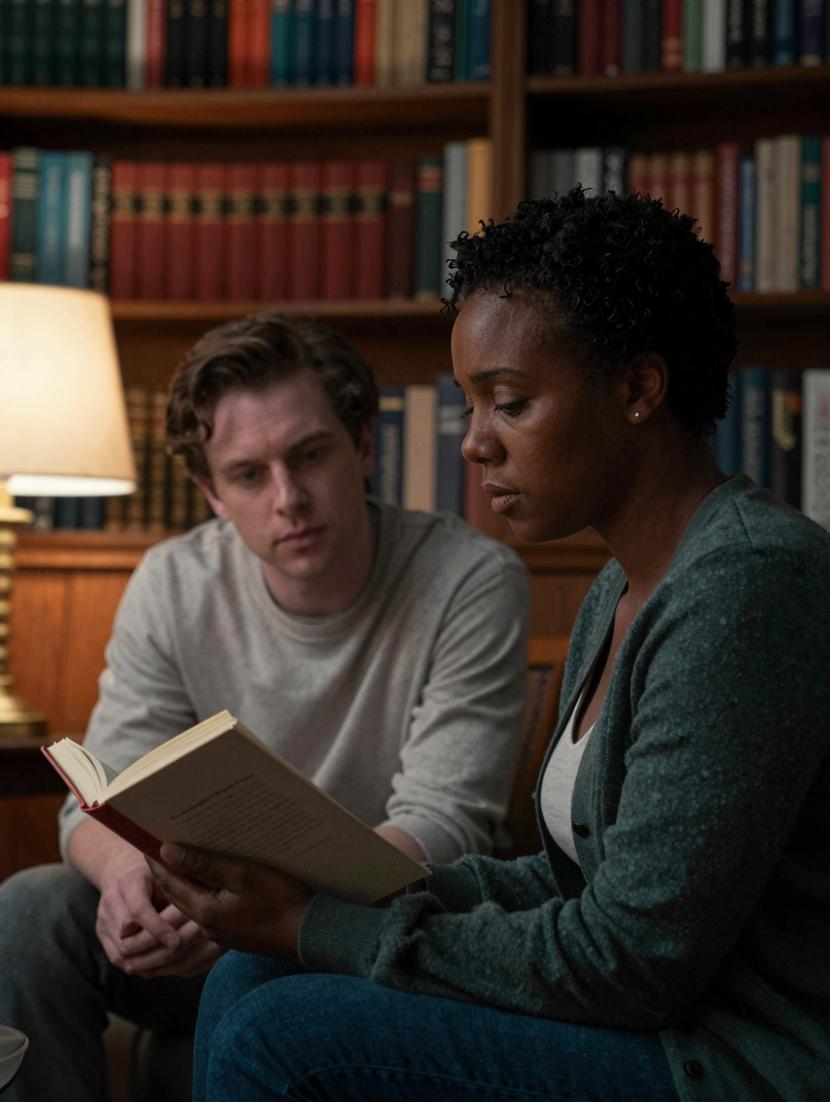
One late night, he discovered Lena in the library, bathed in the soft glow of a lamp, absorbed in a book. She looked peaceful, almost radiant amid the shadows. Gathering courage, Nathaniel settled across from her.
‘What are you reading?’ he asked softly.
‘Beloved, by Toni Morrison,’ she replied, never looking up.
‘Heavy reading for bedtime,’ he observed.
‘Heavy thoughts require heavy books,’ Lena said simply, a small smile teasing her lips. Nathaniel’s lips almost curled into a smile of his own.
They spoke in hushed tones about Clara, about the small fragments of her the boys clung to—the scent of the flowers she loved, her off-key songs, the indulgent rule of dessert first on Tuesdays. Tears smoldered behind Nathaniel’s eyes. ‘Thank you,’ he whispered, ‘for keeping her alive with them.’
Lena closed the book and rose. ‘Good night, Nathaniel,’ she said softly, leaving the room with quiet grace. For the first time in months, he felt less hollow. She wasn’t just healing the boys—maybe she was healing him, too.
Three weeks later, Nathaniel arrived home late, finding the boys asleep. From the kitchen came soft, broken sobs. He approached cautiously, discovering Lena clutching a silver locket, her shoulders trembling.
‘I-I’m sorry,’ she stammered.
‘Who is in the locket?’ Nathaniel inquired, voice gentle.
Frozen, she whispered, ‘Grace… my daughter. She died two years ago, leukemia. She was just three.’
The revelation hung heavy, a silent confession. Nathaniel’s heart cracked alongside hers. Lena’s hands shook as she opened the locket, revealing a tiny photo: a cherubic little girl with bright eyes and gap-toothed grin, clutching a dandelion.
‘My husband blamed me,’ Lena faltered. ‘Said I should have seen it sooner, pushed doctors harder.’
Nathaniel sat unmoving, witnessing the quiet torment of grief that thrives in unseen places. He longed to save her from this pain. But the fracture had splintered her marriage. He knew the locket was all she had left, the final tether to her lost daughter.
‘I became a nanny because…’ Lena’s voice cracked irreparably, ‘…because I can’t stand a world without children’s laughter. It’s the only thing that makes the silence bearable.’
‘When I heard about your boys, what they lost, I thought maybe I could help them in ways I couldn’t help my own daughter.’ Her eyes lifted, tears cascading. ‘I’m sorry. I know this isn’t professional. I shouldn’t—’
‘You’re not just helping them heal,’ Nathaniel interrupted, rough with feeling. ‘You’re healing yourself.’
She shook her head, overwhelmed. ‘I don’t think I’ll ever heal.’
‘Maybe not,’ he whispered tenderly. ‘But loving my sons keeps you alive, the same way you keep them alive.’ Reaching across the table, he covered her trembling hand with his own.
They sat entwined in shared silence, two souls adrift in grief, holding fast in the dark.
‘Does it get easier?’ Lena murmured.
Nathaniel reflected on Clara, the empty half of their bed he still reached for each morning. ‘No,’ he admitted honestly, ‘but the missing becomes different. A presence instead of an absence.’
Lena nodded, tears bright. She closed the locket and pressed it to her chest.
‘Thank you… for not looking away,’ she whispered.
‘And thank you,’ Nathaniel replied softly, ‘for showing up.’
In that fragile moment, their bond deepened beyond roles—no longer employer and employee, but two fractured hearts finding solace amid ruins.
Mother’s Day dawned, a shadow Nathaniel had tried to escape. Last year, Clara had been alive. The boys’ handmade, crayon-smeared cards had sparked joyful tears. This year, the fridge was empty. He resigned himself to endure.
But stumbling downstairs, laughter drifted from the playroom. Lena sat amidst Eli, Caleb, and Owen, surrounded by construction paper, crayons, and glue sticks. They were crafting cards—not just for Clara, but for Lena herself.
Eli offered his drawing first: a stick figure with dark skin, a radiant smile, encompassed by hearts. ‘For Lena,’ Owen announced. Nathaniel’s breath caught. Eli’s card declared, ‘I love you, Lena,’ with stick figures holding hands.
A complex blend of loss and relief twisted in Nathaniel’s chest. Lena’s pale face betrayed surprise. ‘I didn’t ask them to do this,’ she whispered, voice wavering. ‘We should make cards for their mother.’
‘Yes,’ Nathaniel agreed, voice tight.
Caleb held up another card, angel wings and blossoms trailing the edges. ‘We miss you, Mommy.’
The air fled Nathaniel’s lungs. They hadn’t forgotten Clara. They’d simply carved space in their hearts for someone new.
Owen tugged on Nathaniel’s sleeve. ‘Can Lena come with us to see Mommy?’ he asked earnestly.
Nathaniel looked to Lena, who was shaking her head.
‘No… it’s private. For your…’
‘You are family,’ Owen insisted simply.
The words hovered between them. Taking Lena to Clara’s grave felt sacred, yet looking into his sons’ hopeful eyes, Nathaniel found himself answering, ‘She can.’
Wide-eyed, Lena whispered, ‘Are you sure?’
Nathaniel nodded firmly.
An hour later, they gathered by Clara’s gravestone. The boys gently laid their angelic cards at its base, then retreated reverently. Owen reached for Lena’s hand, pulling her close.
‘Tell Mommy you’re nice,’ he whispered.
Lena knelt, tears streaming freely. ‘I hope you don’t mind that I love them,’ she murmured. ‘I’m not trying to replace you. I just… couldn’t help it.’
Eli whispered, ‘Mommy, Lena makes good pancakes. She plays with us. She doesn’t get sad when we talk about you.’
A lump throttled Nathaniel’s throat. He had been the one withdrawing, sinking into sorrow, unintentionally suggesting new love meant forgetting Clara. Lena wiped her tears, meeting his gaze—an unspoken pact passing between them: understanding, forgiveness, and permission to keep living.
Two months later, Nathaniel reluctantly attended a charity gala at Silverwood Country Club. He had avoided these events since Clara’s death, but Elaine insisted, ‘You can’t hide forever, Nathaniel. People want to see you.’
The room swirled with familiar faces, acquaintances who had sent condolences but then drifted away. They offered polite smiles, uncertain how to approach him. Derek Miles, a fellow tech CEO, appeared with his wife, Miranda.
‘Nathaniel, good to see you out,’ Derek said, shaking his hand. ‘How are the boys?’
‘Better,’ Nathaniel replied cautiously. ‘Much better, actually.’
Miranda smiled—but it was sharp behind the facade. ‘Yes, I heard you found wonderful help. What was her name again?’
‘Lena Harper,’ Nathaniel answered carefully.
‘And she’s been quite devoted to the children from what I gather,’ Miranda continued, voice dripping with false sweetness. ‘Excellent at her job. Of course, I just think it’s wonderful she’s so involved. Some would say unusually involved for household staff.’
Nathaniel’s jaw clenched.
‘I’m not sure what you’re implying,’ he said steadily.
‘Nothing,’ Miranda said, brushing his arm. ‘Just that people talk. There was a photo of you all at the harvest fair last week—the boys holding her hands, you pushing the cart. Very domestic. A young widower with three impressionable children…’
Derek cleared his throat. ‘What Miranda means is… maybe consider the optics. For the boys’ sake.’
Nathaniel’s voice turned cold. ‘The boys are happy for the first time in eight months. That’s the only optic I care about.’
Without another word, he turned and walked away, fists trembling.
But the whispers grew louder. Scandalous rumors surfaced in society columns: ‘Which widowed tech titan is getting too close to the help?’ Photos of Lena laughing with the boys at playgrounds circulated online, captions labeling her simply as ‘Nanny.’
Then came the call from Riverview Academy. The principal’s tone was apologetic but firm: ‘Given recent attention and sensitive concerns, perhaps it’s best the boys start next semester instead.’
Nathaniel gripped the phone, heart sinking—not for the school but for what it symbolized. Lena would hear of it. See the whispers and think she was to blame. And she would leave.
He sped home recklessly, mind racing. Upon reaching Lena’s room in the guest cottage, he found the door ajar. Inside, she was packing, half-filled suitcase by her side, clothes folded mechanically, hands shaking.
Nathaniel froze in the doorway.
‘I can’t stay,’ she said quietly. ‘I’ve become the problem. Don’t…’
His voice cracked, desperation seeping through. ‘Lena…’
Her eyes were red-rimmed. ‘Your sons were rejected from school because of me. Because of gossip and people who don’t matter.’
‘They matter to Eli, Caleb, and Owen,’ he countered.
Her voice faltered. ‘They’ll grow up with whispers, punished for someone who forgot her place.’
‘Your place?’ Nathaniel stepped further in. ‘Your place is with my sons.’
Lena shook her head, tears falling onto the shirts in her hands. ‘I’m the maid, Nathaniel. That’s all I was meant to be.’
‘You stopped being the maid the moment my sons laughed again,’ he said firmly.
She turned, fierce but broken. ‘Then what am I? What am I supposed to be to them? To you?’
Nathaniel hesitated; words failed him.
‘You can’t even voice it,’ she spat bitterly. ‘Because the truth is… I’m Black. I’m young. I’m staff. There will always be assumptions. My staying will punish your sons.’
‘Let them assume. I don’t care what they think. You should care,’ he challenged.
‘Eli, Caleb, and Owen deserve better than scandal. Better than… someone who loves them. Someone who made this house a home again,’ she whispered.
An electric silence crackled between them. Lena sank onto the edge of the bed, shoulders collapsing.
‘When Grace died,’ she whispered, ‘I promised myself never to love another child. Losing her nearly killed me. But your boys… I couldn’t help it. And now I have to leave before love destroys me.’
Nathaniel knelt before her, heart pounding violently. ‘What if you didn’t have to leave? The scandal? What if I told the truth—publicly? Made it clear you’re not just staff?’
Her eyes searched his.
‘What truth?’ she asked.
‘That you’re essential. That my children need you. That I need you—not as maid, not as nanny, but someone who understands grief. Someone who sits with me in darkness. Someone who brought light back to a dying home.’
‘I’m not Clara,’ she whispered. ‘I’ll never be.’
‘I know,’ Nathaniel’s voice cracked. ‘I’m not asking you to be. I’m asking you to stay. Because imagining this house without you… I can’t breathe.’
Lena covered her face, sobbing. He stayed grounded, terrified she might refuse.
Finally, she looked up. ‘If I stay, it can’t be like this. I won’t hide. I won’t pretend less.’
‘Then don’t,’ he urged.
‘Your world won’t accept me.’
‘Then my world needs to change,’ he said without hesitation.
Something fragile flickered in her eyes. ‘I’ll stay,’ she whispered. ‘But as myself. Fully. Not as your employee. I wouldn’t want it otherwise.’
They stood, two broken souls discovering fragile hope amid ruins.
Weeks later, Nathaniel stopped hiding.
During a scheduled interview with the Wall Street Journal, their PR team prepped safe, corporate lines: cloud infrastructure, market growth. Yet when reporter Sophie Lin asked, ‘Mr. Grant, there’s public interest in your personal life. Care to comment?’ he surprised everyone.
‘Yes,’ he said firmly. ‘I want to comment.’
Sophie’s eyebrows rose.
‘Lena Harper is the reason my sons live fully again,’ Nathaniel declared. ‘After Clara died, they stopped talking, stopped playing, stopped being children. I hired therapists, tried everything money could buy. Nothing worked. Then Lena came. She didn’t fix them—she simply loved them. Got on her knees and played horse. Read stories. Sat with them through nightmares. Gave them permission to heal.’
‘Some allege the relationship is inappropriate,’ Sophie noted carefully.
His jaw tightened. ‘Some people see a young Black woman caring for three white children and jump to conclusions. They are wrong. She is family. And anyone who can’t accept that doesn’t deserve to decide what my children need.’
Lena gasped softly, clutching the envelope in her hands.
‘You don’t need to say anything,’ Nathaniel whispered, stepping closer. ‘Just stay. Be here. With us.’
Tears streamed freely down Lena’s cheeks. ‘I never imagined anyone seeing me as more than a nanny—or staff. But as someone who matters.’
‘You always mattered,’ he said fiercely. ‘To my sons. To me. And now officially—no more whispers, no more assumptions, no more hiding. Just us, in the light.’
Lena smiled through tears, a sound of relief and disbelief pulling at his heart. She stepped into his arms. ‘I don’t know how to thank you.’
‘Then don’t,’ he said, tilting her chin up. ‘Just stay. With me. With them.’
In the golden garden light, surrounded by Clara’s beloved peonies, they stood—two wounded hearts made whole, love growing amidst the wreckage. A family no longer defined by loss but by laughter, healing, and unwavering hope.
Nathaniel took her hand, fingers intertwined. ‘This,’ he whispered, ‘is just the beginning.’
Lena smiled amidst tears, ‘Then let’s make it count.’
For the first time since tragedy struck, laughter filled the house—not only the boys’ but theirs as well—echoing through every corner, a melody of hope, love, and new beginnings.
Lena held his hand, and Nathaniel felt something beyond grief. He felt hope.
Six months later, the Hope and Clara Foundation opened its doors.
Families from across the Northeast arrived—parents with sick children, grandparents raising grandchildren, siblings clinging to each other amid cancer’s storm.
The once-empty east wing now teemed with life, a refuge of tears, laughter, and resilience. The dedication was modest—few donors, some reporters, and the grateful occupants.
Nathaniel stood at the podium, prepared words abandoned in his pocket. His gaze found Lena in the back, with Eli, Caleb, and Owen, all clad in matching clothes Clara would’ve adored. They smiled—truly smiled.
Clearing his throat, he began, ‘I built my company believing every problem could be solved by understanding its system.’ His voice cracked. ‘Then I lost my wife and learned some things can’t be fixed—only survived.’ The room grew still. ‘I was failing at surviving, and so were my sons. We were drowning in a house filled with everything but the one thing we needed most.’ He locked eyes with Lena.
‘Then someone came who showed me healing isn’t about fixing. It’s about presence. Staying. Loving people—not for who they could be, but for who they are, mess and all. Lena Harper made that real.’
Moved beyond words, Lena covered her mouth, tears streaming. ‘This foundation exists because two women believed the only cure for unbearable loss is unbearable love.’
He paused, then softly added, ‘My late wife Clara taught me to give everything. Lena has shown my sons and me how to live again.’ He gestured to her. ‘Lena, would you join me?’
She hesitated but was nudged forward by the boys. Trembling, she approached the stage. Nathaniel handed her an envelope.
‘This makes you co-director of this foundation and legal co-guardian of my children,’ he said.
Her knees nearly buckled. ‘You already are,’ he added gently. ‘This just makes it official.’
Eli, Caleb, and Owen surged forward, wrapping her legs in loving embraces. Tears flooded Lena’s eyes. Applause swelled around them, but Nathaniel heard only the beating of their united hearts.
Later, beneath the stars in the garden, the boys chased light-footed around flowers planted months ago. Lena sat on Clara’s bench, a tender smile illuminating her face. Nathaniel joined her.
‘Thank you,’ she whispered.
‘For what? For staying? For fighting? For turning pain into something beautiful?’ he smiled.
He truly saw her now—the woman who walked into his shattered life and refused to flee the wreckage.
‘I think God sent you,’ he murmured.
She blinked in surprise.
‘I was angry for so long,’ Nathaniel confessed, ‘angry at Him for taking Clara, for leaving me with sons I didn’t know how to reach. But then you came, and maybe He didn’t leave us after all. Maybe He just sent help, in a way I didn’t expect.’
Fresh tears traced Lena’s cheeks.
Owen dashed over, laughter bubbling. ‘Papa, Mama Lena, come play with us!’
The name no longer hurt—it felt right.
Nathaniel rose, pulling Lena gently up. Together, they joined their sons, their laughter weaving through the garden’s blooms as the sun dipped below the horizon.
At last, Nathaniel understood: love doesn’t end with loss. It transforms, grows, and finds new ways to flourish.
Clara taught him to love wholly. Lena taught him to love again. And their boys taught them all that healing, even from the deepest wounds, is possible.
Their home, once a tomb of grief, now thrived—not because sorrow vanished, but because together, they carried it. In carrying, they found each other.
Lena caught his eye and smiled—not the guarded grin from her first day, but a smile radiant with hope and belonging. Nathaniel smiled back. For the first time in over a year, he was not just surviving. He was living.
Sometimes, when everything falls apart, life pieces itself back together in unimaginable ways—not to erase the past, but to reveal that love is greater than grief, presence more powerful than perfection, and family isn’t just who you’re born to—it’s who stays when darkness falls and brings the light.


