
PART 1
In the relentless, bone-chilling winter of 1987, high in the unforgiving mountains of Sierra Fría, María’s life was torn apart beyond repair. At just 38 years old, she was suddenly left alone—widowed when the truck carrying her devoted husband Raúl and his fellow apple pickers tumbled off the deadly bend known as La Curva Negra. The cold-hearted agricultural company handed her little more than a stained envelope containing 150,000 pesos—an insultingly small sum in exchange for the life of a man whose labor was the backbone of their family.
With five hungry mouths depending on her—Mateo, aged 12; the twins Lucía and Clara, just 8; Dylan, a fragile 5-year-old; and tiny Nina, only a few months old—that pitiful money was no promise of survival, just a sentence to crushing destitution.
Without Raúl’s steady wages, the merciless landlord evicted them from their cramped adobe room with barely two weeks’ notice. After three brutal nights clutching her trembling children beneath a cold stone bridge, the icy mountain winds gnawed at their very souls. Desperation clawed at María’s heart until she made a choice born from sheer will to protect her family.
Clutching the last 80,000 pesos tightly secured around her waist, María went to La Tienda del Arroyo, hoping for a lifeline. Amid the murmurs of rough men, she overheard whispered tales of an abandoned aluminum trailer five kilometers deep into the forest, veiled in strange rumors and shadowed by dark curses—its owner vanished without a trace.
Legends meant nothing to María. Her fears were far more immediate: the freezing night air that threatened to claim the lives of her children.
The trailer was a haunting shell of ruin—rust ate away its frame; weeds towered like guards, and an overwhelming stench of rot, dead animals, and damp decay filled every inch. Its windows were empty eyes staring into despair, and beneath their bare feet, the linoleum floor groaned, threatening collapse. For six grueling days, María and Mateo battled the desolation—sweeping out nests of rats, scrubbing metal walls with icy stream water, and finally prying away the most decayed center of the floor.
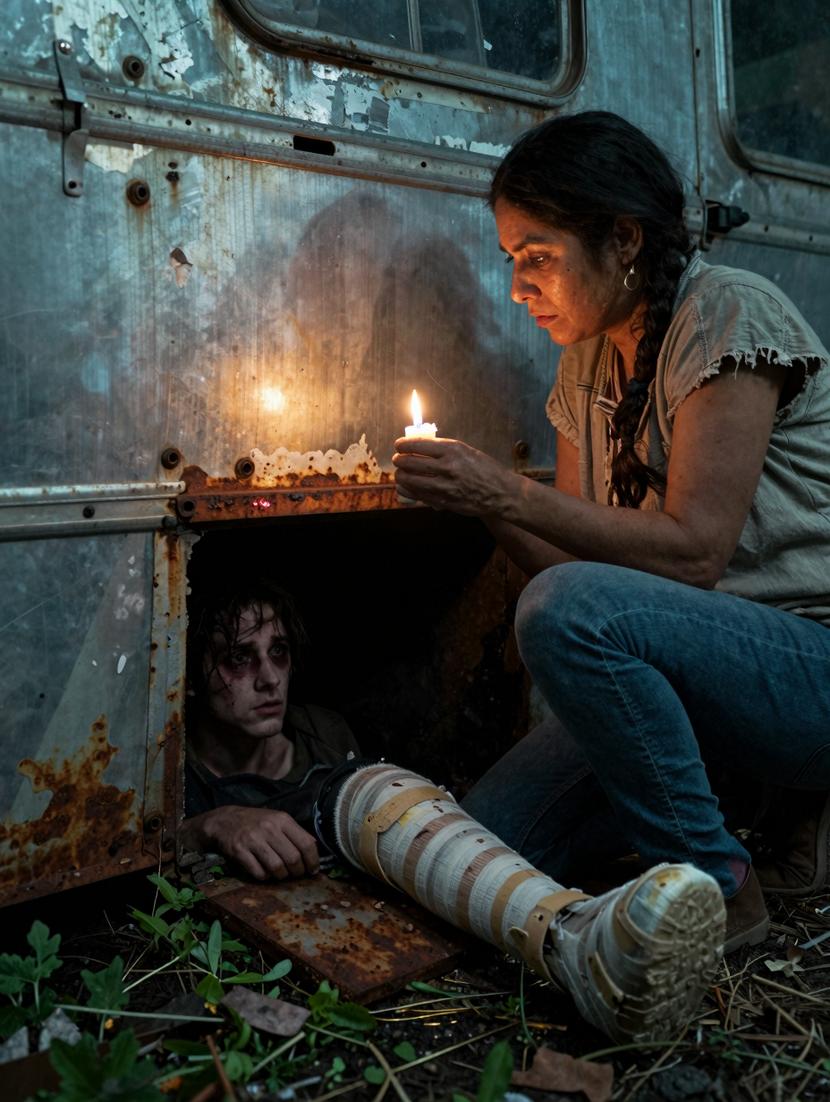
Then, María’s splintered hands struck something real. Something solid. Thick pine boards, perfectly aligned in a square roughly a meter wide. Her heartbeat thundered in her ears. With the help of a rusted metal pipe, she lifted the boards, which cracked hollowly to reveal a yawning, pitch-black hole descending into the cold earth.
Leaning closer, the stench that rose was no mere mold or damp—it was confinement, sickness, sweat, and dried blood. Fear clawed to her throat.
Just as she was about to scream for her children to flee, a faint sound stirred from the darkness below.
Movement.
Breathing.
Something — or someone — was alive in the shadows.
Mateo gripped her arm, pale and trembling. Lucía and Clara stepped back, eyes wide with terror. Gathering her shattered courage, María raised the candle over the hole, its flickering flame revealing a figure curled tight in the cold corner.
What they discovered would drag them all into deadly peril, tearing apart everything María thought she knew about survival and sacrifice.
No one could have foreseen the storm about to break.
PART 2
At the pit’s bottom lay a young man, barely twenty. Mud and dried blood caked his face; one leg twisted grotesquely and bound with crude wooden splints. His hands bore raw abrasions from desperate digging, his bruised and swollen face marked by pain. When the candlelight met his wide open eye, it reflected raw, primal terror.
‘Please… don’t turn me in,’ he rasped hoarsely. ‘They will kill me.’
His name was Adrián, an American biology student. Through fever, tears, and rasping breaths, he revealed he had been trapped in that hole for over two weeks. He had come to Sierra Fría to investigate illegal logging but stumbled upon something far more sinister at La Aserradera de Don Esteban—the most feared man in the region.
There, under cover of night, Adrián witnessed a hidden airstrip where armed men loaded hollowed logs packed with weapons and drugs. Even Méndez, the corrupt police commander, was there, accepting bribes openly.
Caught in their web, Adrián was savagely beaten, his leg broken and bound, then discarded in the forest to perish.
Defying death, he crawled to the abandoned trailer and hid.
A chill ran down María’s spine.
Don Esteban and Méndez controlled everything—no one dared oppose them. Already, a 50,000 peso bounty was placed on the “gringo.”
With that reward, María could finally save her children.
Feed them.
Build them a future.
The weight of temptation threatened to crush her.
Could she betray an innocent man to keep her family alive?
She glanced at Mateo, then at Lucía and Clara, at Dylan and baby Nina. Her thoughts flickered to Raúl’s last words: ‘Raise them to be good people.’
Her choice crystallized.
They hid Adrián beneath the sink, cloaking him with rags and pots. María procured penicillin and mezcal, nursing him through his wounds and fever for ten tense days.
Then, the hunters came.
Armed men tore through the trailer, their boots merciless as they kicked a rusted pile where Adrián was concealed.
Her heart froze—the foreman’s boot landed squarely on Adrián’s body.
If he cried out—
They would all be dead.
Three agonizing seconds stretched into eternity.
Silence.
They left.
That very night, María gathered her children and the barely conscious Adrián, and they fled.
Through the suffocating darkness.
Across forbidding mountains.
While hunger gnawed and danger nipped at their heels.
They reached the sheer cliffs of Cañón del Águila — a thousand-meter drop threatening to swallow them whole.
Trapped.
Behind them, dogs bayed and gunmen shouted orders.
‘Climb down,’ María commanded without hesitation.
Bullets tore through the night.
Rocks cascaded, smashing the fragile earth.
Blood stained the jagged cliff face.
But they survived.
For four relentless hours, they descended—drenched in fear, guided by María’s fierce will.
They crossed three merciless days through desert barrenness until they reached a hidden camp.
Adrián endured.
Seven agonizing months later, he crossed the border to safety.
María never imagined she would see him again.
EPILOGUE
In 1990, a spark of justice ignited.
The government intervened.
Méndez died in a chaotic shootout.
Don Esteban was arrested.
Their corrupt empire crumbled.
Years later, in Santiago, Nuevo León, 2011,
María, now 62, stood in a warm, bustling apartment.
Her children—grown, thriving, and strong—were the bright proof of her sacrifice.
The doorbell rang.
There stood Adrián.
A professor now, holding an apple pie, his eyes shining with quiet gratitude.
‘You saved my life,’ he said, voice thick with emotion.
María smiled, the warmth in her eyes telling of a bond forged in hardship and unyielding courage.


