
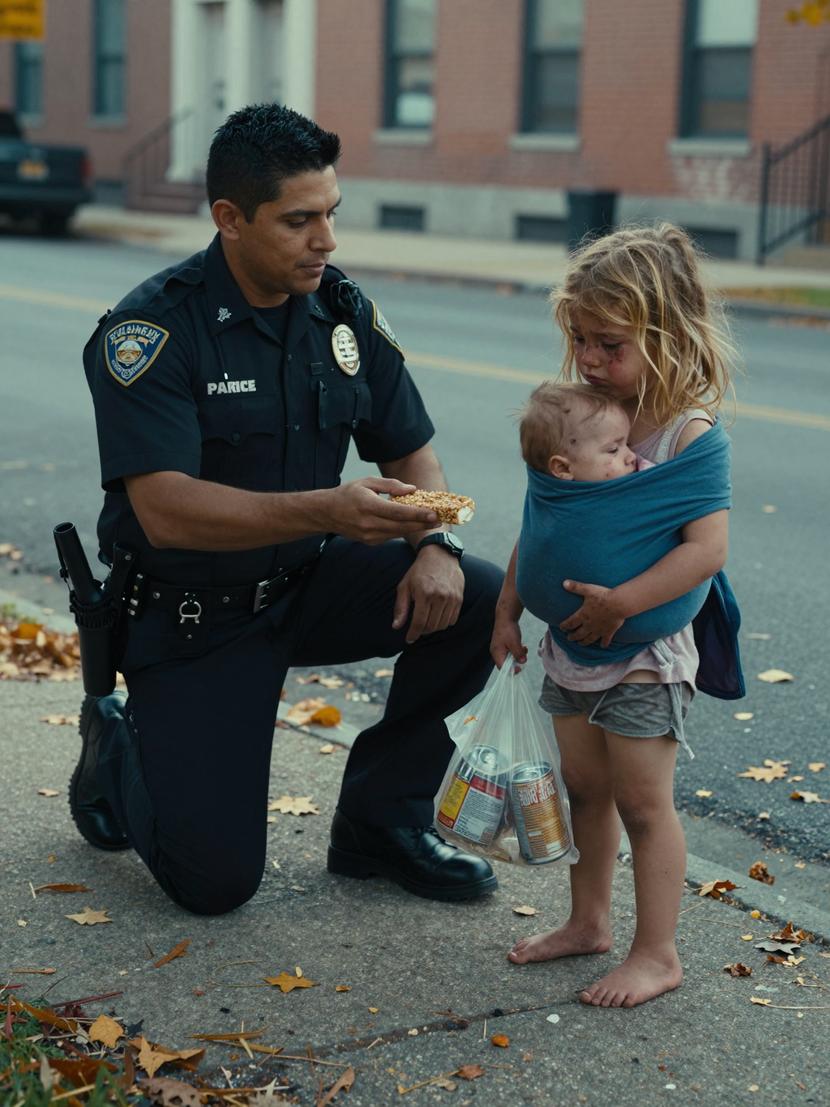
The chill of an unforgiving autumn wind sliced through the near-empty street, scattering amber leaves across cracked sidewalks and brushing past tired brick buildings that whispered stories of a neighborhood left behind by time. Officer Daniel Vega had served twelve years in the force—a guardian through overdoses, devastating crashes, and domestic storms that left scars unseen. Yet, nothing in those years had prepared him for the moment that stopped him dead on that cold morning.
Ahead, beneath a fragile canopy of gold and rust-touched leaves, a small, barefoot figure trudged forward. No more than five years old, her tangled blond hair clung to cheeks streaked with dried tears and dirt. Clutched in one grimy hand was a ripped plastic bag, swollen with crushed cans and refuse collected with silent determination.
Then Daniel noticed the sling.
A faded blue T-shirt, crudely knotted over her shoulder and crossing her chest, held someone—an infant. The baby, tiny and fragile, slept with his delicate head resting just beneath her chin. His skin was pallid, lips cracked like the dry earth beneath them, and even in his slumber, exhaustion weighed on him.
Daniel felt an icy catch in his throat.
He’d witnessed hardship before and seen children fight to survive. But this—this was a raw wound etched into the city itself. A child, carrying another child as if she were both sister and guardian, scavenging through life unnoticed while the world hurried past.
The call had been routine: reports of suspicious activity near the riverbend dumpsters. Daniel expected maybe a homeless adult, or perhaps a group of careless teenagers causing trouble.
Instead, he found this aching truth.
The little girl stooped slowly, fingers clutching a dented soda can. With a practiced, quiet ease, she slipped it into her bag. This was no accident; this was survival. Her oversized shirt slipped off one shoulder, revealing the sharp angles of her frail frame.
The baby stirred, a faint whimper escaping before he nestled tighter against her chest.
Daniel observed the cracked lips, the flushed cheeks buffeted thin by the wind, and her protective posture—a small shield against the biting cold. This was no mere poverty; this was absolution from care.
She didn’t notice his presence at first. Her gaze was fixed on the unforgiving pavement, searching for anything that might be worth a few cents. When her eyes finally met Daniel’s uniform, her tiny body froze—every muscle tense.
Fear rippled across her face.
Her wide brown eyes scanned him—badge, radio, gun belt—and her grip on the bag tightened with desperate resolve. Daniel recognized it instantly. This was no fear of a stranger.
It was fear of authority.
Carefully, he lowered himself, easing the weight of his imposing figure. He said nothing yet. A cold gust stirred the leaves on the ground, and she shivered as she adjusted the sling.
The baby’s breath was faint but steady.
Daniel’s mind drifted to his own daughter, six years old, warm and safe at home—no doubt squabbling over cartoons or snacks. The awareness struck him like a thunderclap.
Summoning gentle courage, he finally asked, “What’s your name?”
A whisper barely rose from her lips.
Slowly, cautiously, she shared that they lived behind the old coin-op laundry. The baby was her brother. Their mother had left days ago, going out to seek food.
She had never returned.
Three nights had passed.
She told him through trembling breath how she’d been doing her best—keeping the baby warm, feeding him whatever scraps she could find, wrapping him in tattered cloth. Someone once told her bottles could be traded for money, so she started collecting them.
Daniel’s throat tightened with a crushing weight.
This wasn’t just a heartbreaking scene; it was an emergency unfolding in real time. The baby needed warmth, nourishment, and medical care. The girl needed safety, urgently.
But Daniel also knew this: any wrong move, and she might run. And if she ran, he might lose her forever.
So he made a choice.
He wouldn’t just act as an officer.
He would act as a human being.
Slowly, he reached into his jacket pocket, pulling out a granola bar he always carried for long shifts. He peeled back the wrapper carefully, extending it toward her, his hands steady and unthreatening.
The girl hesitated, her eyes flickering between him and the offered food.
Then, trembling but tentative, she stepped forward.
That small gesture was the fragile thread of trust forming in a life woven with fear.
What Daniel did not yet know was that after her first bite, after that soft, quiet sigh of relief, her next words would sear themselves into his heart forever—breaking him in ways no badge ever could.
They would ignite a chain of events that would transform not only her life and her baby brother’s—but Daniel’s own as well.
Because sometimes, the greatest kindness arises not from abundant resources, but from a refusal to look away.
Daniel could have chalked this up as just another call. Another file, another forgotten story.
But he didn’t.
He chose to stay.
And that choice drew the fragile line between despair and hope.
In a world rushing by, all too willing to look away, remember this: a single moment of compassion has the power to rewrite a life. You don’t have to fix everything.
Sometimes, all it takes is to stop—and care.


