
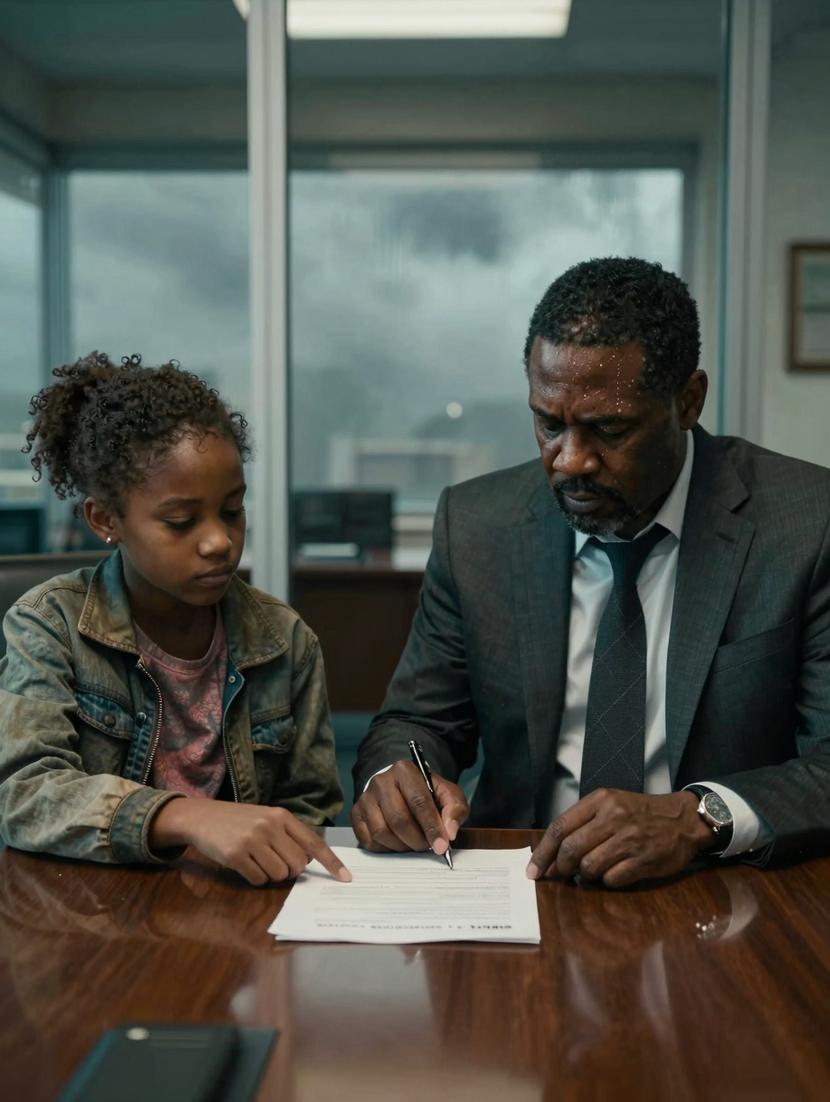
The pen trembled just above the crisp white paper. Daniel Reed’s hand shook with an almost painful intensity, the tip wavering over the signature line as if his body somehow knew that this single motion would dismantle everything he had painstakingly built.
His suit was flawless, pressed to perfection, but his face betrayed a different story — worn, tense, and shadowed with fatigue. A thin bead of sweat traced a slow, determined path down his temple. His throat clenched painfully as he struggled to swallow the rising lump. Around the gleaming conference table, a group of lawyers sat like statues, locked in a frozen silence, their eyes fixed on the bankruptcy documents before them as if awaiting a death sentence.
Then — a quiet, fragile voice sliced through the tension.
“Sir… please don’t sign that.”
Every eye snapped toward the source of the interruption.
Near the glass wall, sheltered from the raging storm outside, stood a young homeless girl no older than twelve. Her jacket was threadbare, clearly too thin for the biting cold, and her shoes were worn to the point of exposing tired heels. Security had reluctantly allowed her inside to escape the tempest — and because she’d been quietly holding doors for people in the lobby all morning.
But now, her gaze wasn’t on the people around her. It was locked on the fateful papers.
“There’s a mistake,” she said, voice timid but steady. “A huge one.”
The lead attorney snapped to his feet, brusque and authoritative. “This is a private meeting. You have to leave.”
Daniel Reed lifted a hand, stopping the protest.
“Wait.”
For one brief moment, a shred of clarity cut through the cloud of despair. Daniel’s eyes locked with hers, searching.
“What kind of mistake?” he asked, voice low but edged with a flicker of hope.
Nina Adeyemi hesitated, then stepped forward cautiously. She raised a finger to a specific paragraph.
“That clause — it transfers the entire debt from the Harborcrest Terminal acquisition. But only sixty percent should have been transferred in the first five years. The rest isn’t due yet.”
The room was swallowed by stunned silence.
Daniel’s eyes darted down to Clause 17C.
He’d pored over it more times than he could count. So had every lawyer seated at the table.
But suddenly, his heart thundered in his chest.
“Stop,” Daniel said quietly, his voice commanding despite its trembling edge. “Reexamine that clause. Now.”
The attorneys exchanged annoyed glances but obeyed.
Minutes ticked by with heavy weight.
Then one swallowed hard and finally admitted, “…She’s right.”
The atmosphere shifted, a breath of fresh air in a stale room.
“That portion of the debt isn’t legally due yet,” the attorney confessed, voice edged with disbelief. “Our liabilities have been vastly overstated.”
Daniel drew a slow, shaky breath, his lungs remembering the long-forgotten rhythm of hope.
“Find her,” he commanded sharply. “Bring her back.”
Nina Adeyemi’s story was one of quiet resilience. Homeless since she was fourteen after her mother’s passing and the crushing burden of rent had swallowed their last thread of security, she survived in subway stations and church shelters, salvaging cans from the streets by day.
Numbers had always been her refuge — a language that spoke truths more clearly than the chaos around her.
Her mother had once been an accountant. “Numbers don’t lie,” she used to say. “People do.”
From early school days, Nina had absorbed enough to detect patterns, to sense the faintest tremor of error or deceit.
That day, she hadn’t intended to peer into the dense legal documents.
But one line stood out like a shove in the dark.
And once seen, it was impossible to ignore.
Three days later, Nina sat not near an exit, but at the polished conference table of Alderbrook Logistics — right beside Daniel Reed himself.
“Speak freely,” Daniel instructed. “Tell me exactly what you see — no hesitation.”
She did.
Misclassified liabilities that distorted the company’s health. Losses inflated far beyond reality. Debt prematurely accelerated on paper, hastening a collapse that hadn’t needed to happen.
A malicious pattern emerged beneath the numbers.
This wasn’t careless management. It was deliberate manipulation.
Ethan Cross, the company’s CFO, left the room before the meeting concluded, his face pale and tight.
Two weeks later, independent auditors confirmed the horrifying truth.
Funds had been siphoned off through shell vendors, losses disguised cleverly as operational costs, figures bent just enough to stay hidden.
Ethan Cross was promptly removed, pending a full investigation.
Six months on, Alderbrook Logistics stood not only intact — but transformed.
Robust oversight became standard procedure; transparency the new expectation.
Nina returned to school, buoyed by a full scholarship from a foundation Daniel quietly established, without attaching his name.
She also returned to Alderbrook, this time as a junior financial consultant — stepping into a brighter future.
On her first day, Daniel leaned close and said quietly, “This company wasn’t saved by money. It was saved by someone who spoke up when it was most dangerous to do so.”
Nina smiled — small, steady, unwavering.
The world didn’t pivot because a billionaire averted bankruptcy that day.
It shifted because a homeless girl saw what no one else did.
Because intelligence needs no title,
Because truth requires no permission,
And because silence, in the face of injustice, is never truly safe.
Sometimes, the most important line in your life is noticed by the one you were never taught to listen to.


