
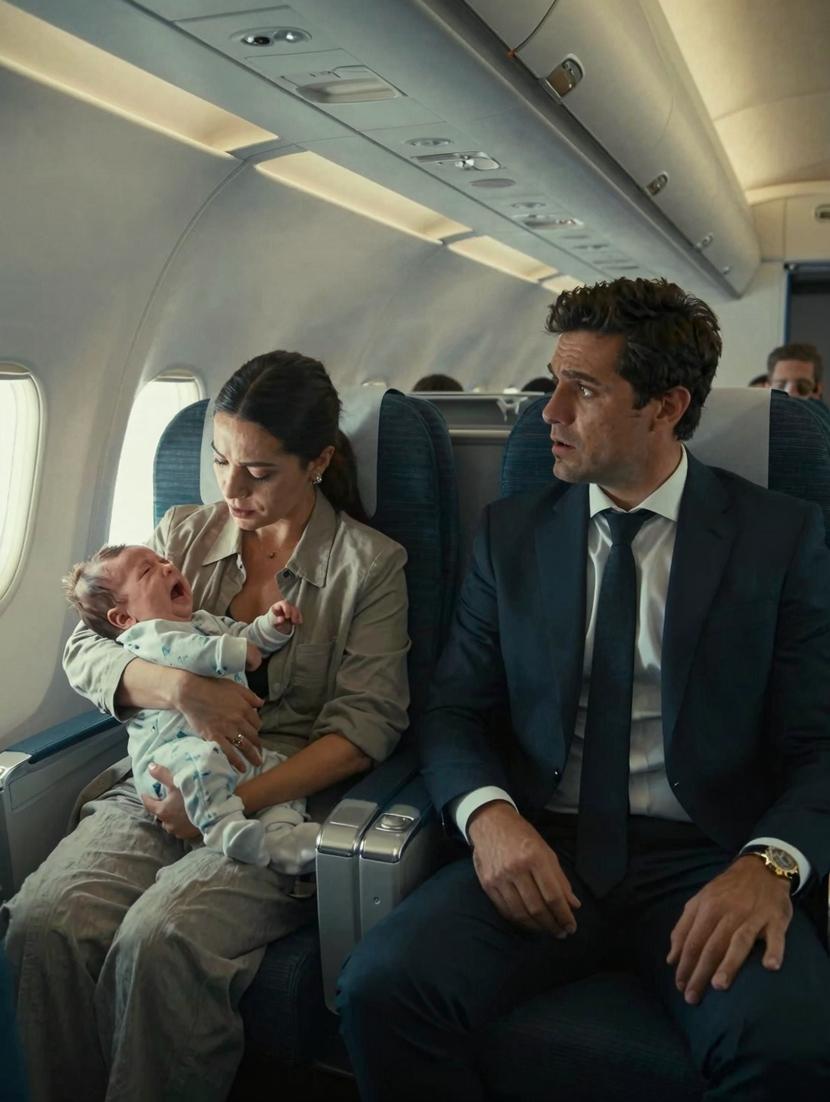
The short flight from Belviera to Valmora should have been a breeze, barely two hours slicing through the clear sky. Yet for Adrián Navarro, forty years old and accustomed to commanding boardrooms, it stretched into an excruciating saga of helplessness. As CEO of one of Spain’s most influential tech giants, with a bank balance boasting more zeros than he could ever dream of spending, Adrián was the epitome of success. His name alone unlocked doors across continents. But 30,000 feet above the earth, perched in a first-class seat that morphed into a gilded prison, he felt stripped of his power and dignity.
Clutched tightly in his arms was Mateo, his three-month-old son, wailing with relentless ferocity. This was no ordinary cry for food or comfort; it was a heart-rending howl born from an invisible anguish that Adrián felt utterly powerless to soothe. Two hours and counting, Mateo’s piercing sobs tore through the plush silence of the cabin. Adrián’s €5,000 suit clung damply to his skin, cold sweat betraying the panic mounting inside him. He had tried everything—feeding from the bottle, offering the pacifier, pacing the aisle with rhythmic steps, the gentle rocking methods recommended by every nanny handbook he’d studied. None of it made the slightest difference.
Around him, the first-class passengers who typically cast admiring glances now shifted uneasily, their eyes flashing unspoken judgments. The silent accusation was palpable: “This man runs a multimillion-euro empire yet cannot calm his own child?” But it wasn’t their looks that stung Adrián the most—it was his own raw, crushing sense of failure. Every tear shed by Mateo felt like a silent reproach, a void carved deeper by the absence of Natalia, his late wife, who had died giving birth. It was as if Mateo’s cries whispered, “You are not her. You don’t know how to love me.”
Several rows away, beyond the shimmering curtain separating first class from economy, Lucía Serrano watched quietly. At twenty-eight, her eyes carried the exhaustion of a life weighed down by hardship. On her lap, her two-year-old daughter Sara slept peacefully—a small beacon of calm amid the recent chaos. Lucía wasn’t cloaked in luxury; her jeans were faded, and her simple T-shirt bore faint stains. Her pockets held the last few euros she had left after scraping together tickets to Valmora, hoping to find work cleaning houses or babysitting after her husband had abandoned her for another woman.
Mateo’s wails pierced through Lucía’s heart rather than irritated it. It was an instinctual, invisible bond that pulls mothers to any child who suffers. She observed Adrián unravel: the trembling in his hands, the stiffness in his posture. He held Mateo like he might break at any moment—precise, careful, but utterly lacking warmth.
The crying escalated, slicing through the cabin’s fragile calm. Flight attendants exchanged helpless glances, tension thick as fog. Adrián, teetering on the edge of desperation, sank back into his seat, eyes clenched shut, silently willing himself to vanish.
Then Lucía made a decision. Quiet as a shadow, she unbuckled her seatbelt, careful not to awake Sara, and rose steadily toward the dividing curtain. A flight attendant stepped forward, blocking her path.
‘Ma’am, you can’t enter first class,’ the attendant warned.
Lucía didn’t flinch or look away. Her gaze locked on Adrián and the screaming infant in his arms.
‘Let me try,’ she said, her voice steady, calm, but carrying the weight of unyielding resolve.
Adrián looked up, meeting the stranger’s dark eyes—eyes free from pity or judgment, brimming instead with raw humanity. In that moment, he sensed she was the lifeline he so desperately needed. Unaware of the profound change this simple gesture would set in motion, he extended his trembling hands and entrusted Mateo to her.
That brief transfer crackled with silent electricity. Lucía cradled Mateo effortlessly; no inspecting hesitance, just a warm rush of closeness—heart to heart, chest to chest.
What followed resembled a sacred ritual. Lucía didn’t rock Mateo frantically. Instead, she paused, letting her breath slow and her calm wash over the child’s tense form. Then, swaying with a natural rhythm like the gentle ebb of ocean waves, she began to sing.
It wasn’t a nursery rhyme. Her voice, rough yet tender, carried an ancient Andalusian lullaby—words soft as moonlight, invoking olive trees and distant nights—sung as if to chase away shadows unseen.
Slowly, astonishingly, the cry faltered. Mateo’s furious scream dissolved into ragged sobs. His clenched fists loosened; his kicking legs stilled. Adrián watched, spellbound, as the mask of tears lifted from his son’s face for the first time in months. Mateo’s wide, dark eyes—so hauntingly reminiscent of Natalia’s—locked onto Lucía’s.
‘Shh, it’s over now, my love,’ Lucía whispered, her hands gently tracing circles along his back. ‘It’s over now.’
In just five miraculous minutes, Lucía achieved what months had failed to accomplish. Mateo exhaled a deep sigh that rippled through the stunned silence of first class before drifting peacefully into sleep.
Adrián slumped back into his seat, tears blurring his vision—a mixture of shame, relief, and newfound hope. When the plane touched down at Aeropuerto del Sol, Mateo remained sound asleep in Lucía’s arms.
Determined he couldn’t let this woman vanish from their lives, Adrián waited by baggage claim. Lucía appeared holding Sara’s hand, pulling a battered suitcase that had clearly endured countless journeys.
‘Please, wait,’ Adrián called out, slightly breathless.
Lucía froze instinctively shielding her daughter. ‘Sir, the baby is fine now. I have to go.’
‘It’s more than that,’ Adrián confessed, fumbling for words but speaking simply and sincerely. ‘You have something Mateo needs. Something I don’t.’
Amid the cacophony of the airport, he offered her something unbelievable—a job not as merely a nanny, but as Mateo’s primary caregiver. A salary beyond her wildest dreams, a place for her and Sara to live under his roof, and, above all, stability.
Lucía eyed him with cautious skepticism. Pain had taught her that generosity often came with unseen prices. ‘I have a daughter. I can’t just move into a stranger’s home.’
‘Bring her with you,’ Adrián insisted. ‘My home in Las Encinas Altas is vast—far too empty for just the two of us. Please, a trial—a month. If you’re not comfortable, I’ll pay you three months’ salary and you can leave. But Mateo…’ His voice cracked. ‘He needs you.’
Glancing at little Sara, who watched Mateo sleep in the luxury stroller with quiet curiosity, Lucía weighed the future—a bare, uncertain road in a crumbling boardinghouse or this lifeline spun from the sincerity of a desperate man. She said yes.
Arriving at Adrián’s mansion in Las Encinas Altas was like stepping into another world. The house was a dazzling showcase of modernity—glass, steel, white marble—beautiful but sterile, as cold as an operating room. No toys, no photographs, no signs of the warmth family brings, only the echo of a flawless life hollowed out.
The first days trembled with unease. Lucía felt alien, an interloper in that gleaming shell. Yet, gradually, the gentle magic she wielded on that flight began to seep into the rooms. She tended Mateo not just with care, but with love. She drew open curtains long shuttered, inviting sunlight to spill over the emptiness. The aroma of sofrito, spices, and homemade meals breathed life into the silent kitchen.
Sara, with the innocence of two years, became the spark igniting change. To her, Adrián was not the imposing CEO but simply “the tall man.” One afternoon, when Adrián sat buried in paperwork, Sara burst into his office chasing a ball. Stopping in front of his imposing mahogany desk, she lifted the ball and asked,“Want to play?”
For the first time in years, Adrián smiled and stepped down from his pedestal, settling on the Persian rug to roll the ball back.
And from that simple game, everything shifted.
Months passed and the mansion transformed. Toys scattered the gleaming living room. Laughter echoed through the corridors. And a family blossomed—not bound by blood but forged through love and choice.
Adrián began leaving work early. Corporate crises paled in importance compared to bedtime baths. He watched Lucía, absorbing her patience, her gentleness, learning how to hold Mateo without fear, how to decipher his silent cues. As he learned fatherhood, he found himself falling for the woman who had become their anchor.
It wasn’t the stormy passion of movies; it was slow, simmering, like Lucía’s stews on the stove. He adored her resilience, the way she tied back her hair when focused, the love she poured equally into Sara and Mateo. She had saved his son—and without knowing it, had saved him as well.
Lucía, in turn, saw the armor Adrián shed day by day—the tenderness beneath the tailored suits, the vulnerability he showed only when sure no one was watching.
Their defining moment arrived one crisp autumn afternoon. Dry leaves carpeted the garden as Lucía sat on a bench, watching Sara and Mateo—now crawling swiftly—chasing among the rustling foliage. Adrián joined her, silence weaving between them like a shared secret.
‘The contract’s over,’ Adrián said softly.
Lucía’s heart fluttered. The trial year had flown by. “Yes… I suppose I should look for an apartment,” she murmured, fighting to steady her voice.
Turning to her, Adrián took her hand, their fingers intertwining naturally. ‘No,’ he said firmly. ‘The contract ends because I don’t want you as an employee anymore. Lucía, this house was lifeless before you. I was lifeless. You brought us back.’
Drawing a steady breath, he let down every shield. ‘I don’t want you to leave. I want this to be our life. I love you, Lucía. And I believe… Sara and Mateo are siblings in every way that matters, except on paper.’
Tears traced warm paths down Lucía’s cheeks—tears of joy long postponed. ‘I love you too, Adrián.’
Their kiss was quiet, a promise sealed—not of passion, but of safety, of homecoming after a long, stormy sea. It was the beginning of a story written first at 30,000 feet.
Two years later, sunlight bathed the courtroom. An elderly judge peered over his glasses, smiling as he reviewed the papers.
‘I rarely see cases like this,’ he said. ‘Usually, we handle conflict and separation. But this… this is the birth of something new.’
Adrián signed Sara’s adoption papers. Lucía signed Mateo’s. Ink confirmed what their hearts had known without doubt.
Outside the courthouse, Mateo—now running and chattering endlessly—grabbed Adrián’s hand. ‘Dad, look!’ he shouted, pointing skyward where a plane streaked across Valmora’s vast blue.
Adrián squeezed his son’s hand, wrapping his other arm around Lucía’s shoulders. A smile spread across his face as memories of that fateful flight surged back—the despair, the desperation, the unexpected blessing nested inside unbearable pain.
‘Yes, son,’ Adrián said, looking into Lucía’s eyes with boundless love. ‘That’s an airplane. It’s where our real life began.’
The Navarro family’s tale soon became legend among friends—not for wealth, but for proving that family transcends DNA. It is defined by who stays when tears flow endlessly, by the courage to ask for help, and the grace to give it to a stranger without demanding anything in return.
Because in the end, the strongest bonds aren’t born of blood but forged by hearts that choose each other, day after day, against all odds.


