
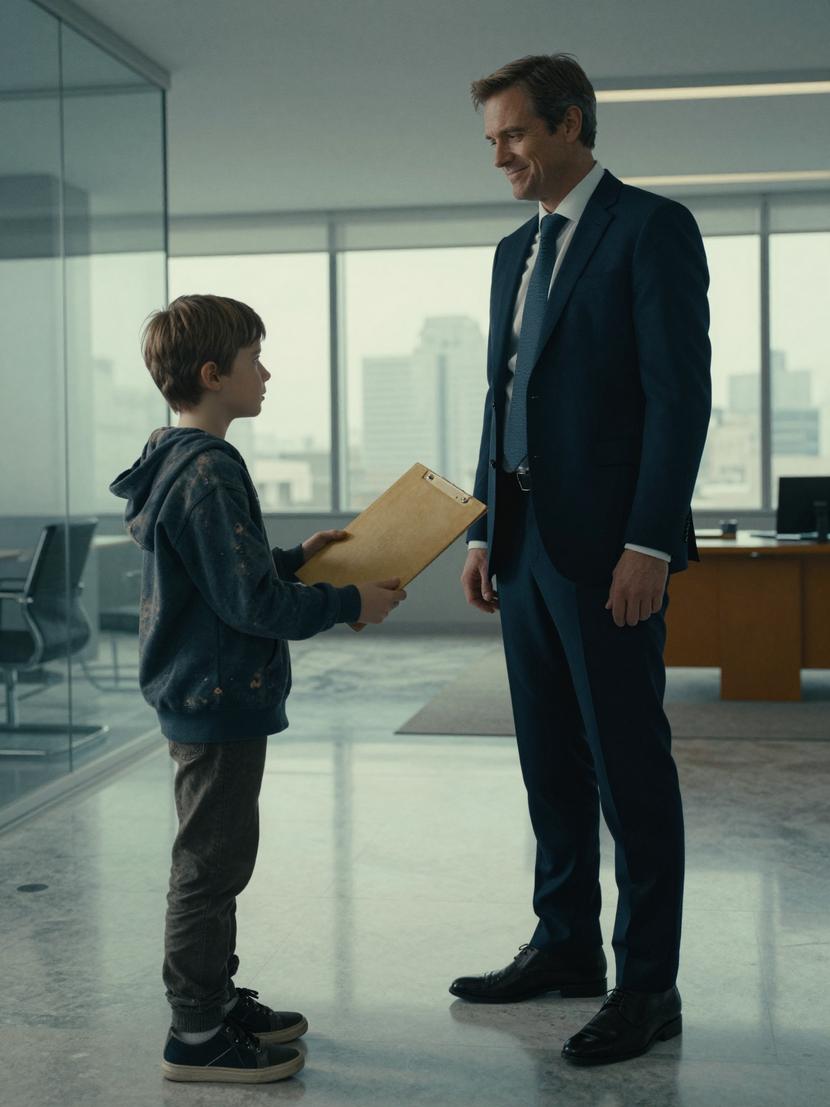
Eli Mercer discovered early on that promises carry a weight heavier than words—especially those whispered beside a hospital bed. At seven years old, his small hand clasped the frail fingers of his grandfather, Walter Reed, the solitary soul who ever spoke Eli’s name with genuine meaning. With a whisper raw from fading strength, Walter said, “When the time comes, go where I told you. Don’t hesitate. You’ll know what to say.” The boy barely squeezed back, the gravity of those words sinking into a part of him he couldn’t yet understand—but never forget.
Three days after the funeral, that moment thundered in.
The afternoon sky was a low-hanging curtain of slate, rain heavy enough to threaten but not yet fall, mingling with the scent of fresh bread drifting from the bakery across the street. In their humble kitchen, Eli sat motionless while his mother, Hannah, broke the wax seal on an envelope as delicate as a secret. Her eyes flickered with something unreadable as she unfolded the aged paper.
“They left instructions… for you,” Hannah said softly. “Walter wanted you to come to Crescent Harbor Plaza. Ask for Mr. Harrington—executive floor.”
Eli nodded once, unwavering. He didn’t ask why; the weight of the moment demanded no questions.
Morning arrived wrapped in a thin veil of mist. Eli gathered the few relics Walter had entrusted him: a plastic folder brimming with dusty documents, a brass key worn at the edges, and a small note inked in faded script: ‘For today. Be brave. Never let money make you feel less than you are.’
Crescent Harbor Plaza towered ominously over downtown Chicago, its glass and steel framework reflecting power and authority. Inside, polished shoes echoed on marble floors, and tailored suits swept past like currents of confidence. Eli’s scuffed sneakers and faded hoodie marked him as an outsider—but he stepped forward without falter.
The concierge’s glance lingered with a mix of curiosity and concealed ridicule. “I need to see Mr. Harrington,” Eli said, holding the folder tight.
No tremor in his voice.
They escorted him upstairs, smirks shared among the staff like whispers of an unspoken joke. On the executive floor, eyes slid over Eli with thinly veiled derision. Whispers slipped through the pristine air; muffled laughter cloaked behind glass walls.
A man in an elegant navy suit stepped forward, lips curled in a smirk. “Lost, kid?”
Eli opened his folder, inhaled deeply, and began to speak. But before a single word formed, the door at the hallway’s end swung open.
Mr. Harrington appeared.
The room’s cold amusement evaporated instantly.
Mr. Harrington’s gaze locked on the slim folder cradled in Eli’s hands. He didn’t move. He didn’t speak. His eyes climbed slowly to meet Eli’s pale, composed face. The boy’s stillness was uncanny—no fidgeting, no hesitation—as though the weight in his hands was a mantle heavier than mere paper.
Laughter didn’t just fade; it shattered. Conversations froze mid-sentence. The soft clinking of glasses hushed. The entire room held its breath, suspended on an invisible thread.
Finally, Harrington’s voice broke the silence, low and stripped of former ease. “Where did you get that?”
Eli swallowed but did not retreat. His fingers closed tighter—not possessively, but in reverence. “My grandfather. Walter Reed.”
The name hung in the air—soft yet seismic.
Harrington’s stance shifted imperceptibly: his shoulders stiffened, eyes sharpening with a flash of something ancient and guarded. He advanced cautiously, as if the floor beneath him might fracture. Taking the folder with trembling hands reserved for precious artifacts, he leafed through the pages, each turn a step deeper into memory.
Those nearby leaned in without realizing, drawn into a quiet gravity. A man cleared his throat nervously; others shifted uneasily, sensing a sacred boundary crossed.
At the final page Harrington halted.
A long, silent pause stretched between them. Then, with almost tender care, he closed the folder—as if it were alive.
“You should have called,” he murmured, words meant for a ghost in the room, for a man others had forgotten.
He then lifted his gaze, voice firm with unyielding authority. “Clear the room.”
A beat of hesitation. Confusion sparking like a tremor across guarded faces.
“I said clear the room.”
Louder now. Unquestionable.
The clatter of chairs, the hurried placing of glasses, the sharp tap of expensive shoes sped into silence. Within moments, the executive floor lay bare—except for Harrington, Eli, and a silent woman in a gray suit standing near the wall, as if she had awaited this moment all along.
“That’s my mom,” Eli whispered, nodding toward the elevator.
Harrington acknowledged with a curt nod. “Bring her up.”
When the elevator doors parted again, Hannah stepped out and halted.
The vastness of the floor overwhelmed her—the wall of glass revealing a glittering cityscape stretching endlessly below, a world she felt both distant from and drawn toward. For a heartbeat she hesitated, ready to retreat.
Then Eli rushed to her side, grasped her hand firmly, anchoring her.
“It’s okay, Mom,” he whispered.
She exhaled shakily and nodded, eyes fixed on Harrington.
“Please, sit,” he gestured toward the table.
They did.
“I owe your family an explanation,” Harrington began.
He spoke of a financial catastrophe decades ago—one that had nearly crushed the empire he now commanded. Of Walter Reed, who had stepped silently into the breach when no one else dared. Of whispered strategies, unseen risks, and sacrifices hidden from the public eye. Of decisions that had saved not just numbers, but futures.
He revealed the existence of a trust forged in secret, documents sealed and locked away, meant to stay untouched until the right moment—a moment Walter had foreseen.
“That account,” Harrington said, pressing his hand upon the folder, “was never meant to be opened early. Your grandfather was clear on that.”
Hannah’s voice trembled. “How much… is in it?”
The figure he named hung heavy in the room.
Hannah gasped, breath caught in shock—wealth beyond her lifetime’s earnings, enough to erase fear, redraw every decision, to reshape a future both hopeful and terrifying.
Eli said nothing.
He listened.
“There’s one last thing,” Harrington added, sliding the brass key across the table.
He crossed to a wall safe, unlocking it with practiced ease. He withdrew a small envelope, edges worn with years.
“This came with instructions,” he said.
Eli opened it carefully.
Inside, a handwritten letter revealed truths not of fortune, but of restraint. Of compassion extended when survival was assured. Of remembering roots when the world forces reinvention. Of never permitting money to diminish your worth—or your duty to others.
When they left Crescent Harbor Plaza that afternoon, the world outside had not changed. The city’s pulse carried on—traffic roared, voices collided, life surged forward as ever.
But Eli gripped Hannah’s hand tighter than before.
“We’re going to be okay,” she whispered, perhaps more to steady herself than him.
Eli nodded.
Because a promise—quiet, patient, deeply guarded—had finally been fulfilled.


