
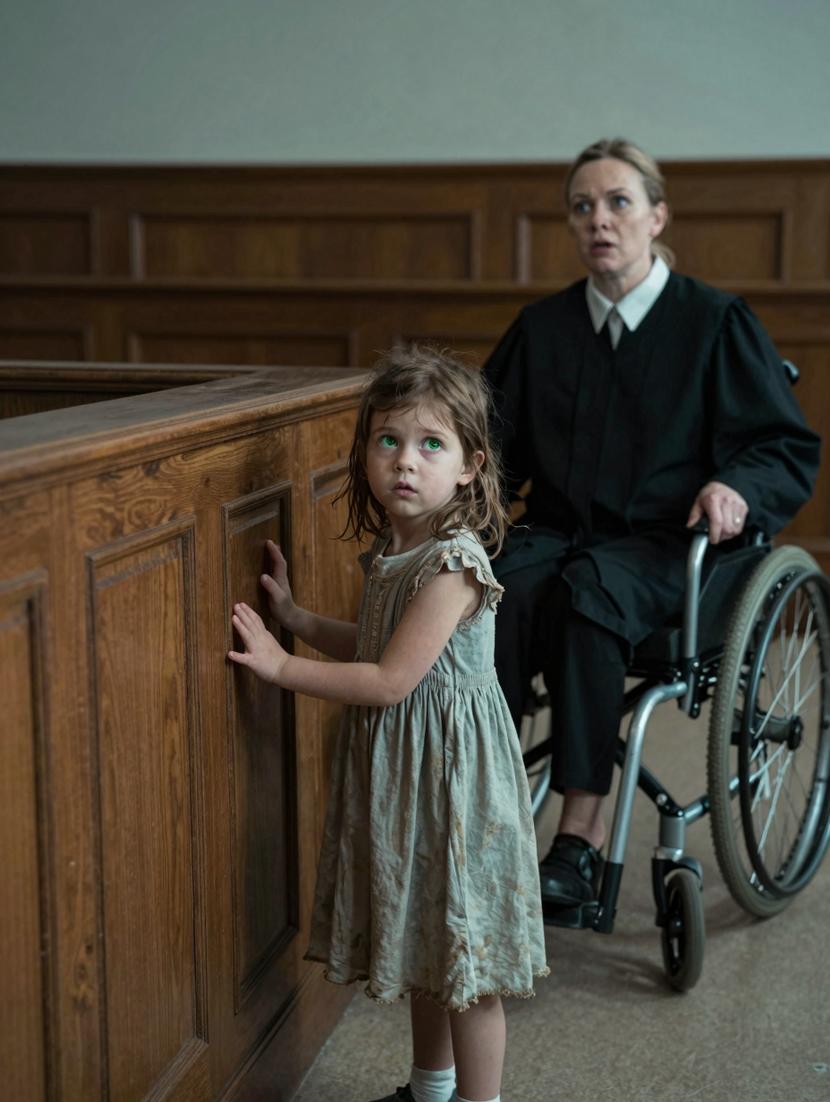
The oppressive silence blanketing the crowded courtroom was profound, thick enough to choke the air itself. For a fleeting moment, it seemed as if every breath had been swallowed whole by the weight of the moment. All faces were riveted on a fragile silhouette making its way with determined small steps toward the front: a mere five-year-old girl, her tangled brown hair wild and unkempt, untouched by a comb for hours.
Her tiny shoes clicked softly, rhythmically echoing off the gleaming polished floor — a stark contrast against the grave stillness in the room. She wore an old dress, too large and hanging loosely over her delicate frame, showing the scars of hardship in every thread.
Presiding behind the grand wooden bench was Judge Margaret Ashford, confined not only by the law she upheld but also by the wheelchair that had become her unwilling companion for the last three years. Her hands gripped the armrests tightly, veins prominent and knuckles pale, a silent testament to battles fought beyond the courtroom.
In her two decades of service on the bench, Margaret had wrestled with the darkest corners of humanity — betrayal, heartbreak, cruelty — yet never had a child this young crossed the courtroom floor in the midst of a felony trial.
The girl paused and lifted her gaze. Her bright green eyes burned with an intensity that felt almost supernatural, piercing right through the judge’s guarded demeanor. Taking a steadying breath, her tiny chest rising and falling with whispered courage, she spoke — her voice sharp and clear, undeterred even by the murmurs rippling through the gallery.
“Judge, ma’am,” the child said, her trembling hands resting gently on the cold wood of the bench. “If you set my daddy free, I promise I will make your legs work again.”
The reaction that followed was immediate and explosive. The courtroom erupted into whispers, gasps, and nervous chuckles, the absurdity of those words cutting through the solemn air like lightning. Spectators pointed, some shaking their heads in disbelief, others casting furtive looks filled with pity toward the small girl — just a child, too young to grasp the gravity of law or the permanence of paralysis.
But Judge Margaret Ashford remained silent, eyes wide, staring down at the little girl as something unspoken stirred within her — a flicker of hope, a strange feeling buried deep beneath the ache in her ribs that she hadn’t felt in years.
To understand how this impossible moment came to be, one must journey back to where the nightmare was born.
Three weeks earlier, Daniel Harper was nothing more than a weary man battling daily to keep afloat. A construction worker with rough hands and a heart soft for his daughter, Mia — his entire universe.
His life was a worn rhythm: rise before dawn to prepare breakfast, plant a gentle kiss on Mia’s forehead, then face the hard labor of the day. Daniel had been a single father ever since his wife’s untimely passing when Mia was just two, navigating the daunting seas of parenthood alone.
Mia was different from other children. She battled severe asthma, a cruel condition that turned chilly winters into months of terror. Some nights, she’d jolt awake, gasping, chest heaving in desperate fight for breath.
Daniel would cradle her close under the dim glow of a bedside lamp, whispering lullabies and rocking her gently until the fear ebbed and her breathing found its rhythm again.
But the medicine that kept Mia alive was a cruel luxury, its cost piling high beyond Daniel’s meager wages. He grabbed every shift he could, muscles screaming in protest, but the paycheck barely held the dark shadows at bay.
He had already sacrificed all he could — selling his car, parting with his watch, and even giving up the wedding ring that linked him to his late wife, a tangible memory now traded for life-saving hope.
Then came that bitter Tuesday morning.
Mia awoke, her tiny body burning with fever, eyes glazed and nearly closed, limbs limp and heavy against the sheets.
When Daniel pressed his hand to her forehead, a cold dread surged through his veins.
“Daddy,” Mia whispered, voice fragile and raspy, “I can’t breathe right.”
Daniel’s heart shattered in his chest. He looked helplessly at the child he loved more than life itself, knowing relief was urgent — but the cruel truth was there, biting cold and unyielding: the last twenty dollars had been spent on groceries just the day before.
The pharmacy was a business without mercy — no money, no medicine. And the hospital? Demanding insurance he did not have.
In desperation, Daniel called his boss, Mr. Caldwell, pleading for an advance.
“Daniel, I wish I could help,” Mr. Caldwell’s voice crackled through the receiver, “but company policy won’t allow it. You know that.”
His hope extinguished, Daniel sank to his knees beside Mia’s bed, helpless as her chest struggled to rise and fall. Her lips showed the faintest, chilling hue of blue, and her little hands trembled with weakness.
He knew, with a bone-deep certainty, that without her medicine, Mia might not make it through the night.
Later that evening, after Mia finally slipped into a restless, uneasy sleep, Daniel faced the hardest choice of his life.
He zipped up his threadbare jacket, pressed a trembling kiss to her hot forehead, then stepped out into the piercing cold night.
The Willow Avenue pharmacy buzzed with the usual evening rush — families gathering cold remedies, elderly neighbors filling prescriptions, teenagers browsing unbothered by the desperation hanging just outside the doors.
Daniel’s hands shook fiercely, not from the chill but from terror clawing through him.
He was a good man — someone who had never lifted even a pack of gum without paying — yet the image of Mia’s blue-stained lips pushed him beyond breaking.
Hat pulled low over his eyes, he stepped through the automatic doors and into the harsh fluorescent glare of the pharmacy — stepping into a story that would soon ripple far beyond those walls.


