
In the glittering heart of Silver Harbor, wealth often bred a dangerous certainty: that any barrier, no matter how deep, could be dissolved with influence, iron contracts, or raw financial might. Julian Hartwell epitomized this belief. As a towering real estate magnate, his empire molded skylines and commanded headlines with ruthless precision. Each sleek tower rising above Riverton stood like a monument to his iron will—unshakable, untouchable.
Yet behind the gleaming glass walls of his pristine penthouse lurked a silence no amount of money could pierce. Mara, Julian’s twelve-year-old daughter, had never spoken a word. Since the day she was born, her lips remained sealed, an impenetrable fortress shielding a tumult of unsaid thoughts and feelings. Behind the grand piano and priceless artworks, her silence was a quiet defiance against the polished perfection surrounding her.
Doctors offered explanations steeped in clinical jargon—selective mutism, trauma from the loss of her mother. Therapists filled rooms with charts and cautious hopes, while specialists delivered predictions that veered from tentative optimism to bleak uncertainty. Progress was a ghost, elusive and perhaps impossible. But Julian, a man forged in the fires of deadlines and deals, abhorred waiting. He summoned the finest minds, dumping wealth on experts like bricks in a foundation, desperate to build a path through his daughter’s silence. Yet the more he pressed, the further Mara seemed to drift into her quiet world, her bright eyes locked away like precious secrets.
One brisk spring afternoon, as Silver Harbor throbbed with its usual chaotic rhythm — honking cabs, hurried footsteps, and distant sirens — Julian’s sleek black car glided to a stop near a bustling plaza in Riverton. The glass monolith of his next business meeting towered ahead, where powerful executives carved destinies from boardroom battles. Mara remained cocooned in the back seat, small hands pressed against the cool window, watching the frantic dance of strangers spilling coffee, snapping at their phones, laughing, and rushing past, living lives woven with noise and haste. She sat ensnared in a silence heavier than the towering steel her father commanded.
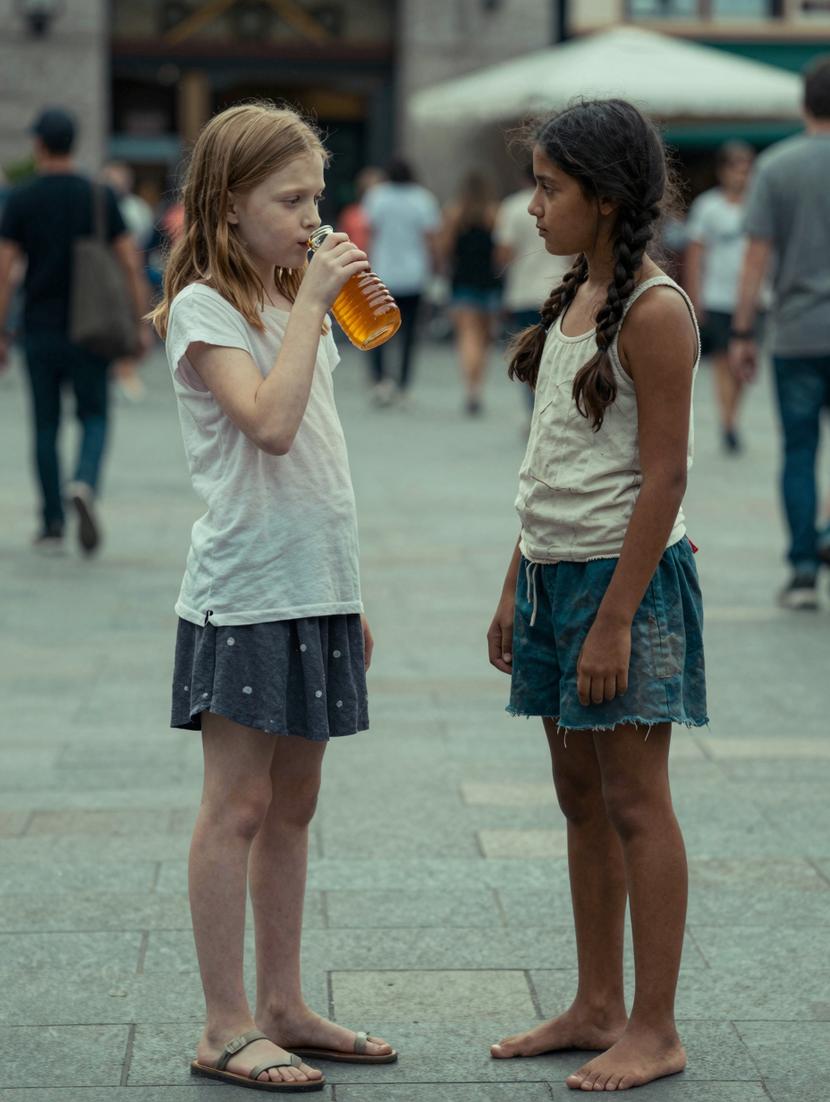
Then, amidst the swirl of rushing feet and glinting skyscrapers, Mara’s gaze caught something unexpected. A barefoot girl, alone yet radiant with quiet dignity, stood nearby. Her clothes were tattered, hair loosely braided, and the sun painted golden halos around her weathered face. In her hands, a simple glass bottle, thick with honey that glowed like liquid amber. She neither begged nor performed—she simply stood, a figure shaped by hardship but unbroken. Her name was Lena Fields, a girl who had mastered the art of standing tall in a world too indifferent to notice.
With a sudden urgency that startled even herself, Mara tugged the driver’s sleeve. Moments later, she stepped out onto the plaza, the city’s cacophony swirling around her like an invisible tempest as she approached Lena. The girl tilted her head with a gentle curiosity rather than suspicion.
Noticing Mara’s fascination, Lena spoke softly, “This isn’t just honey. My grandmother said it gives courage. When something’s made with love, the heart learns how to speak again.”
Her voice carried no trace of salesmanship or whimsy, only a quiet truth woven through generations. Mara searched Lena’s face for any hint of deceit but found only warmth and sincerity. Carefully, Lena unscrewed the bottle’s lid and extended it toward Mara. With trembling hands, Mara lifted it to her lips, savoring the thick sweetness as it slid like liquid warmth across her tongue. In that breathless heartbeat, the world seemed to still.
Then, as if the silence shattering was both miraculous and inevitable, Mara’s lips parted.
‘Papa,’ she whispered, fragile and trembling, yet unmistakably clear.
Across the street, Julian froze mid-conversation, his heart seizing as that fragile sound sliced through the urban roar like a lightning bolt through still skies. When Mara called again, stronger and edged with longing, ‘Daddy,’ he dropped his briefcase and sprinted toward her, his chest heavy with disbelief and a torrent of emotion that made every breath a battle. He fell to his knees before her, clutching his daughter tightly and weeping as though years of stoic control had finally crumbled.
Lena stood quietly beside them, clutching her honey bottle with a knowing smile. Julian looked up, stunned. ‘How?’ he choked, voice thick with wonder.
Lena’s answer was simple. ‘It’s just honey. But my grandmother believed sometimes you have to give people faith before medicine.’
Reaching for his wallet, Julian offered a thick wad of cash, desperate to reward the miracle, but Lena gently refused. “I never tried to sell magic,” she said, “only to help.”
Her words landed like a hammer against Julian’s heart. For the first time in years, he realized how transactional his life had become—built on bargains and numbers rather than belief and connection.
That night, Mara spoke more than she had ever dared. Her voice, though weak, glimmered like a fragile flame shielded from the storms, while Julian sat beside her, tears flowing freely—no longer ashamed to let his guard down.
By morning, Lena had vanished.
Anxiety spread through Silver Harbor like wildfire—search teams scoured every shadow, drivers combed the streets, and social media buzzed with concern. Days later, she was found beneath a weathered bridge, curled beside an empty honey jar, exhausted but unharmed.
Kneeling before her, Julian shed the billionaire’s armor and spoke as a man humbled, offering help without a price tag or condition. Lena hesitated—hope was a fragile stranger in her life—but then Mara stepped forward, voice soft yet insistent.
‘Sister.’
That single word shattered the walls Lena had erected for survival.
Soon, Lena moved into the Hartwell estate. The once silent halls blossomed with laughter, the scuff of footsteps, whispered secrets at twilight, and clumsy dance routines beneath glittering chandeliers. Mara’s voice strengthened with each passing day. Lena began to feel the warmth of a bed that was truly hers.
But happiness was not without its trials. One evening, Lena collapsed. At the hospital, the truth surfaced—a legacy of shadows hidden beneath prosperity. Lena’s grandmother had once toiled in a Hartwell factory, where corners were cut for profit, leaving a trail of illness, poverty, and ultimately homelessness.
The honey had never been a cure. Mara’s voice wasn’t born of sweetness alone—it was born from being seen as more than a problem, as a child worthy of belief. And Lena’s kindness had healed Mara even as Julian’s neglect had fractured Lena’s world.
Julian’s guilt was no legal ledger but a deep moral reckoning. He vowed to rebuild—not with money, but with responsibility.
Launching investigations, overhauling compensation programs, and transforming his charitable foundation into a force for real change, Julian brushed aside critics who branded him reckless. He cared no longer for power—he feared losing his humanity far more.
Months later, under glimmering lights at a charity gala, Mara stood on stage with Lena by her side. Her voice, trembling yet steady, echoed through the hall as she thanked the crowd for giving her hope and, more importantly, a sister. Julian listened, not to applause, but to the miracle of his daughter’s voice—the testament that compassion can rewrite even the coldest stories.
That night, Julian understood: wealth builds towers; compassion builds homes; belief builds voices; and courage—born even in a barefoot girl with a simple bottle—builds miracles.
Mara found her voice. Lena found a family. Julian found his heart.


