
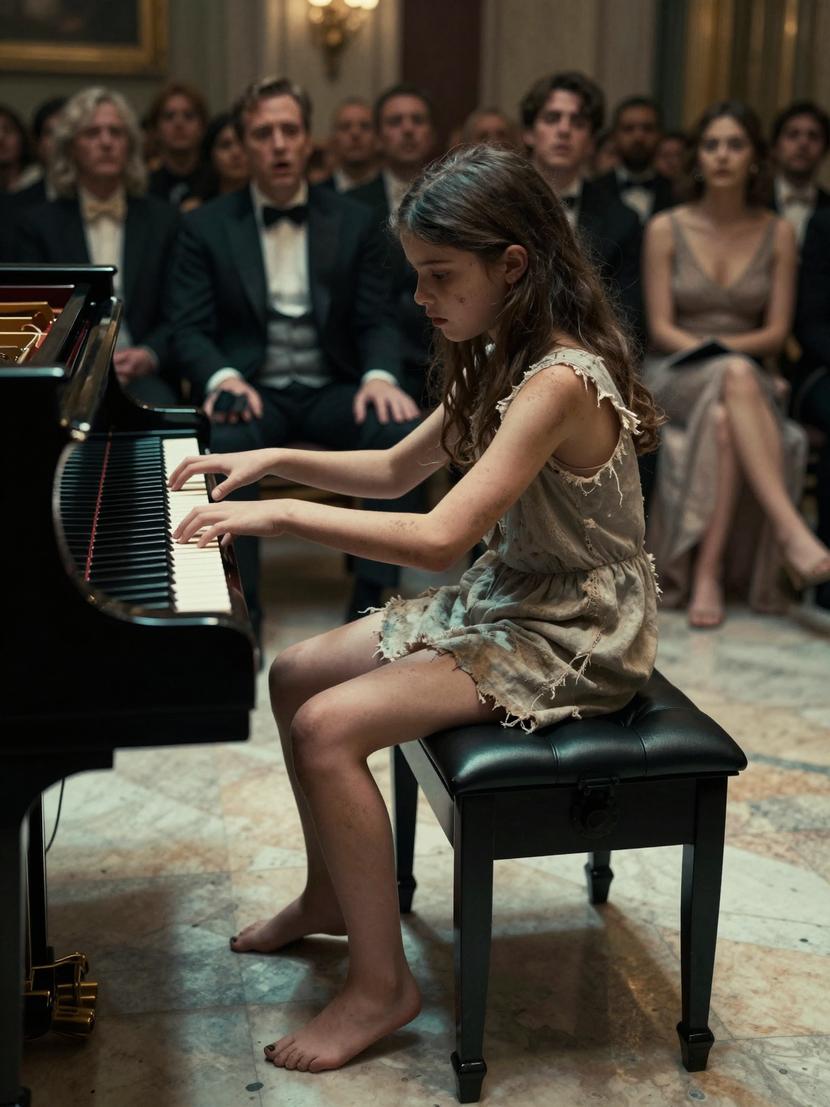
Under the blinding glare of a thousand crystal chandeliers, the annual Bridges for Bright Tomorrows gala dazzled San Remo in all its opulent glory. Inside The Grand Meridian’s grand ballroom, light fractured through champagne flutes like liquid diamonds, and designer gowns swirled across polished marble floors like living artworks. The air was thick with the intoxicating scent of wealth—an elixir of power, privilege, and a carefully staged generosity that dripped like honey but left a bitter aftertaste. Every smile was sculpted, every laugh calibrated, every charitable promise projected loud enough to reach the ears that mattered most.
At the heart of this glittering storm was Celeste Hart—philanthropy’s high priestess and queen of the night. Her magazine-perfect profile and cool, calculating smile masked eyes colder than the diamonds sparkling on her wrists. She drifted effortlessly from one elite donor to the next, regal in her tailored silk gowns, heirlooms dangling like trophies on her neck and fingers. Celeste didn’t merely host the gala; she owned it, her posture a silent command that the room belonged to her.
The string quartet breathed an elegant, haunting melody that seemed stitched from velvet and secrets. The murmurs of conversation were polished and shallow, punctuated by the faint but constant clink of crystal. Everything followed its meticulously choreographed script—until the moment shattered like glass.
From the shadows near the velvet ropes emerged a stark interruption, a contradiction pulsing visibly amid the luxury: a barefoot girl no older than twelve, slipping through the crowd untouched by the surface glamour. Her oversized, tattered hoodie bore the scars of repeated wear, patched with crude gray tape over split elbows. Worn, threadbare pants whispered tales of cold nights endured; her sneakers were frayed and clinging on. Sweat and street dust crusted her face, etching hunger into every sharp angle of her gaunt figure. Yet, beneath the grime, her eyes burned with a fierce, unyielding fire—raw, desperate, and tinged with something far stronger than mere survival.
Celeste was first to intercept her, her ice-cold smile freezing in place as she stepped forward, voice cutting through the room’s murmur like a scalpel. “You don’t belong here,” she said, voice smooth but razor-sharp, carrying the weight of unquestionable authority. “This is a private event, not a refuge. You’re trespassing.”
Her hand flicked just subtly, and two security guards—hulking men oozing boredom and entitlement—closed in like vultures summoned to clean a blemish from the tableau. Around them, cruel titters escaped polished lips, thinly veiled savagery masquerading as amusement. Cameras tilted upwards, phones slowly raised, poised to capture the spectacle of a child’s defiance being extinguished for social sport.
But the girl stood unmoving, a slight lift of her chin meeting the chandelier’s cold glow as if the light belonged to her alone. Her voice rang out, clear, unwavering, slicing through the murmurs without hesitation. “I came to play the piano,” she declared. “I’m going to play a song you’ll never forget.”
The guards tightened their grip, guiding her body toward the exit like a stray animal being dragged from a feast. Her taped sneakers scraped the marble floor in protest. Then, a voice cut through the mounting tension—not loud, but absolute in its calm command.
“Wait.”
Gabriel Reed rose from a table tucked close to the stage, and the room instantly recognized the rare gravity he carried without effort. A legendary concert pianist whose public appearances were events unto themselves, Gabriel’s hands had silenced auditoriums around the world. Now, his gaze settled on the unfolding scene with the sharper curiosity of one hearing a wrong note in an otherwise flawless symphony.
“Ms. Hart,” Gabriel said, voice low yet steady, a faint smile ghosting his lips. “Tonight is about ‘opportunity’—the kind we celebrate with speeches and label a mission.”
The crowd shifted uncomfortably; sudden awareness that cameras were watching turned polite applause into a fragile silence.
“Why not give her one chance?” he challenged, locking eyes with Celeste. “One plate. If she wastes our time, we escort her out—dignified and done. But if she’s worthy… then we live the truth we preach.”
Celeste’s eyes flickered, masking a fury born of image threatened and control slipping. This was a gamble her polished reputation could not afford to lose. She forced a brittle smile and gestured toward the stage where the majestic Steinway gleamed under the warm spotlight like a sanctuary awaiting its priestess.
“Of course,” she purred, voice sweet as venom. “The stage is yours, dear. Amaze us.”
Her mind raced ahead, scripting the inevitable spectacle: a clumsy child pounding out a crude melody, the crowd’s amused superiority, the night’s drama dissolving into gossip served lightly with morning coffee. No one dared ask the girl’s name, no one offered water or kindness. Phones flickered to life, waiting.
Still, the girl walked to the piano with quiet dignity, swallowed whole by the enormity of the stage and the glinting eyes fixed on her like predator and prey. She perched on the bench, her small legs dangling, barely able to nudge the pedals. Fingers, thin and smudged, hesitated a moment above the ivory—then fell with absolute certainty.
The first chord shattered silence—not a wobbly child’s attempt, but a confident, haunting strike. The second followed, delicate yet unyielding, and as the melody unfurled, the ballroom itself seemed to catch its breath. What poured from the grand piano was a tapestry of sorrow and light—a lullaby steeped in grief, the left hand dragging chains of loss, the right lifting fragile sparks of hope. It was ancient, too profound for a child, too raw to be feigned, seeping into the skin and rooting deep beneath.
Silent fascination smothered murmurs. Champagne glasses froze mid-air like delicate crystal caught in amber. A front-row guest’s tremble betrayed them, and a tumbler slipped, shattering on marble with a shock that echoed like thunder in the sacred hush.
Not once did the girl flinch; she played on, as if shards of broken glass were nothing compared to the heavy burden she bore.
At the ballroom’s center, Celeste stiffened, fingers lifting toward her throat, a pallor draining her carefully maintained façade. This music unearthed something rotten beneath her polished veneer. Across the room, Gabriel sprang to his feet, chair clattering behind him, eyes wide with raw, haunted recognition—an old wound torn open before its time.
The final note trembled in the air like a whispered accusation. The girl lifted her hands—no bow, no smile, no practiced gratitude for permission to simply exist—and stood, chest heaving, eyes aflame with a silent, unspeakable defiance. The oppressive quiet pressed against every rib.
Gabriel was first to step forward through the stunned crowd, his voice rough, raw with shock. “Where did you learn that lullaby?” he demanded, voice breaking not from anger but disbelief. “That composition was never published. It was… private.”
Her gaze locked onto Celeste, unwavering. When she spoke again, fury and sorrow cracked her youthful voice like thunder. “Do you recognize it, Ms. Hart?” she yelled, finger stabbing straight at the woman.
Celeste blinked rapidly, scrambling to reconstruct her false smile, voice shaking for the first time. “I don’t know what you mean,” she stammered. “It’s… just a tune anyone could play…”
Tears streaked through dirt on the girl’s cheeks, grief bursting through years of silent endurance. “THAT’S MY MOTHER’S LULLABY!” she screamed, words crashing through the room like a wrecking ball. “The last song she ever wrote! The one you stole after you fired her, after you evicted us from the apartment you rented, after you left us to rot on the streets!”
Pandemonium erupted. Reporters surged forward, cameras flashing like gunfire, chairs scraping as privileged guests morphed into eager spectators of scandal—the richest drama of them all. Celeste’s poise shattered, panic raw and exposed.
“Lies!” she shrieked, elegance dissolving into venomous rage. “Get her out! She’s a filthy charlatan! Her mother was an ungrateful nobody I helped!”
“Enough.”
Gabriel’s voice cut through the chaos like a judge’s gavel, commanding silence not by volume but by undeniable presence. He stepped between the girl and Celeste, a living shield.
He fixed Celeste with icy eyes. “Your ‘talent’?” he spat, scorn slashing through the room. “Her mother was Isabela Cruz, my most brilliant student—a composer whose genius terrified the mediocre. Isabela’s work made your so-called masterpieces look like mere exercises in copying.”
Turning to the cameras, to the reporters and donors who had for years applauded Celeste’s manufactured fame, he declared with lethal calm, “Those compositions that built your empire were not yours. They were Isabela’s. You are a thief.”
A wave of revulsion passed through the room, because stealing money was common enough, but stealing a soul—the wellspring of creativity—was a betrayal of a deeper order. Celeste’s face tightened; rage struggled with terror and loss of control.
Gabriel’s gaze softened as it shifted to the girl—recognition blooming beyond melody to the shape of her jaw, the stubborn set of her mouth, the fierce intelligence in her eyes. He moved closer, as if drawn by a force beyond him.
Kneeling by the stage’s edge, voice low and fragile, he whispered, “Your mother… where has she been? Why did she disappear?”
The girl’s shoulders trembled violently, grief spilling over as she choked back sobs. “She’s gone,” she whispered, voice small and raw. “Died two months ago. Pneumonia. We couldn’t afford medicine. We were living in a shelter on Iron Alley.”
Gabriel closed his eyes briefly, a single tear tracing a quiet confession down his cheek. When he opened them, his broken voice held iron resolve.
“Isabela Cruz was not just my student,” he told the stunned room, “she was the woman I was going to marry. She vanished from my life during my overseas tour. I thought she left me. I never knew she’d been silenced by cruelty.”
His hand rested on the girl’s shoulder with neither ceremony nor pretense—just truth anchored in touch. “And this child, dismissed and scorned by you tonight,” he continued, his gaze sweeping those who had jeered moments earlier, “is my daughter.”
The gilded regime crumbled amid gasps and shifting alliances. The radiant smiles around Celeste faltered; some guests edged away, unwilling to be tarnished by association. Hotel staff and security adjusted their stance—no longer protectors of the queen, but wary observers of a scandal.
Gabriel shed his tuxedo jacket and draped it over the girl’s frail shoulders, the fabric swallowing her small frame not as luxury, but as shield—protection from a world that had long refused to see her.
Then, fiercely, he embraced her, pressing his face into her tangled hair, as though holding her might prevent the erasure of his last link to the woman he loved and lost.
“Did you come here for food?” he murmured, voice breaking.
She clutched his collar, forehead pressed to his chest. Her answer was a whispered vow, heavy with a lifetime of hunger and cold. “Not just food,” she breathed. “I saw your name on the list at the library. I needed you to hear her song. To know who she was, what they stole from her. I promised I would make the truth impossible to ignore.”
Gabriel held her tighter, and in the midst of glittering luxury—where thousands had paid for the illusion of generosity—something fierce and unyielding bloomed: a raw testament not to charity, but to courage, survival, and the irresistible power of a stolen lullaby come home to haunt.


