
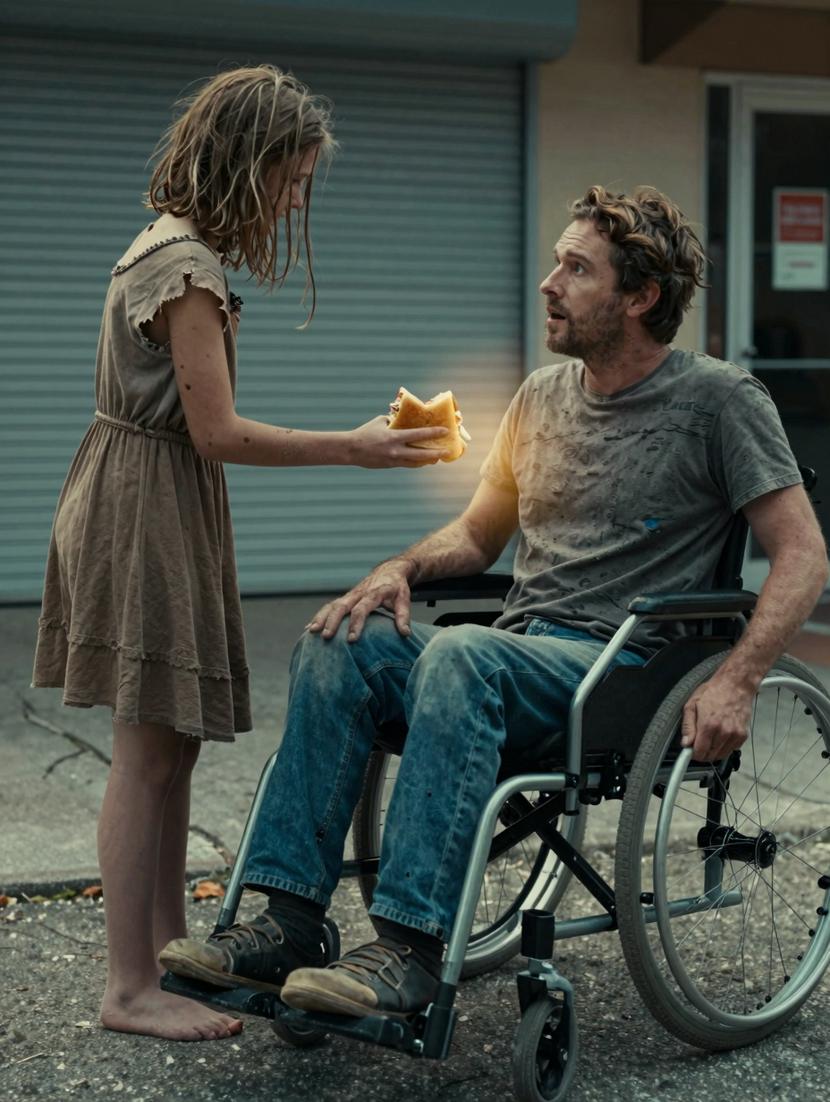
No one truly saw her at first glance.
She stood there—an enigmatic shadow—amid the bustling throngs of Westbridge’s crowded sidewalks. People flowed around her as if she were part of the city’s unseen backdrop, their gazes sliding past her fragile form. A torn, earth-toned dress hung loosely off one shoulder, its fabric whispering stories of neglect. Her bare feet, smeared with dust and pavement grime, pressed lightly on the cracked concrete. Strands of tangled hair veiled her face, dark eyes barely visible as they searched the crowd. She could not have been older than thirteen.
Her slow steps brought her to a man parked by the curb. He was confined to a wheelchair, his face worn beyond his twenty-nine years—a man marked by life’s relentless toll. This was Daniel Mercer, stationed outside a shuttered deli on East Alder Street. Leaning against the spokes of his wheelchair was a cardboard sign, simple and haunting in its plea:
“Disabled. Anything helps.”
Daniel had grown accustomed to invisibility—no one met his eyes anymore. Coins clattered occasionally; scraps of food, even less often. Words, kindness—they were extinct in this part of his world.
Then, she spoke. Her voice was a fragile thread against the city’s roar.
“If you give me food,” she whispered, “I can make your legs move again.”
Daniel blinked, startled. Jolted from years of silence, he stared up at her. There was no wild desperation in her gaze, no pleading. Instead, her eyes held a calm certainty, like a quiet promise.
“Really?” he rasped, disbelief coloring his tone. “You can do that?”
Her lips curved softly—not quite a smile, but an unspoken knowing.
Daniel let out a bitter laugh, rough and hollow. “Kid, doctors tried. They said I’m done for.”
She cocked her head slightly. “Maybe they weren’t listening.”
An eerie stillness settled between them. A sudden chill snaked up Daniel’s spine, despite the sun’s warm embrace.
He reached into his worn bag, fingers trembling as he pulled out half a turkey sandwich—his only nourishment for the day. Hesitating, yet drawn by a flicker of hope, he held it out.
The girl accepted it with reverence, her small, dust-streaked hand trembling as if the food were a sacred gift.
“Sit up straight,” she commanded gently.
Daniel frowned, confusion knitting his brow. “Why?”
“Please,” she urged softly.
Ignoring the knot of doubt in his stomach, he straightened.
Her hand pressed lightly onto his knee, rough and cold.
Then—pain exploded through his legs, sharp and electric.
“Hey—what are you doing?” he cried, gripping the wheelchair wheels desperately.
She leaned closer, lips moving in a whisper swallowed by the city’s chaos.
Suddenly, the searing pain dissolved.
Daniel froze.
For the first time in six long years, warmth — real warmth — flowed through his numb limbs. Not an ache, not a phantom phantom sensation, but life.
His breath caught in his throat. “I…I felt something.”
The girl stepped back, already turning toward the crowd.
“I’ll come back tonight,” she said over her shoulder. “If you want to walk.”
Before he could say more, she vanished like a mirage.
Daniel sat trembling, heart hammering in his chest.
Was this hunger playing tricks? An ember of hope flaring wildly? Or had the impossible simply touched his broken world?
That night, in the dim silence of his cramped studio apartment, he lay awake, rain tapping a restless rhythm against the windowpane. Doctors had condemned him to a wheelchair after the devastating freeway crash that shattered his spine. “Permanent,” they said. “Accept it.”
He had.
Until today.
At exactly 9:47 p.m., a timid knock echoed through his room.
His heart leaped—visitors were a rarity.
He rolled to the door and pulled it open.
There she stood—dry despite the rain’s cold tears. Same ragged dress. Same knowing eyes.
“You came,” he breathed.
“You fed me,” she replied simply. “That means something.”
She stepped inside, gazing around the sparse room. No TV, no warmth—just a thin mattress on the floor.
“You lost more than your legs,” she said softly.
Daniel swallowed hard. “Who are you?”
She said nothing. Instead, she knelt before him, hands settling gently on his knees.
“Stand,” she said, voice steady, commanding.
A bitter laugh escaped him. “I can’t.”
“You can. You’re just scared.”
Dread crashed over him—the fear of falling, of failing, of hoping and breaking again.
But then, life pulsed through his limbs once more—not sharp pain, but a vivid, living fire.
His toes twitched, calves flexed.
His eyes flew open. “Oh my God.”
“Now,” she urged, voice unwavering, “Stand.”
With a desperate cry, Daniel pushed against the wheelchair’s arms. His legs quivered, weak and uncertain.
Then, slowly, they held him up.
He stood.
For three precious seconds.
Then, he collapsed onto his knees, sobbing. Tears mingled with laughter as his hands trembled, tracing the limbs that might vanish like a dream.
When he looked up, she was retreating toward the door.
“Wait!” he called out, voice breaking. “Don’t go. Please. Who are you?”
She paused.
“My name doesn’t matter,” she said softly. “What you do next—does.”
And then she was gone.
By morning, Daniel walked.
Not far. Not steady. But enough.
Doctors called it a miracle. Reporters shouted unexplainable. Social media burned with fascination.
Yet Daniel knew the truth.
He searched every corner of Westbridge for her.
Days faded into weeks.
No one had ever seen the girl.
Until one quiet night at the public library, he discovered a yellowed newspaper clipping:
“LOCAL GIRL, 13, DIES SAVING CHILD IN HIT-AND-RUN.”
His breath caught cold as he stared at the photo.
Same eyes.
Same quiet smile.
Same torn dress.
She had perished two years before his accident.
Daniel sank back, the weight in his chest unbearable.
Then he read the last line aloud, voice trembling:
“Witnesses say the girl whispered something before she died.”
He closed his eyes.
And suddenly, the whisper echoed in his heart.
“You’re not done yet.”
Folding the paper calmly, Daniel rose — stronger, steadier than before.
Outside, the city roared on, indifferent and alive.
But deep inside, he knew — somewhere in this restless world, a barefoot girl smiled.
And walked beside him.


