
Ethan Parker trudged through the front door one weary evening, the weight of a ruthless day at the office etched deep into his shoulders. Failed product launches, investors withdrawing their support, relentless meetings that left him drained—he just craved the deafening silence that had blanketed his home for eight long months. But then, something pierced that silence. Laughter. Genuine, vibrant laughter. His sons—Luke, Noah, and Eli—three little souls who hadn’t known that sound since Elise, their mother, had passed.
Frozen in place, Ethan followed the joyful echoes to the sunroom, where what he saw shattered the cold armor he’d wrapped around himself. Lena Harrington, the maid his mother-in-law Margaret had hired, was kneeling on the floor. His sons were perched on her back, their faces lit with pure, radiant delight. Eli grasped a rope looped around Lena’s neck like reins, and she tossed her head back in an uninhibited laugh that mingled with theirs—a sound so free, it was as if the sun had burst through the long-held storm.
Breath caught, Ethan watched as the boys—specters of their former selves—came alive again, playing, laughing, rediscovering the innocence that grief had tried to steal. And it wasn’t him who’d ignited this spark; it was her.
A storm of relief, gratitude, and shame swelled within him. Lena glanced up; a flicker of fear crossed her face. The laughter ceased. The boys slipped down from her back, instinctively huddling together as if guarding a fragile miracle. Ethan nodded silently, unable to capture his emotions in words, then turned away before the tears overwhelmed him.
He struggled to comprehend it. Could he really feel such deep gratitude toward someone hired to clean and care? But the sound of his sons laughing—he realized—was a treasure he’d lost and never known how much he needed. He had tried everything: therapy, psychologists, routines, toys, books on grief. The boys had vanished inside themselves. And then Lena arrived. She didn’t flee from their sorrow; she stepped into it head-on. Somehow, she breathed life back into their world.
The next morning, Ethan descended the stairs early—not for work, but to find Lena. She stood softly in the kitchen, preparing breakfast with quiet, steady hands. The boys, still in pajamas, bounded in.
‘Lena, can we play horse like yesterday?’ Eli asked, eyes bright.
Ethan’s heart clenched. He should have said no, should have stopped them from growing attached. But he didn’t.
From that moment, tiny but precious moments unfurled. Luke shared a dream; Noah fired questions about dinosaurs; Eli nestled close. Lena listened deeply. She loved these boys unreservedly, and they mirrored that love effortlessly.
Ethan found himself coming home earlier, skipping meetings, conjuring excuses—anything to be near the laughter that once seemed lost forever. Lena never performed; she loved his sons naturally, her care as effortless as breathing.
The house still bore Elise’s presence—her paintings, her coffee mug, her grocery list scattered with her handwriting. Ethan preserved every trace. At night, he wandered the shadowed halls, sometimes pausing at their bedroom door but retreating to the office to find sleep.
One late evening, he discovered Lena nestled in the library’s soft lamplight, engrossed in a book.
‘What are you reading?’ he asked softly.
‘Beloved, by Toni Morrison,’ she replied without looking up.
‘Heavy reading for bedtime,’ he remarked.
‘Heavy thoughts need heavy books,’ she answered simply. Ethan almost smiled.
Their conversation drifted to Elise, to the tender memories the boys clung to—the flower scent she wore, her off-key songs, dessert-first Tuesdays. Tears blurred his vision. ‘Thank you,’ he whispered. ‘For keeping her alive in them.’
Lena closed her book, rising quietly. ‘Good night, Ethan.’
Her presence warmed the coldness in his soul. She wasn’t only healing the boys—she might be saving him too.
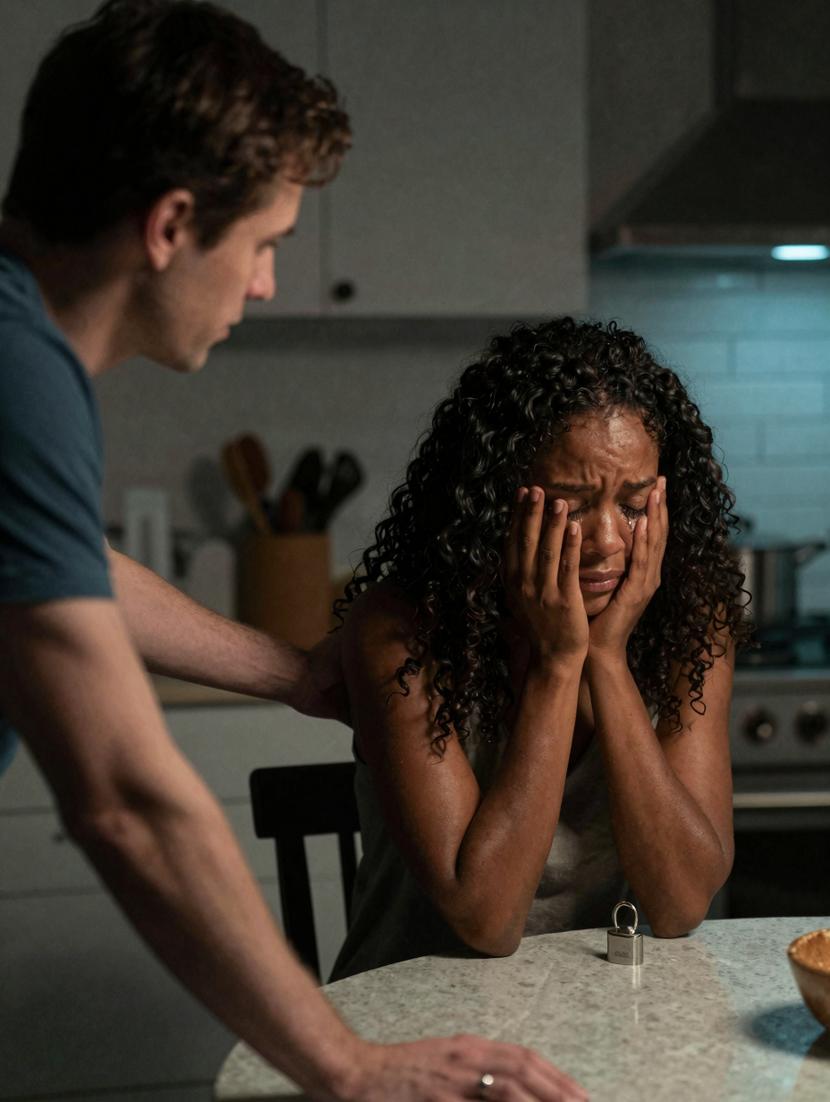
Three weeks later, Ethan arrived home around 8 p.m. The boys were asleep, but from the kitchen came soft, trembling sobs. Lena sat alone, clutching a silver locket.
He approached gently.
‘I’m sorry,’ she whispered, voice cracking.
‘Who’s in the locket?’ he asked, voice low.
Frozen, she breathed, almost inaudible, ‘Grace. My daughter. She died two years ago. Leukemia. She was just three.’
The room held the weight of her grief like thick smoke. Ethan felt a fissure open within him. She opened the locket wider, revealing a tiny photo—a bright-eyed little girl with gap-toothed grin, holding a dandelion.
‘My husband blamed me,’ Lena whispered. ‘Said I should have noticed earlier… pushed doctors harder.’
Ethan said nothing, only sat beside her, absorbing the quiet devastation. Grief, he realized, hid in silent corners, sometimes beneath the strongest faces.
He knew he should have done more to save her. Their marriage crumbled. Ethan inherited all tangible memories: pictures, toys, clothes. But this locket was all Lena had left.
Choked by emotion, he struggled to speak.
‘I became a nanny because…’ Lena’s voice broke utterly, ‘Because I couldn’t live in a world without children’s laughter. It’s the only thing that makes the silence bearable. When I heard about your boys, how much they’d lost… I thought maybe I could help them, in ways I couldn’t help my own daughter.’
Tears streamed down her cheeks. ‘I know it’s unprofessional. I shouldn’t—’
‘You’re not just helping them heal,’ Ethan interrupted, voice hoarse. ‘You’re healing yourself.’
She shook her head. ‘I don’t think I’ll ever heal.’
‘Maybe not,’ Ethan said softly. ‘But loving my sons—it’s keeping you alive, the same way you’re keeping them alive.’ He reached out, covering her trembling hand.
Together, in the quiet, two broken souls clung to each other against the dark.
‘Does it get easier?’ she asked.
He pictured Elise, their empty bed. ‘No,’ he admitted. ‘But the pain… it changes. It becomes a part of you—less absence, more presence.’
Lena pressed the locket to her heart.
‘Thank you,’ she whispered. ‘For not turning away.’
‘And thank you,’ Ethan replied, ‘for showing up.’
Their bond shifted from employer and employee to something raw, fragile, real.
Mother’s Day loomed—a specter Ethan had tried to outrun. Last year, Elise had been alive to cherish the boys’ crayon-smeared cards and sticky handprints. This year, the fridge was empty. He braced merely to endure.
But then he heard voices from the playroom. Lena, seated among sheets of construction paper and crayons, was making cards with Luke, Noah, and Eli.
Eli beamed, holding up his drawing: a dark-skinned stick figure surrounded by hearts. ‘For Lena,’ he declared. Ethan’s chest tightened.
Luke’s card read, ‘I love you, Lena,’ three stick figures holding her hands.
A twist of sorrow and relief wrapped his heart. Lena looked up, pale. ‘I didn’t ask them to do this,’ she stammered. ‘We should be making cards for their mother.’
‘Yes,’ Ethan agreed tightly.
Noah held up another card adorned with angel wings and flowers. ‘We miss you, Mommy.’
Air fled Ethan’s lungs. They hadn’t forgotten Elise—they’d made space for someone new.
Eli tugged Ethan’s sleeve. ‘Can Lena come with us when we visit Mommy?’
He looked to Lena, who quietly shook her head. ‘No… it’s private. For your family.’
‘You are family,’ Eli insisted simply.
Those words hung heavy. Taking Lena to Elise’s grave felt sacred, yet when Ethan glimpsed his sons’ hopeful eyes, he heard himself say, ‘She can.’
Lena’s eyes widened. ‘Are you sure?’
‘Yes.’
An hour later, standing side by side at Elise’s grave, the boys laid their angel cards gently on the headstone. Stepping back, Eli reached for Lena’s hand, pulling her near.
‘Tell Mommy you’re nice,’ he whispered.
Kneeling with tears streaming, Lena murmured, ‘I hope you don’t mind that I love them. I’m not trying to replace you. I just… couldn’t help it.’
Rick whispered to the stone, ‘Mommy, Lena makes good pancakes. She plays with us. She doesn’t get sad when we talk about you.’
Ethan’s throat tightened. He’d been the one withdrawing, making them feel love for someone else was betrayal.
They shared a glance—understanding, forgiveness, and the permission to live on.
Two months later at the Willow Creek Country Club charity gala, Ethan found himself reluctantly present. Margaret had insisted, ‘You can’t hide forever, Ethan. People want to see you.’
Familiar faces offered polite smiles, distant and uncertain. Derek Wells, a fellow CEO, approached with his wife, Melanie.
‘Ethan, good to see you out,’ Derek said, shaking his hand. ‘How are the boys?’
‘Better,’ Ethan replied, ‘much better.’
Melanie fixed a sharp smile. ‘I hear you found wonderful help. What’s her name again?’
‘Lena Harrington,’ he answered cautiously.
Melanie’s tone dripped with false sweetness. ‘Quite devoted, I hear. Excellent at her job. Some say unusually involved for household staff.’
Ethan’s jaw clenched.
‘I’m not sure what you’re implying,’ he said.
‘Nothing,’ Melanie said, touching his arm. ‘Just that people talk. You were spotted last week at the farmers market—the boys holding her hands, you pushing the cart. Very domestic. A young widower with three impressionable children…’
Derek cleared his throat. ‘What Melanie means is maybe consider the optics. For the boys’ sake.’
Ethan’s voice turned icy. ‘The boys are happy for the first time in eight months. That’s the only optic I care about.’ He walked away, hands trembling.
But the whispers accelerated. Blind items in social columns hinted: ‘Which widowed tech titan is getting too comfortable with the help?’ Photos circulated online showed Lena laughing with the boys at the park, captions branding her ‘Nanny.’
Then came the call from Crescent Ridge Academy. The head’s voice was apologetic yet firm.
‘Given recent attention and sensitive concerns, perhaps it’s best the boys start next semester.’
Clenching the phone, Ethan felt the blow—not at the school’s decision—but at what it meant. Lena would hear the gossip, see the posts, and blame herself. She’d leave.
He raced home, mind spinning, and found her packing in the guest cottage. The door stood open. Clothing folded and stacked mechanically, trembling hands betraying calm.
He froze.
‘I can’t stay,’ she said quietly. ‘I’ve become the problem. Don’t—’
Ethan’s voice was rough, desperate. ‘Lena…’
She looked up, eyes red-rimmed. ‘Your sons were rejected because of me, because of gossip, because of people who don’t matter.’
‘They matter to Luke, Noah, and Eli,’ Ethan said.
Her voice cracked. ‘They’ll grow up hearing whispers. Punished for my being here.’
‘Your place?’ Ethan stepped forward. ‘Your place is with my sons.’
She shook her head, tears dripping onto the shirts in her hands. ‘I’m the maid. That’s all I was supposed to be.’
‘You stopped being maid the moment my sons started laughing again.’
Fierce sorrow flashed in her eyes. ‘Then what am I? What am I supposed to be? To you?’
Words stuck in his throat.
‘You can’t even say it,’ she spat bitterly. ‘Because the truth is… I’m Black. Young. Staff. People always assume. My staying will punish your sons.’
‘Let them assume. I don’t care. You should care.’
‘They deserve better. Better than scandal. Better than… someone who loves them, the one who made this house feel like home again.’
Silence crackled between them. She slumped on the bed edge.
‘When Grace died,’ she whispered, ‘I vowed never to love another child. Losing her almost broke me. But your boys… I couldn’t help it. And now I have to leave before loving them destroys me.’
Heart pounding, Ethan knelt beside her. ‘What if you didn’t have to leave? If I told the truth? Declared publicly you’re not just staff?’
Her eyes searched his face. ‘What truth?’
‘That you’re essential. My children need you. I need you too. Not as maid, not as nanny. As someone who understands grief, who sits in the dark with me when sleep won’t come. Someone who brought light back to a dying home.’
‘I’m not Elise,’ she whispered. ‘I’ll never be.’
‘I know. And I’m not asking you to be. I’m asking you to stay because I can’t breathe imagining this house without you.’
She covered her face, sobbing. He stayed, terrified.
Finally, she looked up. ‘If I stay, I won’t hide. I won’t pretend to be less than I am.’
‘Then don’t,’ Ethan breathed.
‘Your world won’t accept me.’
‘Then my world must change.’
Something in her eyes softened. ‘I’ll stay. But not as your employee. As myself. All of me. I wouldn’t want it any other way.’
They stood—two broken souls discovering fragile hope amid the wreckage.
Weeks later, Ethan faced a Metro Business Ledger interview. PR points ready: cloud infrastructure, market expansion—safe terrain. When Clara Nguyen, the reporter, asked about his personal life’s recent public scrutiny, old Ethan would have smiled away.
But he thought of Lena packing her suitcase. The boys’ fearful faces. Luke’s whispered words at Elise’s grave.
‘Yes,’ he said firmly. ‘I’d like to comment.’
Clara’s brow arched.
‘Lena Harrington is why my sons live in ways that matter. After their mother’s death, they retreated into silence and shadows. Specialists, therapists—nothing worked. Then Lena arrived. She didn’t try to fix them; she loved them. Played horse on the floor, read stories, sat through nightmares. She gave them space to heal.’
‘Some suggest the relationship is improper,’ Clara said cautiously.
Ethan’s jaw hardened. ‘Some see a young Black woman caring for three white children and assume things that aren’t true. That is not the truth. If they can’t see that, they don’t deserve to determine what my children need to thrive.’
Lena, clutching an envelope, tears trembling in her eyes, whispered, ‘I don’t know what to say.’
‘Then don’t,’ he said softly, stepping closer. ‘Just stay. Be here with us.’
Tears spilled freely. ‘No one ever saw me like this. Not just nanny. Not staff. Someone who matters.’
‘You’ve always mattered,’ Ethan said. ‘To my sons. To me. Now, officially, you will. No whispers, no hiding. Just us—together—in the light.’
Lena laughed—a sound soaked in relief and disbelief that struck Ethan’s chest like a prayer. She stepped into his arms.
‘I don’t know if I’ll ever thank you enough.’
‘Then don’t,’ he whispered, lifting her chin. ‘Just stay. Be here.’
In the golden garden light, among Elise’s beloved peonies, they stood as two shattered hearts finding wholeness, a family reborn not from forgetting, but from courage, love, and laughter.
Fingers intertwined, Ethan whispered, ‘This is just the beginning.’
Lena smiled through tears. ‘Then let’s make it count.’
For the first time in months, laughter filled the house—boys and two adults—echoing with hope and a future worth holding onto.
As Lena reached for his hand, Ethan felt something beyond grief: hope. Six months later, the Hope and Elise Foundation opened, sheltering families shattered by cancer and hardship.
The once-empty east wing brimmed with life—tears, laughter, survival.
At the dedication, amidst donors and reporters, Ethan’s prepared speech lay untouched. Instead, he saw Lena at the back, standing with Luke, Noah, and Eli, their smiles radiant and whole.
He began, voice breaking, ‘I founded my company believing every problem could be solved. But then I lost my wife and learned some things aren’t fixed—only survived. We were drowning in a house filled with everything except what we needed most.’
His gaze found Lena.
‘Then someone came, who taught me healing isn’t fixing; it’s presence, love without expectation. This foundation exists because two women showed that unbearable loss can be met with unbearable love.’
He motioned for her to join him. Reluctant but encouraged by the boys, Lena approached the stage trembling.
Ethan held an envelope. ‘This makes you co-director and legal co-guardian of my children.’
Her knees nearly buckled. ‘You already are,’ he added softly. ‘This just makes it official.’
The boys rushed forward, wrapping her in warm embraces. Tears streaming, she knelt, and the crowd’s applause washed over them, but Ethan’s focus was the family they’d become.
Later, in the garden, watching the boys run among the flowers planted months ago, Lena whispered, ‘Thank you.’
‘For what? Staying, fighting, making beauty from pain?’ Ethan asked.
He truly saw her—the woman who came into shards of his life and refused to turn away.
‘I think God sent you,’ he said quietly.
Surprised, Lena looked at him.
‘I was furious at Him for taking Elise, for leaving me with three boys I couldn’t reach. But then you arrived. Maybe He didn’t abandon us—maybe He sent help in a form I never expected.’
Fresh tears traced Lena’s cheeks.
Eli bounded over, laughing breathlessly. ‘Papa, Mama Lena, come play!’
That name no longer stung—it felt right.
Ethan pulled Lena to her feet, joining their joyful chase beneath a sun setting over a garden where love refused to die.
In that moment, he understood: love does not end with loss—it transforms.
Elise taught him to love fully. Lena taught him to love again. And his sons taught him healing is possible even when impossible.
Their home, once a tomb, thrummed with life—not because grief vanished, but because they carried it together, finding light in the darkness.
Lena caught his eye, her smile real and hopeful—no longer reserved or professional.
Ethan smiled back, finally living instead of merely surviving.
Sometimes, when everything falls apart, life pieces itself back—not to erase loss, but to reveal that love surpasses grief, presence conquers perfection, and family is who stays when darkness threatens to consume.
He reached for Lena’s hand. ‘This,’ he whispered, ‘is our beginning.’
‘Then let’s make every moment count,’ she smiled through tears.
And in that home once silenced by sorrow, laughter blossomed anew—from the boys, and from the two of them—filling every shadow with hope, love, and the promise of tomorrow.


