
The courtroom air was suffocating, thick as summer humidity, pressing down on every soul present. It wasn’t a calm silence—it was the kind that made your heartbeat pound as if it might rupture your chest. My eight-year-old son, Elias, sat mere feet away, his small legs swinging anxiously from the edge of the polished wooden bench. He looked fragile, swallowed whole by the grand, sterile room.
Across the aisle stood my ex-husband, Adrian, as imposing and self-assured as ever. Flanked by his sleek lawyer, he wore that all-too-familiar smug smile—a mask of confidence that never quite reached his calculating eyes. Without sparing a glance at Elias or me, he stared straight ahead, putting on the act of the devoted father for the judge’s benefit.
The judge, a man with weary eyes framed by a neatly trimmed gray beard, pushed his glasses up the bridge of his nose. He rifled through a stack of thick documents before locking eyes on Adrian. “Mr. Carter,” his voice was a low, measured rumble. “You petition this court for a change in custody, asserting that your son has expressed a desire to live with you permanently. Is that the claim?”
Adrian’s voice was smooth, practiced, like silk draped over steel. “Yes, Your Honor. Elias has confided that he feels uncomfortable with his current living arrangement.”
A cold pit opened in my stomach—an unyielding frost of betrayal. A lie, tailor-made to pierce me. My gaze fell on Elias, my sweet boy burdened beyond his years, and I saw the invisible weight crushing his small shoulders. His eyes refused to meet mine.
The judge softened, directing a gentler tone to Elias. “Elias, your father says you want to live with him full-time. Is that true?”
The entire courtroom held its breath—the moment of impossible choice for a child caught between two worlds. I wanted to scream, to shatter the sterile air, to protect him from this cruel verdict of the lips. But I was frozen, powerless—only able to watch.
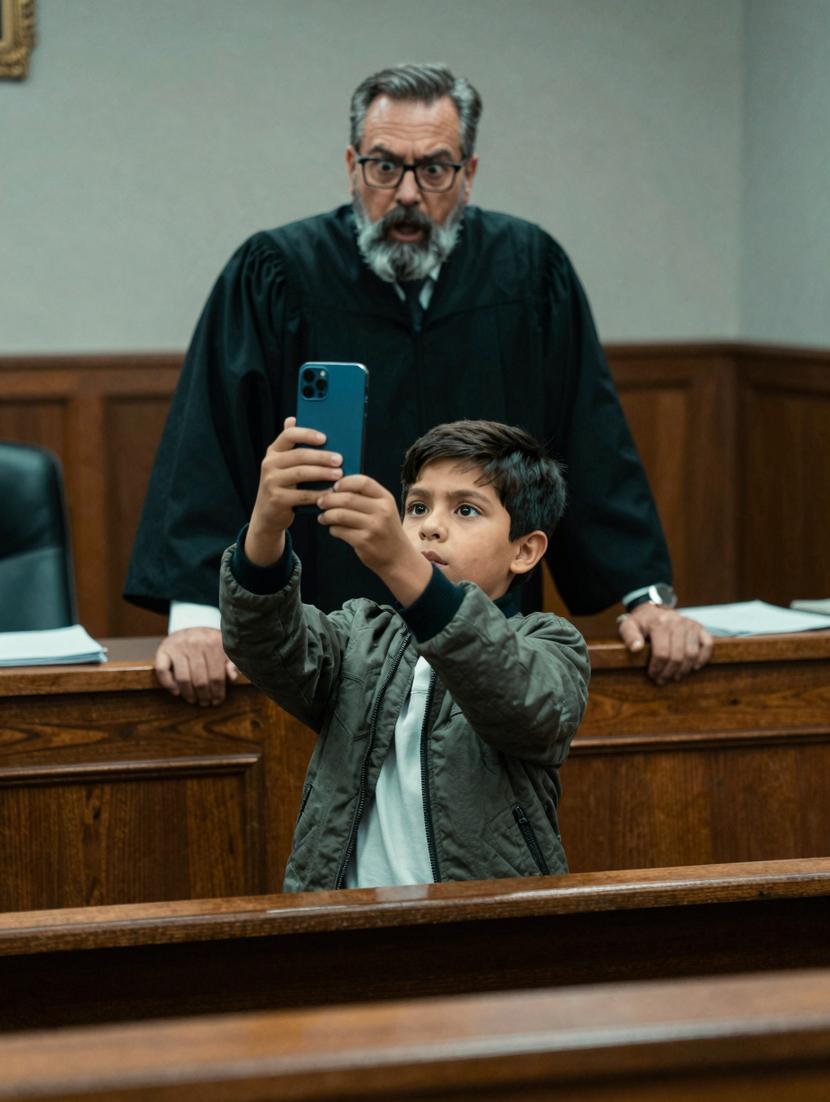
Elias didn’t answer immediately. Instead, he slid silently from the bench and stood, gripping something hidden deep in the pocket of his jacket. His eyes locked not on Adrian, but on the judge.
“Your Honor,” he said, a small voice clear and steady as a bell’s toll, “may I play a recording from last night?”
Shock rippled through the courtroom. The judge, anticipating a simple affirmation, froze in place. Adrian’s smug expression evaporated, replaced by a flicker of stark panic.
In that instant, with his worn and slightly cracked phone held aloft, Elias seized control of the room.
Adrian and I had been separate for three years. The man who dazzled the world with charm and success was a different tempest behind closed doors—volatile moods, sudden tempests of anger ignited by the littlest provocations: a dropped toy, a spilled sip. When I summoned the courage to leave, it was to save Elias—to give him a sanctuary of peace instead of fear.
For a while, survival was possible. I juggled two jobs; my mother, Marisol, was my unwavering rock—caring for Elias, helping with homework, ensuring he never felt unloved. Adrian’s visits were fraught, but bearable. He appeared in his luxury SUV, designer-clad, bearing expensive toys to win his son’s heart—an opulent contrast to our humble home. Each scornful glance, every cutting remark about my modest apartment or hand-me-down car, was his weapon against me.
Then, six months before this day, everything shifted. Adrian enlisted a high-powered attorney and filed for full custody, casting me as an overwhelmed, incapable single mother. His legal team painted a glittering future—his financial success, his new wife—all structured as the ideal environment Elias deserved.
The breaking point came a week before this hearing. Elias accidentally spilled juice on the carpet. A minor mishap, but Adrian’s fury soared. Voices thundered through the thin walls. When I confronted the storm, I found Elias pressed trembling against a wall as Adrian yelled mere inches from his face. At that moment, I realized this wasn’t custody—this was control, an all-consuming battle to dominate no matter the cost.
The weekend before the hearing was torture. Elias returned subdued, quiet, clutching an expensive new backpack unopened. He retreated to his room for hours, eyes fixed on the distant windowpane. The weight of his silence bore down; stomachaches became frequent.
That night, long after I thought he’d fallen asleep, soft crying whispered from his room. Outside the door, I listened. He was speaking to his beloved stuffed bear, Patches.
“He said I have to lie,” Elias’s voice cracked with tears. “He said if I don’t tell the judge I want to live with him, he’ll… he’ll make Mommy go away.”
My heart shattered into a thousand fragments. Adrian’s fight was a weapon—poisoning our son with fear, turning love into coercion. I longed to burst inside, to hug Elias and promise safety, but I knew more words might terrify him further. He was protecting me in his own fragile way.
The next day, pale and quiet as he prepared for the last visit before court, Elias asked softly, “Mommy, can I take your old phone? The one with the games?”
I hesitated, then nodded, believing it a simple comfort. I had no inkling he was arming himself emotionally for the battle ahead.
Back in the courtroom, silence stretched taut as the bailiff delivered the phone to the judge. Adrian’s lawyer jumped to her feet. “Objection, Your Honor! This is improper; we cannot know the contents of that device.”
The judge raised a hand, stilling her protests. He looked at Elias, then to Adrian, whose face had grown pale and rigid with fury. “I will hear it,” the judge declared, final and unyielding.
He pressed play.
The courtroom filled with the harsh sound of Adrian’s voice—not the polished public facade, but a cruel, threatening whisper filled with menace.
“It’s simple, Elias,” the recording began. “When the judge asks, you say, ‘I want to live with my dad.’ Look sad. Make them pity you.”
Elias’s trembling voice responded, “But I don’t want to leave Mommy.”
“Not about what you want!” Adrian’s volume rose, corralling fear. “It’s about what’s right for the family. Your mother can’t provide—only I can. But you owe me this one favor. If you don’t, I can’t promise what will happen. People who upset me… they disappear. Understand?”
The recording faded. The silence that followed was suffocating.
The judge removed his glasses, rubbing tired eyes, then gazed at Adrian with raw contempt. No longer a figure of authority, but a man confronting betrayal.
Adrian stood frozen, his confident facade shattered by the undeniable trap.
His voice when he spoke was low and commanding, reverberating through the hushed room. “Mr. Carter, in all my years on this bench, I have rarely witnessed such a blatant, cruel manipulation of a child. You have failed not only as a father but as a human being.”
He raised his gavel. “Custody is awarded in full to the mother, effective immediately. Mr. Carter’s visitation rights are suspended pending a comprehensive psychological evaluation and completion of a court-ordered parenting program. Court is adjourned.”
The gavel struck with finality—it was over.
As the crowd began to disperse, I sat rooted, unable to move. Elias finally looked up, his eyes wide and glistening. A single tear traced down his cheek. Pulling him close, I buried my face in his hair, and I wept—tears not of sorrow, but of fierce relief and pride that burned deep in my soul.
Hand in hand, we stepped out of the courthouse, leaving behind shadows and into the brilliant clarity of a new dawn. We were free. Together, we had triumphed.


