
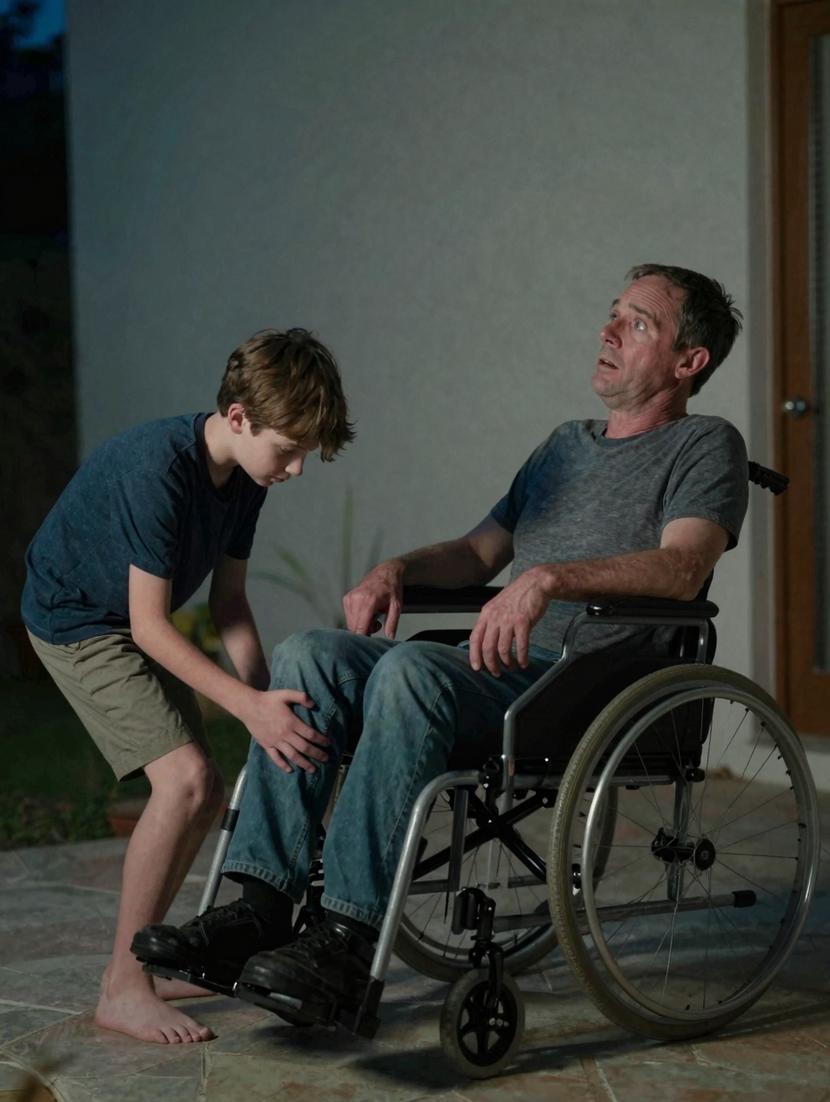
The late evening air on the patio thickened suddenly, the kind of heavy silence that doesn’t politely fade but presses like a weight against your ribs. Barefoot and vulnerable, the boy hovered on the edge of something impossible—his fingers inches from the knee of the man in the wheelchair, where a forgotten injury had shadowed the past like a ghost. The old medical journal had been clear: the damage was overlooked there.
Julian Mercer, reclining in his wheelchair, flashed a faint, knowing smile. “Fifteen seconds,” he declared, voice cutting sharply through the hushed crowd. “After that, I’m calling the police.”
Phones lifted like a silent wave, whispers carrying the thrill of a story about to break across the globe.
The boy closed his eyes, took a breath, and pressed.
A piercing scream shattered the stillness of the night.
‘Get your hands off me!’ Julian yelled, fury laced with fear.
Then everything stopped.
Breath caught, face drained of all color, Julian sat frozen in disbelief. No shudder of pain, no sudden movement—only a quiet, electric sensation that had long been buried. Eleven years of numbness shattered in a heartbeat.
“That’s… not possible,” he whispered in awe.
The boy stepped back, steady in command. “Try again,” he said calmly.
Laughter rippled uncertainly through the crowd before fading, replaced by stunned silence. For the first time, Julian’s fingers trembled.
—
Eleven years ago, Julian Mercer had received the verdict no one wants to hear. After the accident—the spinal injury—that white room, those faces that held no understanding of life beyond prognosis, had told him he would never walk again.
What Julian never learned was that ‘unlikely to recover’ is not ‘impossible.’ Yet, in courtroom settlements and hushed agreements, “unlikely” sold far less paper than “never,” and “never” silenced questions.
—
Gripping the wheelchair arms like a lifeline, Julian whispered, “I can’t.”
The boy met his gaze with steady calm, no glimmer of triumph or terror. “Yes, you can.”
With trembling resolve, Julian forced strength into limbs long abandoned. Legs shaky, fragile—but responsive.
He stood.
Not with grace, not with balance, but standing nonetheless.
The check slipped from his fingers, forgotten.
There was no triumphant cheer. The crowd simply parted, as if witnessing something sacred and fragile.
—
The police arrived—an uninvited consequence, not for the boy’s daring, but because the questions now demanded answers. Old doctors were named, medical records summoned from dusty files, the past pried open.
One officer knelt before the boy, voice soft yet probing, “What’s your name?”
The boy hesitated, aware that names leave trails, expose secrets.
“No,” Julian said suddenly, stepping forward with fierce protectiveness. “He stays with me.”
“Protecting him?” the officer asked.
Julian swallowed, the truth tightening in his throat.
“No,” he said, voice cracked with truth. “I’m afraid of losing him.”
—
That night, the veil lifted. Julian finally saw who the boy was—no miracle, no magic.
He was a living archive: a photographic memory, an extraordinary mind forged by tragedy. His mother had died quietly during a clinical trial that vanished without a trace—the very trial sponsored by the company Julian had invested in, the very system that had made him wealthy and erased the boy from existence.
Julian, once certain he was the victim, now understood the painful truth.
He was not a victim.
He was a beneficiary.
—
“I’ll give you everything,” Julian promised, the weight of his guilt wrapped in desperate generosity. “Money. A home. A name.”
The boy looked up, eyes shining with something deeper than need.
“I don’t want your money.”
“Then what do you want?” Julian asked, his voice cracking.
A smile—a fragile but powerful thing—crossed the boy’s face.
“The truth.”
—
The downfall was quiet but inexorable.
Reports leaked, lawsuits followed, careers unraveled without fanfare.
Years later, a reporter asked the boy, now a man, why he had risked everything.
He answered with calm certainty, “They laughed at me. They believed their money made them untouchable.”
He paused, eyes steady.
“It didn’t.”


