
The harshest sound I’ve ever known isn’t the piercing scream that shreds the air. It isn’t the terrified screech of tires clutching for control before disaster. It isn’t even the relentless, chilling beep of a heart monitor flatlining into silence. I have lived through every one of those.
No—the worst sound is subtle, chilling in its silence.
It’s the drawn-in breath of five hundred restless teenagers, that collective pause vibrating with cruel anticipation just before a predator pounces. That one intake of air means only one thing: something, or someone, is about to break.
It was a cold, damp Tuesday in November in Westbridge, the kind of day that seeps through your clothes and lodges itself beneath your skin, refusing to leave. The weary sun blinked through a gray, sullen sky, and the clouds drooped, as if the heavens themselves had given up the fight.
And in the midst of it all, it was exactly three years since my mother’s last breath.
I stood alone inside the girls’ locker room, the harsh fluorescent lights buzzed cruelly above me, reflecting off the cold tiles. My hands trembled as I splashed icy water on my face, trying desperately to steady them. Those lights stripped away any warmth, casting shadows that etched my pale skin and hollow cheeks into a ghostly mask.
My name is Nina Hart.
I was seventeen.
And I looked like I’d been holding my breath underwater too long.
My skin was paper-thin pale. Dark circles framed my tired eyes, which had learned early on to scan rooms for threats long before they tried to notice beauty. My hair was wild, rebellious and unkempt, and the only thing remotely soft on my body was the vintage cotton dress I wore—my mother’s.
It was an old Laura Ashley print, faded white with tiny blue flowers. It smelled faintly of lavender, dust, and the precious safety I lost that day three years ago. The dress swallowed my thin frame, hanging loose because I’d been skipping dinners, sacrificing meals just to keep the lights on. But today, that dress was more than fabric—it was armor.
Because today, I had to walk into the gym.
The Spirit Assembly.
Mandatory.
Skip it, and Principal Mercer would mark me absent. Too many absences meant suspension. Suspension meant losing my job at the diner. No job meant no lights. No lights meant the darkness that I already knew too well.
I leaned into the mirror and whispered, barely audible, “Just get through it.”
Then I heard it—the unmistakable sound of heels striking tile with cold precision. Click-clack. Deliberate, practiced.
That sound had a name.
Tessa Blake.
I didn’t look back. I didn’t need to. Tessa had a talent for hunting prey—her eyes always zeroed in before she stepped in.
“Talking to yourself again, Nina?” Her voice dripped with bored mockery.
I shut the faucet off, slow and deliberate.
Her reflection appeared behind mine—golden hair cascading in perfect waves, a face carved for magazine covers, and a smile razor-sharp enough to cut.
Trailing behind her like obedient shadows were Madison and Savannah, her tag-along accomplices, ready to amplify the torment.
Tessa leaned casually against the locker and surveyed me like a predator appraising wounded prey. Her gaze flicked down to the hem of my dress.
A cruel chuckle escaped her lips. “Wow.”
My throat tightened.
“I didn’t realize today was ‘Thrift Store Formal.’ Is that… cotton?”
“It was my mother’s,” I whispered, the words tasting bitter and raw, trembling from a vulnerability I fought to suppress.
Tessa arched a perfectly shaped brow. Her smile widened, predatory and cold. “Oh, right. The dead mom.”
Madison giggled. Savannah smirked.
“You really are the full tragedy starter pack, huh? Dead mom, absent dad, poor girl dress.”
“My dad isn’t absent,” I snapped impulsively, a fire burning where numbness usually lived.
A mistake.
Tessa tilted her head, voice silky but sharp. “Oh? Then where *is* he?”
The room seemed to shrink around me.
I burned red and swallowed the hard truth no one asked for. I hadn’t seen my father in six years—no calls, no visits, just ghostly promises of support that faded like mist. After Mom died, I didn’t even know who to resent.
I lied.
“It’s… he’s deployed.”
Her laugh was a soft, sinister whisper. “Sure he is.”
Tessa stepped closer, voice dropping so only I could hear. “You walk around like you’re strong, but you’re not. You’re just… alone. And today, the whole school is going to see it.”
She turned and left, her shadows trailing behind her, smug and satisfied.
I should have run.
I should have disappeared.
But survival doesn’t ask what you should do.
So I dried my face. Adjusted the skirt of Mom’s dress. Lifted my chin.
I stepped into the gym.
The moment I crossed the threshold, the noise slammed into me like a furnace. Five hundred teenagers packed into bleachers swathed in maroon and gold. The pep band warbled through a halfhearted “Eye of the Tiger.” The stench of sweat, floor wax, and cheap perfume hung thick in the air.
I hugged the far wall, climbing to the highest back row, curling into myself. Invisible. Safe—or so I hoped.
Principal Mercer gripped the microphone like it was a lifeline. “Alright, settle down! Special presentation from the Student Council.”
My heart plummeted.
Then she strode out—Tessa Blake. The gym’s queen. Dressed to dazzle, smiling with practiced sweetness that masked icy cruelty.
Cheers erupted from the popular crowd. Teachers smiled politely. Mercer looked relieved—the backing of Tessa’s father was the school’s financial lifeline.
Tessa raised the mic.
“Hey, everyone! This year, we’re starting a new tradition—the Cedar Hollow Charity Award.”
The gym hushed.
My pulse pounded.
Tessa’s smile sharpened. “We want to recognize a student who really needs our help. Someone who reminds us that even when you have nothing, you still show up.”
My skin crawled cold.
Then she said it.
“Nina Hart!”
The spotlight hit me like a thunderclap.
I froze.
My mind scrambled for mercy. For kindness. For proof that this was real—that someone saw what’d been happening and wanted to stop the hurt.
“Come on, Nina!” Tessa’s voice sang like poisoned honey. “Don’t be shy!”
A shove from behind jolted me.
“Go,” a boy hissed—laughter in his breath.
My legs trembled as I descended row by row. The click of my worn sneakers echoed—each step a countdown.
Tessa beamed at me when I reached the center.
But it wasn’t a smile. It was a razor-edged snarl.
“Here she is,” Tessa announced, voice laced with mock sympathy. “Nina. We know things are tough. No mom. No dad. Just you.”
Laughter rippled through the sea of faces.
I forced air into words. “Why am I here?”
Tessa’s head tilted, pretending kindness. “Because we got you something.”
Madison and Savannah hauled a large box wrapped in shiny gold paper—the kind reserved for pricey gifts.
My fingers turned numb.
Tessa handed the box to me, like a mocking prize.
“Open it,” she purred.
The gym leaned forward.
My fingers trembled so much the ribbon slipped. I lifted the lid.
A sour, rotten stench rushed out—old food, decay, something fouler.
And there it was.
Trash.
Banana peels. Used tissues. Crushed soda cans. Old coffee cups. Crumpled wrappers. The bottom smeared with a slimy, disgusting sludge.
My mind emptied.
Then it slammed back into place.
Laughter exploded like shattering glass.
Tessa leaned close, voice a venomous whisper only I could hear.
“Because you’re garbage. Garbage belongs with garbage.”
My throat clenched tight.
My eyes burned.
I scanned the gym.
Teachers stared blankly.
Some looked uneasy.
None moved.
Principal Mercer avoided my gaze, fixated on the floor’s chipped paint.
Then Tessa pulled out an egg from behind the podium.
She held it high, a grotesque trophy.
The crowd roared.
She hurled it at me.
Smack.
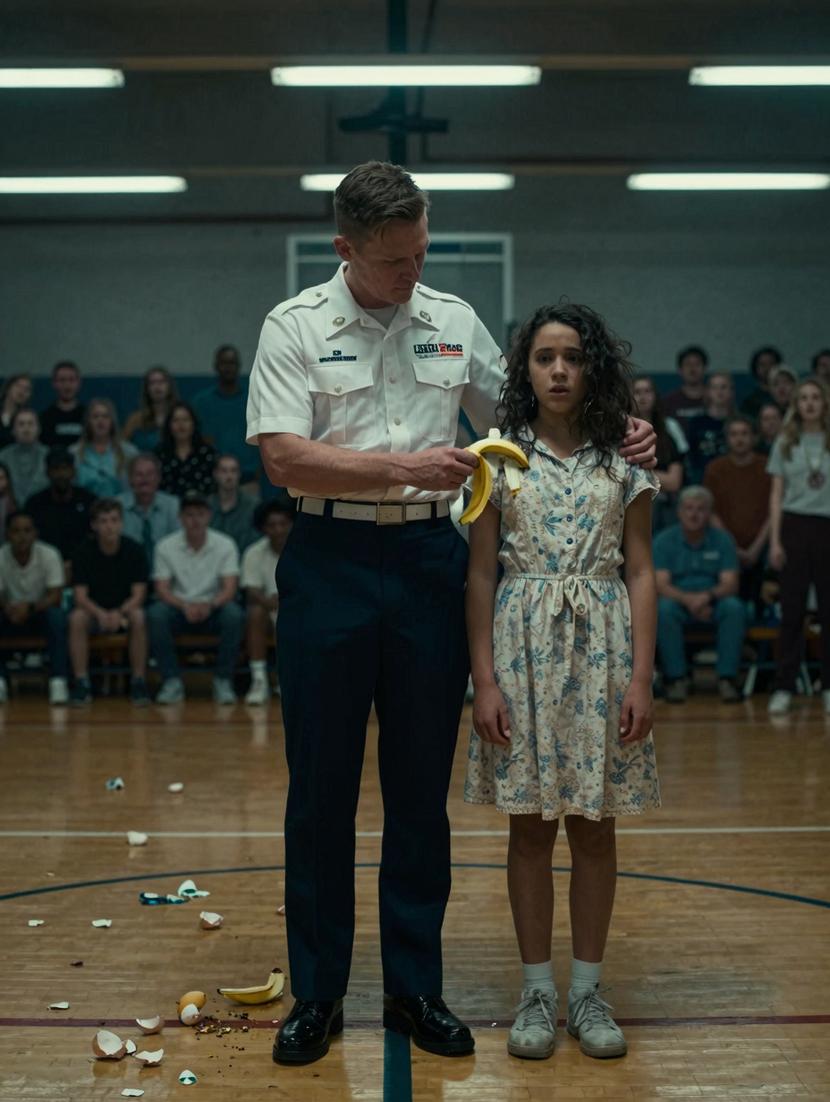
The egg struck my shoulder, splattering yolk down my neck. Slick, cold, invading the delicate collar of my mother’s dress.
I gasped.
“Food fight!” someone called from the front row, and chaos broke loose.
Eggs sailed. Tomatoes arched. Milk cartons exploded at my feet, spewing white ruin across the blue flowers of the dress, a cruel stain.
Laughter slammed like a deafening wall.
I stood frozen.
My body, burdened by too much pain, shut down.
I stared blankly ahead, arms hugging myself, shrinking into the smallest space imaginable.
Tessa grabbed handfuls of trash and flung them at my chest.
“Where’s your soldier daddy?” she screamed, voice slicing through the chaos. “Is he too busy saving the world to save his trash daughter?”
The gym howled.
My vision blurred.
I thought of my mother.
Her fragile hand in mine.
Her whispered prayers for him—Ethan Mercer.
My dad.
A ghost.
A myth.
A man who never came.
I swallowed a sob, staring up at the unforgiving ceiling lights as if they might swallow me whole.
And then—
BOOM.
The double doors at the gym’s far end slammed open, crashing through the noise with a force that was unsettling, unnatural.
Not a late teacher.
Not a student.
An invasion.
The music died. The laughter faltered, then vanished.
A tomato midair dropped, splatting wet on the floor.
Silence.
All eyes shifted.
Through the open doors marched a group of men who didn’t belong at a high school.
No school colors. No backpacks. Not casual.
Trained.
Dressed in dark tactical gear—no flash, no dramatics, just silent efficiency.
Their movements synchronized, surveying, sweeping, closing.
The gym’s temperature plummeted.
Teen bravado cracked and evaporated.
Then the squad parted.
And a man stepped forward.
No tactical armor.
Instead, a dress uniform—pristine, adorned with heavy ribbons that told stories of sacrifice and duty.
His hair was trimmed close, streaked with silver at the temples. His face bore the weight of hard decisions.
He stopped at center court.
He didn’t look at the crowd.
He didn’t look at Tessa.
He looked at me.
My breath caught.
Those eyes.
I remembered them—etched in a faded photo my mother kept hidden, sacred.
Ethan Mercer.
My father.
The ghost who was supposed to be a myth.
He stepped forward.
Click. Click. Click.
His polished shoes sounded loud against the polished floor.
Three steps. Then he stopped just feet away.
His gaze swept me—milk-stained dress, remnants of eggshell in my hair, trash scattered at my feet.
His jaw clenched. A muscle twitched.
He breathed in, slow, measured, holding back a storm.
Then he spoke—his voice calm, but rolling with thunder beneath the surface.
“Who is in charge here?”
Principal Mercer’s voice cracked in response. “I—I am. Principal Mercer.”
Ethan didn’t glance at him yet.
He reached out, carefully peeling a banana peel from my shoulder.
My knees buckled, helpless.
But before I could fall, his arm steadied me—strong, unwavering, real.
He pulled me close enough that I could smell the sharp mix of starch, leather, cold air… the scent of history and sacrifice.
He bent down, voice low, tender.
“I’ve got you.”
Something inside me shattered.
I didn’t cry softly.
I cried like a wounded animal finally breaking free.
Ethan straightened and finally scanned the gym.
And the room seemed to shrink beneath his gaze.
He took in every student, every teacher, every silent adult who had stood by and watched.
He fixed his eyes on Tessa.
She held another egg, trembling.
It slipped and shattered at her feet.
His voice did not rise. That was the worst part.
“You,” he said calmly.
“A joke,” she stammered, face drained.
Ethan’s stare was a blade. “A joke.”
He turned to Principal Mercer.
“You allowed a child to be assaulted in your building, under your watch, with your staff as silent witnesses.”
“I—we didn’t know,” Mercer stammered.
“My daughter deserves more than ignorance to keep her safe,” Ethan said, voice dropping icy cold. “She needed an adult. You failed her.”
He shifted slightly, addressing the men behind him like a commander issuing an order centuries in the making.
“Clear a path.”
They obeyed instantly.
The gym emptied like a retreating tide.
Ethan kept his arm tight around me as we walked.
Faces passed—former laughter replaced by shame and guilt.
Phones lowered.
No one knew how to breathe.
Tessa stood frozen, mouth agape, eyes wet—not with remorse, but fear.
When we reached the doors, the cold hall air struck my skin like fresh air after drowning.
Ethan paused, looking back once.
“I have one question,” he said, voice steady. “And I want honesty.”
Silence stretched.
He pointed to the box of trash.
“Who thought this was acceptable?”
No answers.
He nodded once.
“That says everything.”
Then we left, and with each step away, the weight of silence remained behind.


