
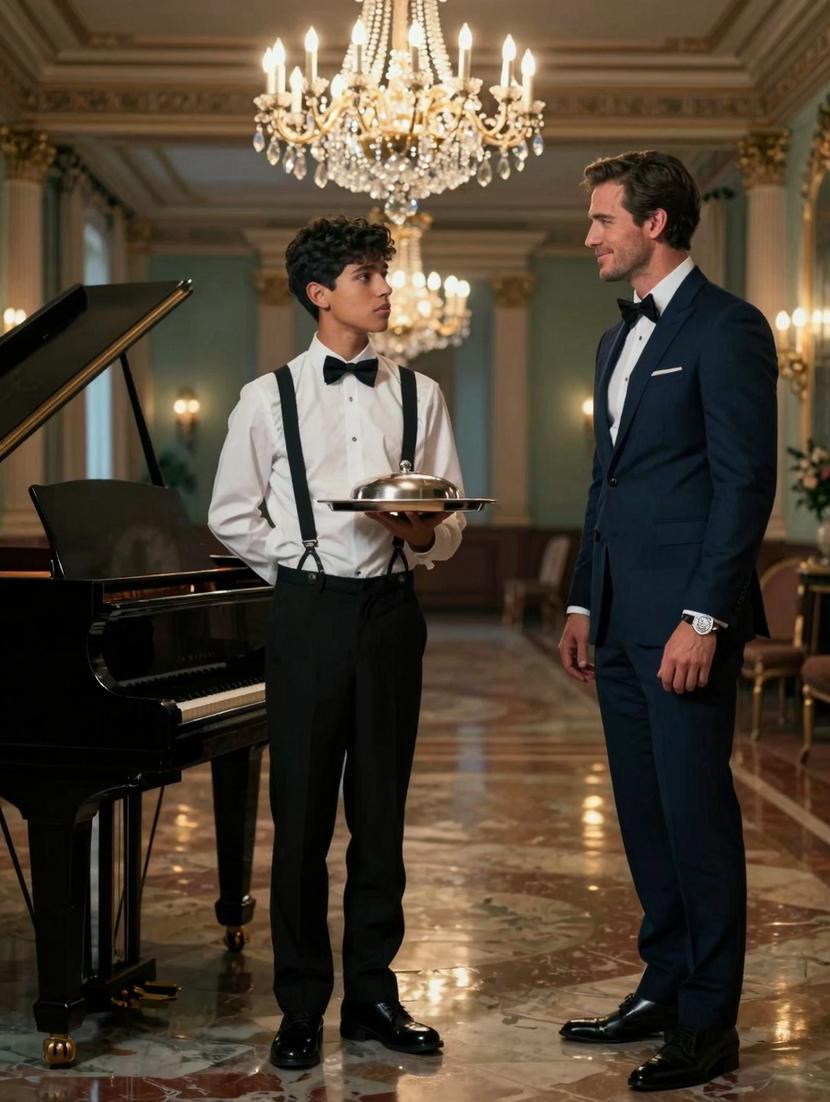
Underneath the opulent glow of a grand chandelier, its crystal arms scattering light like a galaxy frozen in golden time, the magnificent hall buzzed with elegant revelry. The polished marble floor mirrored the shimmering spectacle, where laughter mingled with whispered conversations and the soft clink of fine crystal, all weaving the very fabric of undeniable luxury.
In this realm where wealth needed no introduction—an unspoken presence hanging in the air—a solitary black grand piano stood near the far wall, gleaming and still, an imperious sentinel waiting for a touch worthy of its soul.
Almost lost amid the glittering throng was a slender boy, no older than fifteen, dressed in a sharply pressed waiter’s uniform. His shoes bore subtle signs of wear, and his poised hands steadied a silver tray brimming with sparkling glasses. Yet, his gaze was not on the guests or the revelry—it was fixed on the waiting piano, a silent flame flickering in his eyes.
To the crowd, he was just another servant, unnoticed and unremarkable. But beneath his quiet exterior, a storm surged—a heartbeat louder than the music, pulled by every note whispering memories only he could hear.
With a whisper of courage gathered painstakingly through the evening, the boy edged closer to the piano. Nearby, a tall man in a fine navy suit chuckled among his privileged companions, his diamond-studded watch gleaming as a symbol of untouchable status.
The boy’s voice broke softly through the din, tinged with a mixture of vulnerability and resolve: “May I… play this piano?”
The laughter halted for a heartbeat. The man turned his gaze downward, eyes locking onto the uniform, the humble tray, the boy who dared to ask.
A slow smirk curled his lips. “You? You’ve ever touched a piano before?” His tone was loud enough to carry, dripping with amused doubt.
Guests chuckled—not maliciously, but with the cold certainty of scaled impossibility. The boy felt the sting of embarrassment flood his cheeks, the familiar urge to shrink away creeping in. But something stronger, a quiet fire, held him firm.
Without a word, he nodded once and lowered the silver tray onto a nearby table, the soft clatter of metal on wood echoing like a proclamation.
He took a seat at the piano bench with deliberate calm. A murmur ran through the crowd—curiosity, skepticism, and a flicker of intrigue blending in the air.
Raising his hands slowly, as if greeting an old friend lost to years, he revealed a faded tattoo on his wrist: a small, delicate guitar silhouette, worn but unmistakable.
The man’s amusement wavered, then vanished entirely. His eyes locked on the ink, recognition dawning with unsettling clarity.
Then, the boy struck the first key.
A crystal-clear note pierced the silence—a pure, resonant sound that held the room captive. Another note followed, then another, until within moments, the tentative melody blossomed into a sweeping, vibrant symphony of longing, memory, hope, and heartache—an unspoken story pouring through his fingertips.
Guests froze mid-conversation, glasses halted mid-air, and even distant servers paused, drawn by the magnetic force of the music filling the vast hall. This wasn’t mere talent; it was a soul reclaiming its voice.
Near the piano, the man’s expression shifted, tightening with a mixture of astonishment and something deeper—recognition tinged with years of lost chances.
Years before, a clandestine video had circulated quietly through elite musical circles: a child no older than eight playing with breathtaking brilliance on a battered roadside keyboard, raw and hauntingly beautiful. Then, nothing—no name, no trail, just a small guitar symbol etched beside the instrument.
The man’s voice fell to a reverent whisper, barely audible: “Wait… are you the one?”
Without pause, the boy’s fingers danced on the keys, an unspoken answer glowing in his eyes.
The final note lingered like a question suspended in time, then the silence shattered as applause erupted—a tidal wave of sound that swelled beyond the boy’s quiet figure. Standing ovations, cheers, stunned silence interwoven in awe.
The boy’s hands slipped gently from the keys, a flicker of fear crossing his face—as if revealing this part of himself was both a victory and a risk.
The man stepped forward, this time stripped of sarcasm, his voice low and sincere: “What’s your name?”
A pause. Then softly, “Mateo.”
The name fell unfamiliar to the crowd, but the music remained—a lasting testament to the extraordinary hidden beneath modesty.
“Where did you learn to play like that?” the man pressed.
Mateo’s eyes drifted to the piano, then rested on his own hands. “My mother,” he breathed. “Before she got sick.”
A hush deepened, understanding widening.
“I used to play in the subway after she couldn’t teach anymore,” Mateo continued, voice steady but laced with past pain. “Someone recorded it. Then we had to move. I stopped for a while.”
“Why?” the man asked gently.
Mateo’s gaze dropped. “Because playing didn’t pay for medicine.”
The raw truth weighed heavier than any music, fracturing the opulence around them with fragile reality.
The man swallowed hard, emotions long buried rising: regret, sorrow, a profound apology.
“I’m sorry,” he murmured.
Mateo shook his head softly. “It’s okay. You didn’t know.”
In that moment, the man grasped something vital: brilliance knows no boundaries of wealth, and sometimes, the quietest presence harbors the deepest greatness.
“Mateo,” he said with care, “would you play again? Not as a waiter. But as a musician.”
Mateo lifted his eyes, uncertain but hopeful. “For everyone?”
“For the world,” came the reply.
Months later, that same stirring melody filled a grander, brighter hall. The audience had arrived for one reason only—a young man at a grand piano no longer unseen.
As Mateo’s fingers caressed the keys, the music carried the same haunting soul as that unforgettable night. But this time, there was no laughter—only reverent silence and profound listening.
And somewhere in the crowd, the man who had once mocked quietly wiped away tears—a man grateful to have been proven wrong.
Because sometimes, the smallest question—
“Can I play this piano?”
—ignites the dawn of a life the world almost overlooked.
And sometimes… the one invisible to all is precisely the one everyone has been waiting for.


