
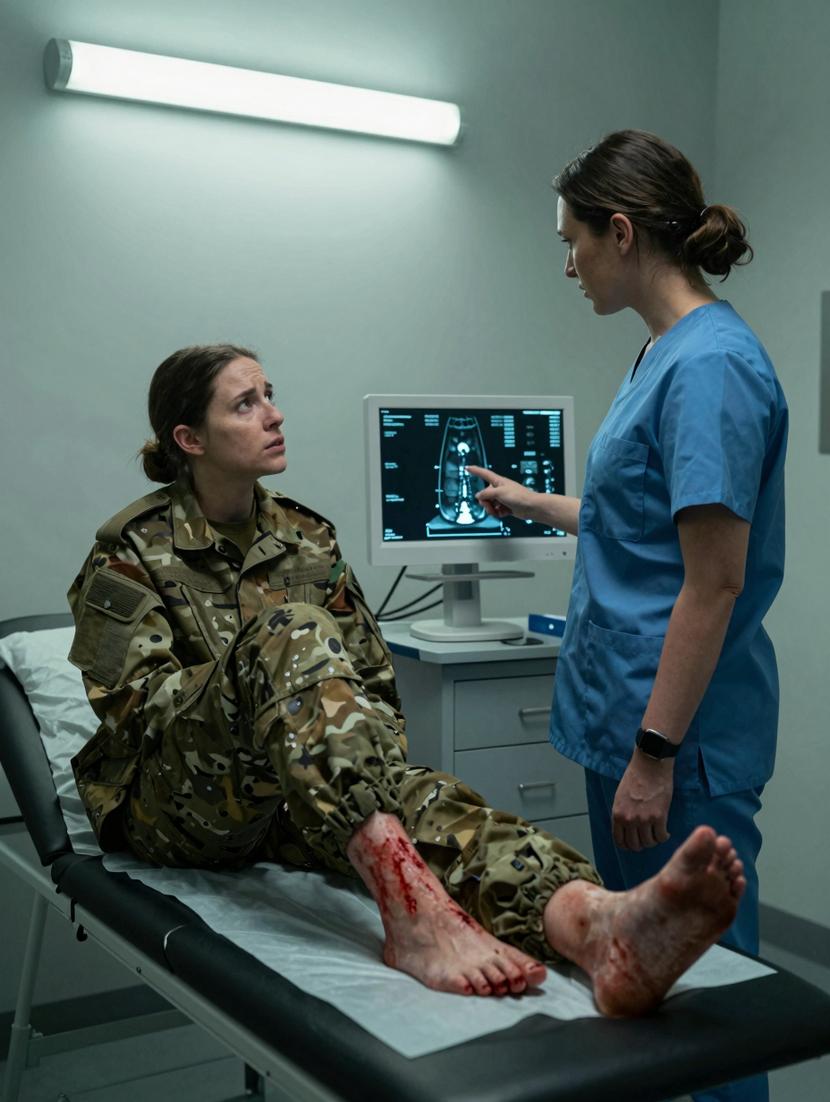
I was still wearing my uniform, the fabric straining across my swollen knee, when my father’s voice came through the phone, cold and firm: ‘Your leg isn’t worth five thousand dollars.’ The word disability lingered in my mind—not as a frightening future, but a stark certainty the doctor had just delivered. Surgery had to happen within a week, or my life would be rewritten in limps and limitations. My boot was half unlaced; I could hardly bear to move, my knee pulsing with pain beneath the fatigues stretched too tight.
On the other end of the line, my mother exhaled softly, a weary sigh thick with disappointment. My sister’s laughter echoed—a careless, bright sound utterly devoid of sympathy. Then came my father’s voice again, almost gentle, yet heartless: ‘Sweetheart, we just bought a boat. This isn’t the right time.’
Something inside me stilled, a sudden cold settling in my chest.
The injury had happened two hours from home, during a routine training exercise—movement under load, steady pace. Nothing out of the ordinary. But when I felt that sickening pop, the heat rolling up my leg, and the ground rushing closer, I knew the pain was different. Pain in the military is familiar, but this was a beast that stole your breath and filled your head with static. When I tried to stand, my leg gave way, no longer mine to command.
The medic was at my side in seconds, eyes narrowing. ‘Don’t move,’ he ordered, catching the urgency in his voice.
In the cramped clinic room, the white fluorescent lights blinked steadily above as I lay on a narrow examination bed. The Physician’s Assistant was frank, tapping at my MRI image glowing on a gray screen. ‘Severe ligament damage,’ she said quietly, almost grimly. ‘Maybe more. You need surgery—soon.’
‘How soon?’ I whispered.
She hesitated—a silence that drowned me with dread. ‘This week,’ she finally said. ‘Delay it, and you face long-term impairment. Limping. Reduced mobility. Possibly permanent disability.’
The ticking clock was ruthless. The surgery itself wasn’t the problem. It was the system—the endless wait for approvals, the bureaucracy standing between me and walking again. Army medical permissions dragged on in slow waves. Weeks—and I had only days.
Then she slid a scrap of paper across the cold metal tray: $5,000. A figure that weighed like a mountain, a lifeline to a future where I might escape this pain.
That night, alone in my barracks bed, leg swathed in bloodied gauze, I stared at the phone for what felt like an eternity. Around me, life roared on—laughter, music, the clashing of a video game far off. But for me, the world narrowed to a single call.
My father answered after three rings, his voice bright and distracted. Metal clinked behind him—tools or a television blaring.
‘Dad,’ I said, trying to steady my voice, ‘I got hurt. It’s bad.’
I laid out the facts: the injury, the urgency, the cost—an upfront sum I couldn’t cover alone. I promised repayment.
Silence.
Then came the slow exhale I knew too well, the one that meant no. ‘We just bought the boat,’ he said finally. ‘You know that. It’s really not a good time.’
I closed my eyes, swallowed hard. ‘It’s my leg,’ I said, voice trembling. ‘If I don’t do this, I might never walk right again.’
His reply was chillingly detached. ‘You’re young. You’ll adapt.’
Before I could respond, my mother took the receiver. Her voice was calm but cutting. ‘Maybe this is a lesson,’ she said softly. ‘You chose this career, you chose the risks. A limp will teach you responsibility.’
Like it was a minor inconvenience.
Then my sister’s laughter spilled in again—light, amused. ‘Relax, you’ll manage. You’re the tough one, aren’t you?’
My gaze dropped to my leg, soaked through the gauze with dark, stubborn blood, staining reality with permanent shadows.
‘I understand,’ I whispered.
Because I did.
I hung up, and inside the clamor of the barracks, something inside me crystallized—clear, cold resolve.
Two days later, in my tiny off-base apartment, I hobbled on crutches. Each painful step was a stark reminder of what hung in the balance. The meds dulled the stabbing edge of pain, but never the gnawing fear—I ran through my options over and over: payday loans, credit cards, anything to clutch time in my hands.
Then came the knock.
My brother stood at the door—grease-stained coveralls, dark shadows under his eyes. Sixty hours a week turning wrenches in a grim mechanic’s shop, hands permanently marred and scarred.
His eyes flicked over my injured leg. He cursed under his breath. ‘They didn’t help you,’ he stated, no question.
I shook my head.
Without hesitation, he dug into his pocket and pressed a worn wad of bills into my palm—tens, twenties, well-used and folded. ‘Eight hundred dollars,’ he said quietly. ‘I sold all my tools.’
‘You need those,’ I told him.
‘I need you walking,’ he shot back, determination steady in his gaze. ‘I’ll figure out the rest.’
They had a house full of wealth, savings, equity—all poured into a boat named after a place they’d only visited once. He had nothing, and gave me everything.
I took the money, not because it was enough—it wasn’t—but because I needed to remember someone was standing with me while I bled.
Before leaving, he squeezed my shoulder. ‘You’ll be okay,’ he promised. ‘You always are.’
He didn’t know what storm was coming. But I did.
That night, I lay awake, pain thrumming in slow, controlled waves, while my mind trapped itself in memories I wished had faded.
Growing up, roles were clear. My sister was the ‘Investment.’ Precious potential wrapped in endless support and promises. My parents were proud, openly declaring it. Every failure met with new money, new chances.
I was the ‘Reliable One.’ The silent worker. The one who didn’t ask for help. The one who fixed things quietly.
When my sister’s first business—a lavish online boutique—collapsed after burning through fifteen thousand dollars, my father simply wrote a check. No questions, no consequences. The wellness studio that followed? Bankrolled by refinancing the house. ‘You have to spend money to make money,’ he’d preach.
I remembered sitting at the kitchen table after a twelve-hour shift, swallowed in silence and cereal, watching this cycle unfold like a play I wasn’t part of.
At twenty-two, my car’s transmission failed. I asked for a two-thousand-dollar loan. They agreed, of course—on terms. A contract printed from my father’s office, notarized by my mother. Five percent interest. Formality was important, they said. Character-building.
I ate canned food and walked miles to save gas, repaid them early, clinging to the belief responsibility garnered respect.
It didn’t.
Now, numb and wounded, the pattern was painfully clear. This was never about money. They had it. They just didn’t have it for me.
By morning, the military hospital’s bureaucracy loomed unchanged. Weeks to approval—time I could never borrow.
I searched the walls of my cramped apartment, the stained carpet, the peeling paint. Then the numbers: payday lenders, personal loan sharks—places with sweet words and sharp claws.
I went.
The office smelled of stale coffee and desperation. The man behind the desk spoke in practiced tones as his computer calculated how much of my future I’d pawn for a moment of healing. The interest rate was monstrous. The repayment terms merciless.
‘Do you understand?’ he asked.
‘Yes,’ I said, voice steady.
I signed.
Two days later, on an austere gurney, I counted the cracked ceiling tiles as anesthesia pulled me away. The surgeon’s confident words when I awoke echoed in my mind: ‘We got it in time. Follow rehab, and you’ll recover fully.’
Relief crashed over me, fierce and sudden.
Recovery brought no charity. Loan payments loomed in three days. My bank account bled—forty-seven dollars and change. Paycheck a week off.
I juggled numbers in my head like falling stars, tried bending reality to fit desperate math. Considered selling plasma, old furniture—choices that tasted of shame.
Then, a trivial receipt unfolded in my palm—a water bottle, crackers, a lottery ticket bought on a whim.
Another look; then silence filled the room. It wasn’t a fortune, but it was enough. Enough to breathe, to hope, to stop drowning.
I kept the secret.
Instead, I found a lawyer—a glass-paneled office, quiet confidence, no gimmicks.
On crutches, I walked in like a woman pushed to the edge. No words wasted; I declared two goals: protect my assets, understand their finances better than they did.
He said, carefully, ‘That changes everything.’
I nodded.
Soon, the myths unraveled. The house, once a nest egg, was mortgaged to breaking. Payments months overdue, cluttered beneath unopened notices. The boat? Barely paid off, its price stacked on high-interest credit cards and shaky loans. My sister’s business? A cash pit, kept afloat by debt.
‘They aren’t wealthy,’ he said softly. ‘They’re pretending.’
I stared, numb.
They refused me five thousand dollars to save my leg, yet poured tens of thousands to mask their crumbling reality.
‘Can we shield you? Protect your assets?’ he asked.
‘No,’ I said. ‘I won’t run. I will own it.’
That was the birth of the plan.
A company formed—anonymous, clean, a vessel of truth disguised in shadows.
We bought their debt for less than it was worth—not from greed, but clarity.
Within forty-eight hours, I transformed from the forgotten daughter into the owner of their debts, their home, their illusions.
They didn’t know.
That was the hardest part—not shattering the façade, but holding the power behind it.
Through a British-accented intermediary, we met at their favorite private lunch club—my father’s stage of importance.
I stayed away.
The pitch unfolded without me—how we specialized in distressed assets, offering ‘retention strategies’ to ease their burden in exchange for control.
My father preened. My mother worried about appearances. My sister dreamed of expansion.
The contract was dense, fifty pages full of fine print—with a razor-sharp clause buried within: any breach, late payment, misuse—lease terminated immediately. No delays.
They didn’t bother to read it.
When the pens scratched signatures, I felt a weight settle—not triumph, but finality.
That night, I stood unaided. For the first time since the injury, my leg held steady. I smiled—not because I’d won, but because I stood alone, strong.
They believed I’d just ‘figured it out.’
Silent discipline guided me forward.
Outside appearances stayed intact. They called it ‘strategic restructuring.’ My sister flaunted filtered Instagram moments of glitter and champagne, unaware she was celebrating on money I controlled, in a house I now owned.
I watched, healing as they crumbled in denial.
Physical therapy became my sanctuary. The smell of disinfectant and soft rubber mats. The older therapist’s steady voice: ‘You don’t have to prove anything here.’
Slowly, I relearned trust in my body.
The lawyer’s precise questions shaped my understanding; debts, payments, precarious margins became tools to wield, not monsters to fear.
Weeks later, my father called—tone rehearsed, strained. Checking in, fishing for approval.
I responded flatly. He hung up abruptly.
They needed witnesses to their stories, and I refused to be one.
Then, the inevitable happened.
A single missed payment triggered the cruel clause. Lease terminated. Notices filed. Procedure executed flawlessly—legal, cold, unyielding.
I scheduled the meeting.
My parents arrived late, irritated, demanding senior staff. They faced only me, calm and commanding.
They didn’t recognize the woman who now controlled their fate.
‘Hello, Mom. Dad,’ I said. ‘I’m the owner.’
Shock and silence suffocated the room.
Anger flared—my father’s rage spilling out like wildfire, accusations, threats.
I listened, then laid the evidence down—contracts, purchases, unpaid dues.
My mother broke, raw tears flowing.
‘You tricked us.’
I shook my head.
‘You signed.’
Security hovered as the truth settled.
Outside, cold air filled my lungs. I called my brother: ‘Pack your things. I bought the shop.’
Silence, then laughter through tears.
Resolution, not revenge, anchored me.
Their collapse was quiet, staged with calculated precision—locks changed, notices posted, dignity left at the doorstep.
My mother’s voicemail was a fractured symphony of grief and disbelief. No apologies.
My father’s call roared with threats and veiled boasts of hidden wealth.
I breathed steady, revealing calmly, ‘I know. That’s why I reported it.’
Lines went dead.
Days later, my sister came—a mask of sympathy and entitlement.
‘You didn’t have to do this.’
I laughed softly. ‘Extreme? Like refusing five thousand dollars to save my leg?’
Her answer dissolved into sharp accusations, then slamming heels retreating down the hall.
I walked outside, bare and steady, legs beneath me sure and strong.
I thought of the girl who signed a crushing loan alone—the one who swallowed pain and learned self-respect.
I thought of my brother, his shock turning to pride when I told him he never had to sell tools again.
Family, I realized, wasn’t blood alone. It was who stood beside you when you bled.
Whispers spread, friends asked, family fractured under evidence’s weight.
I felt no victory—only quiet clarity. They weren’t destroyed by me; they were undone by their own arrogance.
One afternoon, my therapist called after me: ‘You walk like you trust yourself again.’
‘I do,’ I smiled.
The house stood empty longer than expected. No spectacle, only silence—the final truth.
I focused on healing, inside and out, earning trust through action.
One evening, closing the shop with my brother, he mentioned seeing my parents watching from afar.
‘I told them this place isn’t theirs,’ he said quietly. ‘They should leave.’
‘You didn’t have to,’ I told him.
‘I did,’ he answered.
Weeks later, charges moved forward. Legal wheels grinding patiently.
My mother’s last letter begged for understanding—a plea for forgiveness I didn’t owe.
I understood perfectly.
I stood on my balcony, stretching my healed leg, feeling strength rise with every breath.
The girl who once equated love with silence was gone.
In her place stood a woman defined by self-respect.
At the final meeting, my parents arrived alone, fractured.
The attorney laid out consequences.
My father whispered hoarsely, ‘You didn’t have to ruin us.’
‘I didn’t ruin you,’ I said steadily. ‘I stopped saving you.’
He recoiled.
Outside, leaves crunched beneath steady steps. I thought back to bloodied gauze and $800 bills, and knew I’d gone just far enough.


