
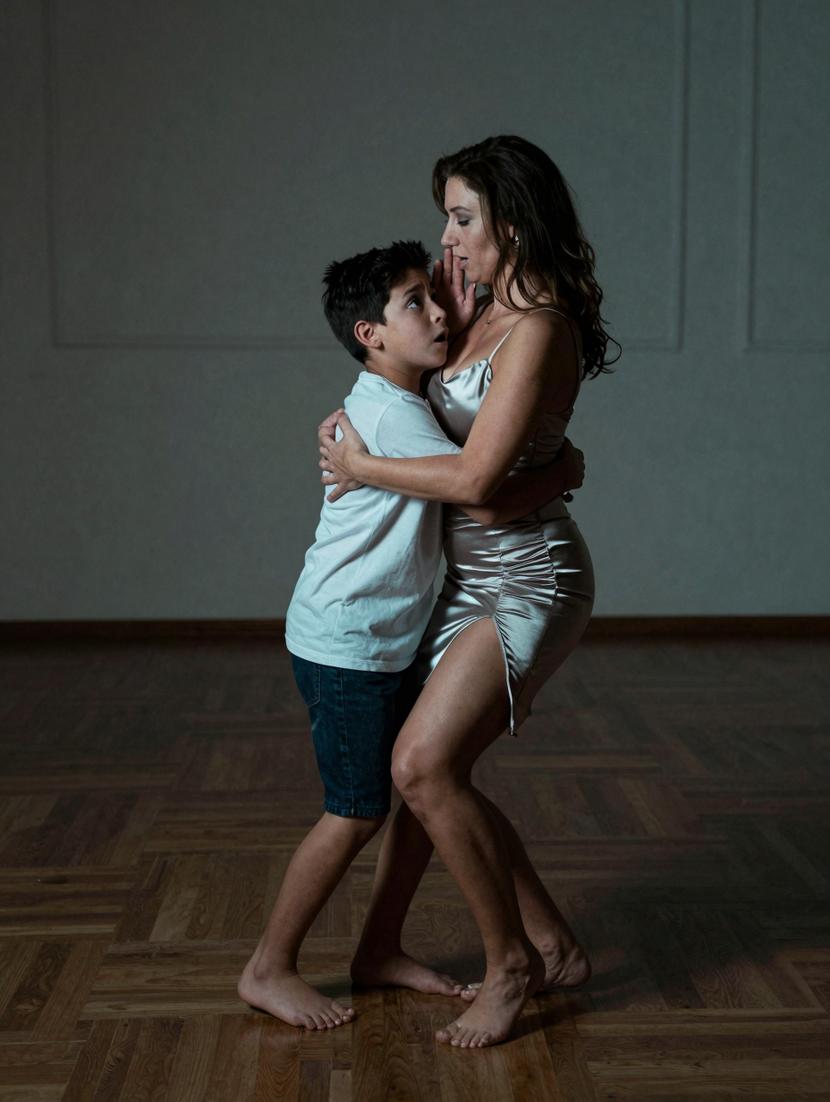
When Natalie Mercer rose from the polished floor, her legs shook—not with fear, but with an overwhelming jolt of recognition, like lightning striking her soul. The boy’s words replayed in her mind, crystal clear, a whisper she couldn’t erase:
“Mom said to find you. She said you know where my sister is.”
No one else had heard that tiny voice. But for Natalie, time fractured and paused. She scanned the glittering crowd in the rose hall—gowns swirling, tuxedos shimmering—but the boy had vanished into thin air. Even the vigilant security teams came up empty-handed.
Yet Natalie knew—he was real.
And she knew who had sent him.
To truly grasp the gravity of that night, you must rewind two decades.
At 19, Natalie Mercer was struggling—no wealth, no safety net. She lived in a cramped, dimly lit apartment cluttered with textbooks and empty coffee cups. Instant noodles sustained her empty stomach after grueling night shifts. Lonely and scared, she was carrying a secret—a pregnancy.
The father fled the moment he learned. Her mother had passed years earlier; her father was a distant shadow, emotionally out of reach. Alone, abandoned, Natalie faced a harrowing choice.
She gave birth to a fragile baby girl—so small, with deep dark eyes and delicate fingers that curled around her own like hope itself. But with no support, no money, no future to offer, Natalie made the heart-wrenching decision to sign the adoption papers. The agency’s promises whispered of safety, love, and a new life.
She let her daughter go, never to see her again.
Years slipped by like grains of sand.
Natalie clawed her way through college, learned the ruthless art of finance, gambling on risks with uncanny instinct and shrewd luck. By 35, she was a multimillionaire, celebrated and polished—but the ache beneath her glamour never faded.
Every year, on the day her daughter was born, Natalie’s heart faltered, wondering where she was—did she laugh today? Was she cherished? Did she even remember?
A marriage came and went—her husband had accused her of loving her work more than anyone, never knowing the secret she bore locked inside.
That secret was a silent weight—a haunting shadow behind the gloss of magazine covers and stirring speeches.
The charity gala was meant to raise funds for vulnerable children—a bitter irony that wasn’t lost on Natalie.
She gave half a million dollars with a practiced smile, posed for the flashbulbs, and delivered a speech meant to inspire. But then, through the glimmering crowd in the rose hall, she saw him—a barefoot boy slipping quietly inside.
Something raw and primal clenched in her chest.
She couldn’t let security bar him. Kneeling, she invited him to dance.
He was seven or eight, thin, trembling with wide frightened eyes.
As they moved together, a strange, undeniable familiarity bloomed. Then he spoke—the words that shattered everything.
“Mom said to find you,” he whispered.
Natalie’s knees nearly buckled.
“What… did you say?” she gasped.
“She said you know where my sister is—that long ago, you let her go.”
Her world split apart, raw and exposed.
When he vanished, panic surged through her veins. She ran, searched desperate corners, called out until her voice cracked. Friends whispered she’d lost her mind.
But he was more than just a boy.
He was a message.
That night, driven by haunting hope, Natalie hired a private investigator. She handed over every scrap of information—adoption papers, dates, names stored away like fragile relics.
“Find her. No matter the cost.”
Two weeks later, the truth came back.
Her daughter was Lucia. Twenty years old. Living with her adoptive family in a modest house on the town’s edge.
But there was more.
Lucia had a younger brother. Mateo—the barefoot boy from the gala.
The investigator uncovered their story.
Lucia’s adoptive mother was gravely ill, cancer gnawing away with only months left. Long ago, she made a promise—to help Lucia find her biological mother. But fear kept Lucia from starting that journey.
So the adoptive mother found Natalie online, learned of the gala, and sent Mateo with a mission:
“Find the woman in the silver dress. Tell her your sister needs her.”
He went barefoot because shoes were a luxury they could not afford.
Three days later, Natalie stood before a small, weathered house. Peeling paint, a modest porch—but something warm radiated within.
A frail woman wearing a gauzy scarf opened the door. “You must be Natalie,” she said softly.
Words failed Natalie.
“Sofia—Lucia—is waiting.”
Down the quiet hallway, Natalie saw her daughter—dark hair cascading, eyes hauntingly familiar. Twenty years between them melted in a fragile greeting.
“Hi,” Lucia’s voice was barely a whisper.
Natalie sank to her knees, tears pouring in a flood of remorse and love. “I’m so sorry. I’ve never stopped thinking about you.”
Lucia enveloped her in a gentle hug. “Mom told me everything. I understand.”
Hours passed as they bridged lost time. Lucia shared her dreams of medicine, the struggles she fought quietly. Natalie listened, her heart wide open.
And she made a vow:
“I’ll help you—with school, with life. If you’ll let me, I want to be part of your world.”
A hopeful smile broke through. “I’d like that.”
The following months transformed their lives.
Natalie funded Lucia’s university tuition, covered the adoptive mother’s treatment, and enrolled Mateo in an excellent school—gifts of shoes included this time, more than Mateo could count.
The adoptive mother passed peacefully six months later, surrounded by love and gratitude. In her final moments, she thanked Natalie for answering her last wish.
Natalie and Lucia’s bond grew, imperfect but real. Lucia called her Natalie—not “Mom”—a title honorary to the woman who raised her. Natalie accepted that, treasuring love over labels.
Out of her fortune, Natalie sold two companies and founded an organization to support young mothers facing agonizing choices.
Five years onward, Lucia became a dedicated pediatrician. Mateo studied law, fueled by a fierce desire to protect children. Every Sunday, the three shared meals, laughter, and the fragile beauty of their chosen family.
Not conventional. Not perfect.
But family.
All because a barefoot boy dared to walk into the rose hall and deliver a message that turned everything upside down.
Sometimes, the wounds of the past cut deepest. But what defines us is the courage to build what comes next.
Natalie Mercer couldn’t rewrite her history—but she rewrote her future.
And that was more than enough.


