
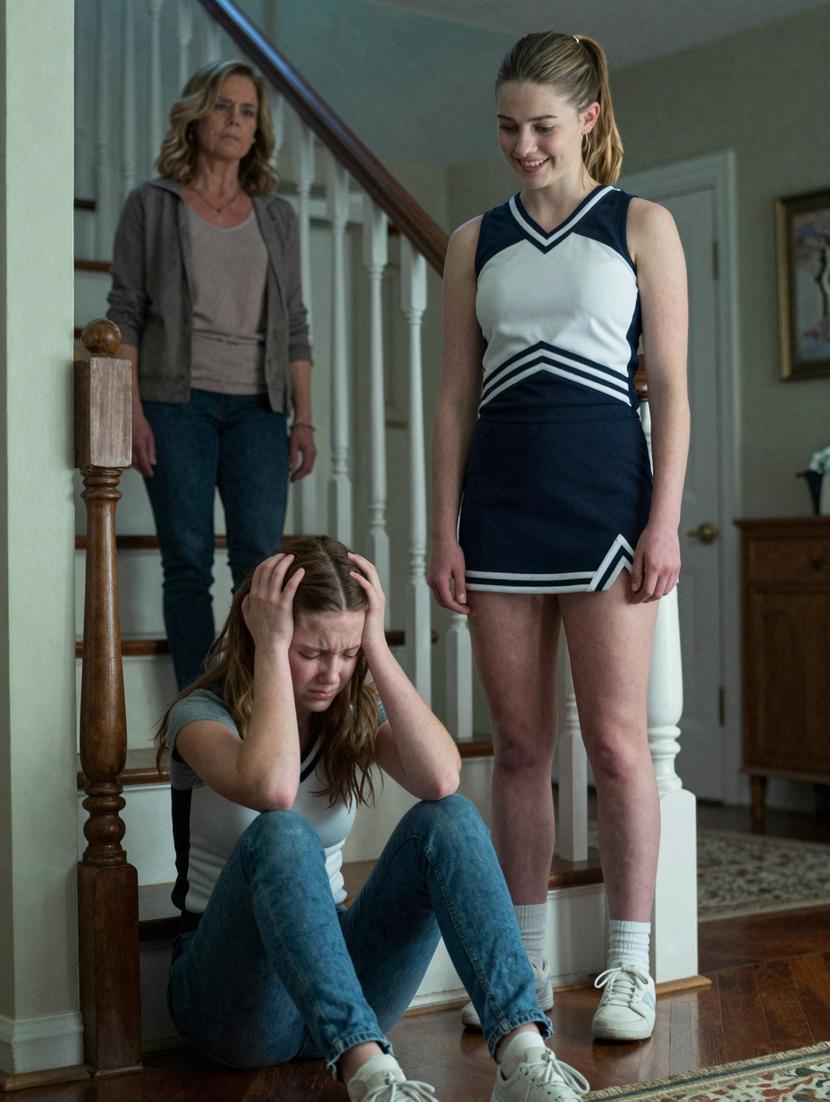
Chloe Bennett’s sharp, insistent voice rang down the hallway just as I crumpled at the bottom of the stairs, a fierce, throbbing pain blooming in my skull. The world tilted and twisted, the edges of my vision blurring and darkening. I’m Avery Collins, sixteen years old, and I had just fallen victim to my sister’s latest calculated “prank” — one that, against every bitter expectation, would shatter the fragile illusion of our family forever.
My gaze landed feebly on the swirling pattern of the entryway rug, dizzy and disoriented. Mom appeared almost instantly, her face taut, not with worry but with irritation simmering just beneath her perfect calm. ‘What happened?’ she demanded, eyes flickering sharply between me and Chloe, her flawless eighteen-year-old daughter.
‘She tripped,’ Chloe supplied smoothly, her cheerleader smile snapping into place like a practiced mask. ‘You know how clumsy she is. Just missed her step.’
But I hadn’t tripped. I was threading my way up the stairs, steady and unaware, as Chloe stalked behind me. Without warning, she shoved — a sudden, brutal shove straight between my shoulder blades. Like clockwork, just like she had done for years. The small shoves, the “accidental” stumbles, the “playful” collisions that everyone dismissed because they seemed so subtle or too perfectly timed to be noticed.
This time was different. This time I couldn’t simply laugh it off and stand up.
‘My head,’ I gasped, fighting to sit upright. The room lurched as nausea rolled over me like a wave, burning bitterly in my throat. ‘I… I need a doctor.’
Mom’s face tightened, her lips thinning with impatience. ‘Don’t be so dramatic, Avery. If Chloe says you tripped, then that’s what happened. Besides, your father has an important dinner with his partners tonight. We don’t have time for this.’
That was our family creed: no trouble, no embarrassment, no waves. Chloe was the golden child — perfect student, captain of the cheer squad, student body president, my father’s shining pride. And me? Avery Collins. The quiet one, the artistic dreamer, the problem to be hushed and concealed.
I tried to stand, but my legs refused to cooperate. The last thing I heard before darkness swallowed me was Chloe’s exasperated sigh.
—
I blinked awake in the harsh glow of the emergency room’s fluorescent lights, each buzz and hum hammering at my throbbing head. Mom sat nearby — not holding my hand, but scrolling rapidly through her phone, no doubt scheming to fix dinner plans. Dad paced impatiently, still in his suit, a dark shadow of annoyance etched across his face.
‘She’s always doing this,’ I overheard Dad mutter. ‘Always stirring things up right when it matters.’
Then Dr. Harris entered, a man whose calm seriousness cut through the room’s tension like a blade. ‘I’m Dr. Harris,’ he said firmly, eyes scanning my chart. ‘We need to run several tests. Avery’s symptoms are concerning.’
‘Tests?’ Mom’s sharp tone rose. ‘She just had a little fall. She’s so clumsy.’
Dr. Harris’s gaze hardened. ‘A ‘little fall’ that causes concussion and unconsciousness is anything but little, Mrs. Collins. We need an MRI to rule out serious injury.’
Dad quickly stepped in, his lawyerly voice slick and self-assured. ‘We have our own specialists. We’ll have them evaluate her tomorrow.’
Not this time. Dr. Harris stood unwavering. ‘No. These tests will be done now. This is a matter of safety.’
Turning to me, his voice softened. ‘Avery, can you tell me exactly what happened? Did you trip?’
The truth burned hot on my lips — Chloe had pushed me — but I caught Mom’s sharp, silent warning across the room: Protect the family. Stay silent. Don’t rock the boat.
‘I… I tripped,’ I whispered, the lie tasting like ash.
Dr. Harris wasn’t convinced. ‘Any dizziness before the fall? Nausea? Has this happened before?’
Before I could answer, the curtain was yanked aside and Chloe stormed in, her cheer uniform crisp, face flushed with a mask of concern. ‘Oh my god, Avery! I was so worried!’ She grabbed my hand, her manicured fingers cold and firm. ‘I was scared when you fell! I told Mom we should come immediately!’
The doctor’s eyes narrowed, reading the performance. ‘You saw the fall?’
‘Yes!’ Chloe’s voice dripped concern. ‘She was walking, lost in her world as usual, and suddenly slipped. I tried to catch her but it all happened so fast!’
Sick waves churned inside me. Chloe’s specialty was rewriting reality — making herself the savior, me the vulnerable, distracted victim.
‘The MRI will give us more answers,’ Dr. Harris said decisively.
After he left, Dad’s voice, cold and clipped, cut through the room. ‘Avery, do you realize what this is going to cost? For a bump on the head? Ridiculous.’
‘I’m sorry,’ I murmured, words born from a lifetime of being invisible and blamed.
‘You should be,’ Chloe snapped, dropping the act. ‘Dad’s missing his dinner because of your attention-seeking.’
Mom smoothed her dress, her voice frosty. ‘This has to stop. We will talk when we get home.’
I closed my eyes, letting their cold words wash over me. But deep inside, something ignited — years of silent suffering bubbling to the surface.
As a nurse wheeled me to radiology, my family retreated, already weaving the narrative they wanted to tell. But inside the MRI’s pounding rhythm, I made a vow. No more silence.
Little did I know, the scan would expose hidden horrors — secrets buried in shadows for years — and Dr. Harris’s next words would shatter the power my family held over me. The truth doesn’t whisper; sometimes it screams loud enough to be undeniable.
—
The results arrived sooner than expected. Back in the ER, my head still throbbed fiercely while Mom texted furiously and Dad grumbled about hospital delays. Chloe had vanished, probably crafting another “worried sister” post.
Dr. Harris entered, grim-faced, accompanied by a sharply dressed woman holding a briefcase.
‘Mr. and Mrs. Collins,’ the doctor announced, voice clipped. ‘This is Ms. Alvarez, from Child Protective Services.’
The room’s atmosphere shattered. Mom’s phone clattered down. Dad stopped pacing, his color draining.
‘CPS?’ Mom gasped. ‘This must be a mistake. Avery’s injury was minor.’
‘Minor?’ Dr. Harris barked with restrained fury. He clipped the MRI scans onto the lightboard, illuminating them starkly. ‘This is today’s injury — a serious concussion with subdural swelling. But more troubling are these,’ he pointed to scattered marks on my brain. ‘Old injuries. Multiple previous traumas, some recent, some scarred over.’
I stared at the ghostly images of my broken brain — the headaches, dismissed as stress; the dizzy spells I was told to ignore. Every ignored symptom etched into my memory.
Dad blustered, desperate. ‘She’s just clumsy! Always has been!’
‘Mr. Collins,’ Dr. Harris snapped, ‘these injuries don’t come from clumsiness. They match repeated, directed impacts — shoves, blows.’
Ms. Alvarez stepped forward, calm and authoritative. ‘Avery, would you speak with me privately?’
Before I could respond, Chloe burst back, soda in hand, eyes darting. ‘What’s going on?’
Taking in the scene—the scans, the stranger in a suit, the pale parents—her mask instantly slipped back on. ‘Oh my god, is Avery okay? I was so worried!’
Dr. Harris’s icy gaze bore into her. ‘You said you witnessed the fall.’
‘Yes!’ Chloe nodded eagerly, rushing to my bedside. ‘She just tripped again. I tried to catch her, but—’
Ms. Alvarez interrupted, holding up a tablet. ‘Security footage tells a very different story.’
A hush fell. ‘Security footage?’ Mom whispered.
She pressed play. Grainy black-and-white video, the stairwell camera capturing everything. Me, climbing carefully upstairs. Chloe, right behind, her hand lashing out — a harsh shove, hard and deliberate. No accident.
Chloe’s perfect poise cracked, her face paling. ‘No, that’s not—’
‘There’s more,’ Ms. Alvarez said quietly. ‘The school principal cooperated fully and gave us their footage.’ Another video flickered on the screen: two months prior, Chloe body-checking me into a brick wall by the gym. Then, three weeks ago in the parking lot, Chloe slammed a car door into my head and laughed. ‘It’s a pattern.’
Our family’s illusion crumbled. Mom gripped her purse, trembling. Dad looked drained, running damage control in his mind. Chloe — the golden girl — snarled in fury.
‘SHE DESERVED IT!’ Chloe screamed, shattering the silence. ‘Perfect grades, always moody! She made me look bad! I competed for their attention, and she stole it all!’
‘Lily,’ Mom hissed, trying to regain control, but it was too late.
‘Better grades, better art, better at everything!’ Chloe sobbed, fury and jealousy raw and ugly. ‘I sabotaged her. Every test, every show, every moment — a little accident to keep her down.’
Her confession struck me like a physical blow — the headaches, the sprained wrist, the missed recitals — all deliberate sabotage.
Ms. Alvarez’s firm voice broke through. ‘Chloe Bennett, you admit to intentionally harming your sister?’
Dad rose, trembling, desperate. ‘This is a family matter. We’ll handle it ourselves.’
‘No,’ Dr. Harris said firmly. ‘This abuse nearly killed her. It ends now.’
I looked around at my shattered family — denials, calculations, fury — and finally felt an icy clarity. The MRI had lifted the veil. The cameras spoke the truth. And for the first time, I was ready.
‘Avery,’ Ms. Alvarez said softly, ‘would you like to tell us your story?’
A cold strength surged through me. ‘Yes,’ I said, sitting taller despite the pain. ‘It’s time I did.’
Chloe lunged, nails bared, but a hospital security guard intercepted. ‘You little snitch! After everything we’ve done for you!’
‘Ms. Bennett,’ Ms. Alvarez warned, voice sharp, ‘the police are en route.’
The mention of police shattered my parents’ denial. Mom wept, not for me but for the scandal. Dad dialed furiously.
But I no longer cared. The truth was free. And so was I.
—
Six months later, everything had changed.
Chloe faced felony assault charges. Her spotless record — carefully concealed by my parents for years — and pricey lawyers spared her juvenile detention, but she was sent to a residential psychiatric facility and placed on strict probation. The overwhelming evidence and CPS intervention crushed any chance the family had to cover it up.
I had moved in with Aunt Melanie, Mom’s estranged sister who walked away from the family façade years ago. Her home was a cozy sanctuary filled with art, music, and genuine laughter — everything our house never was. ‘Your room is ready,’ she said warmly when CPS approved the transfer. ‘Here, Avery, you get to be you.’
My neurologist confirmed Dr. Harris’s diagnosis: years of hidden head trauma had left permanent marks. But for the first time, I was receiving real care — proper medication, understanding, and respect instead of dismissal.
My parents fought for custody, spinning tales about ‘family unity’ and ‘teenage misunderstandings.’ But Aunt Melanie stood firm, a fierce protector. ‘They lost that right when they ignored documented abuse,’ she told the judge. The court agreed.
Returning to school was the hardest part. But slowly, others came forward with stories — whispered confessions of Chloe’s cruel antics, finally breaking her untouchable image. My art teacher, Mrs. Carter, brought me my old sketchbooks. ‘We always wondered why you faded away,’ she said softly. ‘Your place in Art Club is waiting when you’re ready.’
Piece by piece, I reclaimed what Chloe tried to destroy. Headaches eased, grades soared, and I returned to the art club. My paintings grew bolder, vibrant, alive — evidence of resilience in the face of shadows.
Then, a message from Chloe arrived — the first since the hospital. ‘I’m sorry,’ it read. ‘Counselor says I need to make amends. Can we talk?’
I stared at my brush dripping with paint. Aunt Melanie had taught me to protect my healing.
No, I typed back. Not yet.
It felt powerful — choosing me for the first time.
My parents still tried to spin their version: texts about ‘forgiveness,’ lawyers whispering ‘family unity.’ But now, their words were just noise. The MRI, the footage, the truth — those could never be silenced.
A year after the stair fall, I stood onstage at the state art competition, accepting first place for my series ‘Invisible Wounds,’ a raw portrait of hidden trauma and survival.
I saw my parents in the back — uninvited but present — Mom’s practiced, pained smile in place, already plotting her narrative.
But I wasn’t playing their game. My speech wasn’t about forgiveness; it was about the power of truth. ‘Art speaks what words cannot,’ I told the crowd. ‘Each piece holds a story — not just of pain, but of survival and strength.’
Afterwards, Aunt Melanie hugged me tight. ‘Your mother called,’ she said with a wry smile. ‘Asked if you’d be ‘coming home now.’’
Looking around the gallery at my bold canvases — colors bursting from darkness, fractured forms reborn — I smiled.
‘I am home,’ I said.
That night, as I pinned my medal to the corkboard in my sanctuary, I realized sometimes the harshest breaks build the strongest foundations. The MRI hadn’t just revealed damage. It shattered silence and finally gave me the power to reclaim my story. My latest painting sat by the window — a swirl of colors, darkness within but no longer dominant. Just one fragment of a larger, vibrant whole.


