Chapter 1: The Storm’s Wrath
The rain wasn’t simply falling on Route 47; it was raging like a relentless storm of gray fury, turning the highway into a treacherous river of slick asphalt. My windshield wipers thrashed violently, battling the sheets of water pounding against the glass, each swipe a desperate attempt to hold back the chaos outside.
I’m Adrian Cole, twenty-eight years old, and as of last Tuesday, officially “redundant.” That corporate euphemism felt like a punch in the gut.
I’d spent half a decade at Northbridge Institute of Technology, earning my aerospace engineering degree with honors, dreaming of designing propulsion systems that would one day take humanity to Ares Prime. But life had other plans. After three relentless years grinding at a mid-tier company, I was let go—“budget constraints” was the cold phrase that cut me loose.
Today epitomized my luck’s nadir.
I gripped the steering wheel of my 2011 Chevy Cobalt, a car saturated with the stench of stale fast food and quiet desperation. I was driving home from a crushing interview in Hartford.
The interviewer, a peer clad in a sleek Armani suit, barely spared my carefully crafted portfolio a glance, scrolling idle on his phone as I nervously detailed my noise-reduction blade innovation. Finally, with that dismissive look that felt like a slap, he said, “You’ve got theory, Adrian. But you lack ‘street smarts.’ We need warriors, not librarians.”
Warriors? I wanted to scream that I was surviving on instant noodles and pawning cherished vinyl records just to keep the lights burning. Did that not count as grit?
Exhaustion weighed heavy in my bones, a relentless ache.
All I wanted was to crawl into my damp basement apartment and fall into oblivion.
And then, through the rain, I saw them.
On the emergency shoulder, barely visible, sat a weathered beige Buick Century—a relic from a forgotten era—its hazard lights flickering weakly.
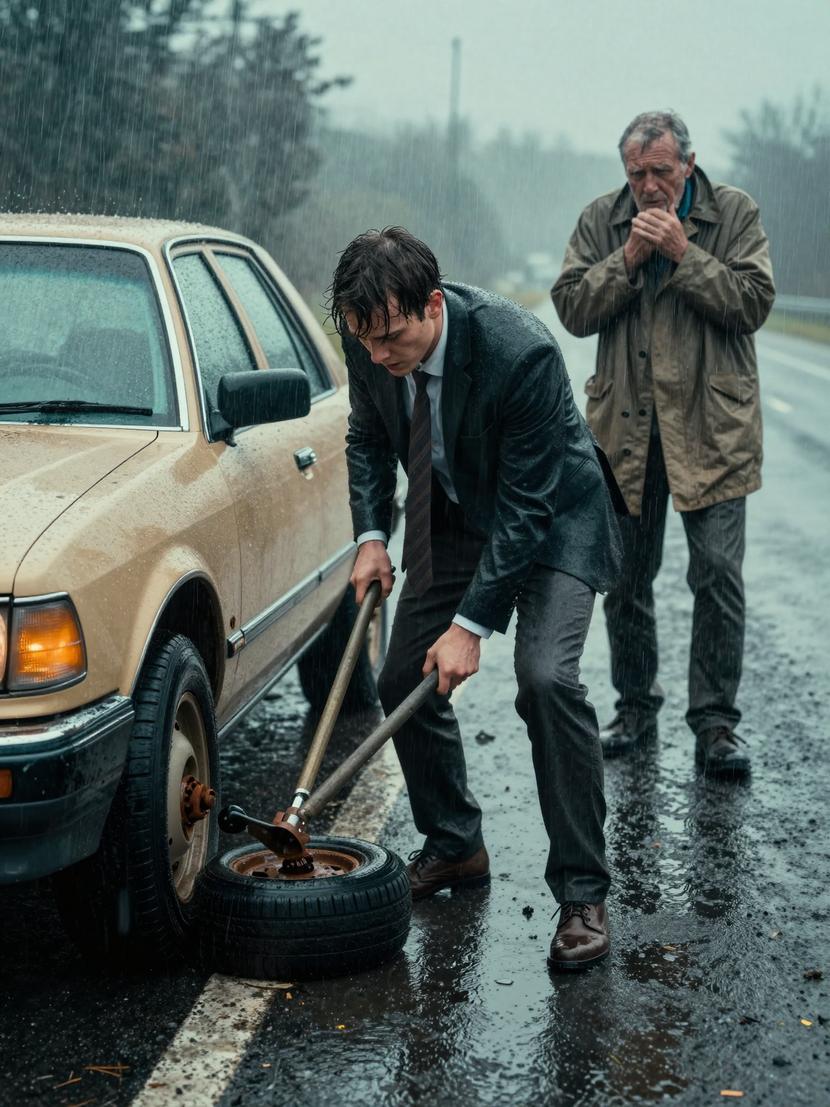
Beside it, an elderly man struggled against the battering wind, his thin, soaked windbreaker clinging to his frail frame as he wrestled with a tire iron. Inside the fogged passenger window, an equally old woman curled in silent dread.
Cars tore past at seventy miles per hour, spraying grime and water like waves crashing on a shoreline. BMWs, Mercedes, Teslas—all symbols of success—rushed by, indifferent. Not one slowed. Not one cared.
A sinking feeling tightened in my chest. I gripped the wheel so tightly my knuckles blanched. I had no time—no energy. Gas money was tight. Why should I stop?
Then his foot slipped on the slick asphalt.
He nearly fell into the traffic’s merciless flow as a semi’s horn blared through the storm.
“Damn it,” I muttered. My conscience wouldn’t let me turn away.
I flicked on my right blinker and pulled off the road.
Chapter 2: The Midnight Engineer
I pulled the heavy raincoat from the backseat—the only relic of value besides a worn set of engineering textbooks—and braced myself against the icy blast.
“Sir!” I called into the storm, voice barely cutting through the roar of tires and thunder.
The old man startled, turning to me with wide, fogged eyes. He looked wrecked—shivering, shaking—his hands trembling so violently I couldn’t tell if it was the cold or something else.
“I… can’t get it loose!” his voice cracked, weak and ragged. “Rusted on tight.”
Through the rain-smeared glass, I saw the shredded rear right tire—a monstrous maw torn to shreds.
“Get in the car!” I urged, concern outweighing politeness. His lips tinged blue. “You’ll freeze out here. I’ve got this.”
“But—”
“No buts!” I guided him gently but firmly toward the door. His wife looked at me through the window, her silver hair pinned tight, eyes mingling gratitude and worry.
I closed the door and knelt in the mud, rain seeping through my soaked clothes.
He was right: the lug nuts were sealed by years of rust and brute force, welded as if by iron chains.
Breathing deep, I let my engineering mind cut through the fatigue. Brute force alone wouldn’t dislodge this. I needed leverage.
I dashed to the trunk, digging through my messy toolbox until I found it—a hollow steel pipe, a relic of a bygone project.
Sliding it onto the tire iron, I doubled the length of the lever arm.
Torque equals force times distance. Physics, raw and powerful.
Planting my foot firmly on the pipe, I gritted my teeth and pushed with everything I had.
CREAK… SNAP!
The first nut gave way like a defeated enemy. Then the second surrendered. The third fought back hard; my foot slipped, and I crashed my knee onto the gravel. Pain shot through my leg, my only “good” suit pants now soaked and torn in the rain.
But I refused to stop. Twenty grueling minutes later, the spare tire was on, my hands blackened and numb from cold and grease.
Tapping on the window, the old man rolled it down, warmth mingling with the smell of old leather and pipe tobacco.
“You’re good to go,” I said, wiping rain from my eyes. “But that spare’s a donut—don’t go above fifty. Get off at the next exit and check your pressure.”
He gave me a hard look. Up close, his deep blue eyes were sharp, far too alive for a frail old man.
“What’s your name, son?” he asked.
“Adrian. Adrian Cole.”
From a soaked jacket pocket, he produced a battered wallet, counting out a few trembling bills.
“Please… let me repay you. I have forty dollars.”
Two weeks’ food for me now, but their beat-up car told a different story.
“Keep it,” I said with a faint smile. “Buy your wife some soup. You both look frozen.”
His wife’s voice, warm and refined, broke the silence. “You are a businessman, yet you look like a drenched vagrant.”
I let out a bitter laugh into the storm. “Unemployed engineer, ma’am. This suit didn’t bring me much luck.”
His eyes narrowed, measuring me anew. “Unemployed… an engineer?”
“Aerospace,” I nodded, gaze lowered. “But they say I lack ‘grit.’ Guess they’re right—why else would I be stranded on the side of the road?”
I sighed, fatigue crashing in waves.
“Drive safe. Watch for puddles.”
I turned away, escaping the cold and mud, my mind already slipping back into darkness.
Chapter 3: The Breaking Point
A week dragged by like a slow torture.
Rejection emails piled up. Mr. Langley, my landlord, cornered me with overdue rent reminders. I started pricing my father’s old guitar at the pawnshop. I was invisible, stranded on my highway shoulder as everyone else cruised by in spaceships of success.
On a bleak Tuesday morning, clad only in boxers, I stared at the peeling wall, wondering if the crack was spreading or if my life was shrinking.
The phone rang.
Mom.
Panic raced through me. I didn’t want to lie or admit my failures. She was always glued to the news, convinced the apocalypse was near.
But I answered. “Hello, Mom.”
“Adrian!” Her scream cracked through the line, unhinged and urgent. “Answer me! Turn on the TV! CHANNEL 8—NOW!”
“I don’t have cable anymore…”
“Use your phone! Just—turn it on!”
Reluctantly, I did, and the headline hit me like a thunderclap: THE RETURN OF A LEGEND.
Chapter 4: The Spotlight
The screen showed a glossy podium with a forest of microphones—the nation’s biggest networks gathered under one roof. Behind it, the emblem of Vector Aerotech Group shimmered—a stylized wing of steel and blue.
This was aerospace Mecca. I’d applied five times, never passing the digital gatekeepers.
But the speaker wasn’t the polished CEO from glossy magazines.
It was the old man from the highway.
Only now he wore a perfectly tailored charcoal suit, exuding command. His silver hair was neat, his posture regal. Those piercing deep blue eyes locked onto the crowd.
Beside him stood the woman from the Buick, radiant in pearls and silk.
“Mom,” I whispered. “That’s Wesley Harrington.”
Wesley Harrington, founder of Vector Aerotech, a recluse for a decade.
Mom’s voice trembled. ‘Adrian, you met Wesley Harrington!’
Arthur—no—Wesley took the mic, commanding silence.
“Fifteen years ago, I left this company seeking peace. But recent unease drove my wife, Elaine, and me to test if kindness still survives in our ruthless world. We staged a breakdown on Route 47 during a storm, dressed as ordinary folk.”
Faces scribbled, cameras flashed.
“Hundreds of cars passed. Not a single one stopped. Not even my own executives, too consumed by greed.”
A quiet hush fell. Wesley fixed the camera with those sharp eyes—piercing through screens, through walls.
“Until a young man in a cheap suit pulled over.”
My heart stuttered.
“He did not know who I was. To him, I was a poor old man freezing. He ruined his suit to fix my car with a brilliant engineering solution—a steel pipe for leverage.”
Elaine wiped a tear.
“When I offered my last forty dollars, he refused. Told me to buy soup for my wife.”
The reporters gasped.
“An unemployed aerospace engineer, he said he lacked ‘grit.’”
A dark chuckle from Wesley: “Fixing a rusted axle in a monsoon—that’s grit.”
He held up a charcoal sketch of me—mud-streaked, eyes fierce.
“I don’t know his last name—only Adrian. But I have a message for him.”
He leaned forward.
“Adrian, if you’re watching, today I fired my Head of Innovation—the man who drove past that roadside. The position is yours. Come and claim it.”
Chapter 5: The Summons
Frozen on my sofa, the phone dropped silently.
“Adrian! Did you hear that? You’re the Head of Innovation now!” Mom shouted through the line.
“I… I have to go,” I whispered, swallowing my disbelief.
The doorbell rang—a deep knock, crisp and certain.
At the door, a towering security agent in black suit and earpiece stood, flanked by a convoy of three black Cadillac Escalades blocking the street.
“Mr. Adrian Cole?”
“Yes?”
“Mr. Harrington awaits you. We tracked your phone immediately.”
“You tracked me?”
“Mr. Harrington possesses significant resources,” the man smiled. “Please, sir. We shouldn’t keep him waiting.”
I glanced down at my slippers—bunny ears fluttering with every step—and the boxers. “I… I need to change.”
“No need. Mr. Harrington insisted you come as you are. That is real grit.”
Through neighbors’ amazed stares, I climbed into the sleek SUV, the door sealing me into a new reality.
Chapter 6: The Summit
Twenty minutes later, police escorts cleared the way to Vector Aerotech’s towering glass headquarters.
I had gazed up at this building in desperation countless times, wishing for just an internship.
Now, a red carpet sprawled beneath my feet.
Security guards who once sneered at my resumes now saluted as I passed in slippers and all.
The private elevator soared to the penthouse.
Glass walls revealed a sprawling city skyline. Wesley Harrington rose from behind a desk shaped like a starship’s bridge.
“Adrian,” he said warmly, extending a hand.
“Mr. Harrington. I didn’t realize…”
“That’s the point. If you knew, you would have stopped for money or fame. You stopped for humanity. That’s priceless. Something this company lacks.”
Elaine rose from a leather sofa, embracing me with warmth scented of lavender.
“Sorry about the suit,” she smiled.
“It was old anyway.”
Wesley returned to his desk, sliding a thick file toward me.
“I investigated you after I remembered your plate. Impressive—Northbridge valedictorian, patents, citations. Yet rejected five times by HR.”
“Algorithms,” I muttered.
“We trust machines too much, people too little. That ends now.”
He laid a contract before me.
Title: Head of Special Projects & Innovation.
Salary: $450,000 plus stock.
Signing bonus: $50,000.
My hands trembled. This wasn’t just a job; it was salvation—for Mom, for broken dreams.
“One condition,” he said firmly.
I looked up.
“Use your signing bonus to buy a suit—your best. And fix your mother’s leaky roof. We know.”
Tears burned hot down my cheeks.
“Yes, sir.”
“And Adrian?”
“Yes?”
“Ditch that Chevy. A company car waits. And buy some shoes. Bunny slippers don’t belong here.”
We laughed—a sound that chased away years of pain.
Chapter 7: The Workshop
I signed, marking a new beginning.
The next hours blurred. Introductions to the board. A gold badge granting me untold access.
Inside the massive R&D hangar, I was met by the eyes of hundreds—the brightest minds—some skeptical, others curious.
Darren, the foreman who’d thrown away my resume, approached, sweat beading his brow.
“Mr. Cole, welcome. The turbine schematics are ready.”
I studied the massive engine on the stand.
“Pop the hood.”
“Sir?”
“Take off the casing. Don’t just show me drawings. I want to see the guts. Hand me a wrench.”
His smile broke through—the smile of a mechanic seeing a kindred spirit.
“Yes, sir!”
Chapter 8: Full Circle
Three years have passed.
I’m no longer the unemployed man in a smelly Chevy Cobalt. Now, I drive a Jaguar XJ. I’ve paid off Mom’s debts, turned her house into a sanctuary, and transformed my old apartment into affordable housing for students.
Vector Aerotech thrives under my leadership, launching engines more efficient and quieter than any before.
We work with our hands, our sweat, and grit.
In my corner office, a rusted, bent tire iron rests on a glass shelf—a reminder of that stormy night.
Wesley retired last year, living peacefully with Elaine in Umbria’s sun-soaked hills. Yet every Sunday, he calls—not about stocks, but vintage cars and engine tales.
Last week, caught in a storm like that fateful day, I spotted a young woman stranded beside a smoking Honda Civic.
Tired from board meetings, dressed in an expensive suit, I could have driven on.
But I didn’t.
I pulled over, umbrella in hand.
“Need a hand?” I asked.
Her wide eyes met mine, disbelief in the face of the Jaguar and the man who had been nobody just years ago.
“I can’t pay you,” she said.
I smiled, feeling Wesley’s invisible hand steady on my shoulder.
“No matter,” I said, rolling up my silk sleeves despite the rain. “Just promise me this—pay it forward.”
Because in that moment you stop, you change a destiny. And sometimes, you become the person the world truly needs.
Yes, the world needs brilliant engineers. But more—it needs hearts that stop in the rain.
THE END.
I stopped on the highway to help an elderly couple with a flat tire — just a small good deed, or so I thought. A week later, my mom called me, screaming into the phone: “ADRIAN! Why didn’t you tell me? Turn on the TV. RIGHT. NOW.” That’s when everything flipped upside down.