
“Mara, let’s face it. You’re not even his real mother in spirit. You’re just a woman who got pregnant and lied about it. You don’t belong in this house.” Those words crashed over me like thunder. For a moment, I thought the noise in my ears drowned out what I’d just heard. But around the Thanksgiving table, the silence that followed was deafening. Forks hung suspended mid-air, wine glasses frozen at lips, and even the baby in the high chair seemed to sense the sudden stillness, staring wide-eyed.
She had said it—right there, in front of everyone.
Nadia, my daughter-in-law. The woman I’d once lifted out of desperation, given work when she had nothing. The same woman I protected from a criminal record after catching her stealing from my bakery years ago.
Now, she stood poised in her slick designer heels and perfect makeup, gazing down at me with utter disdain, as if I were nothing more than dirt under her sole.
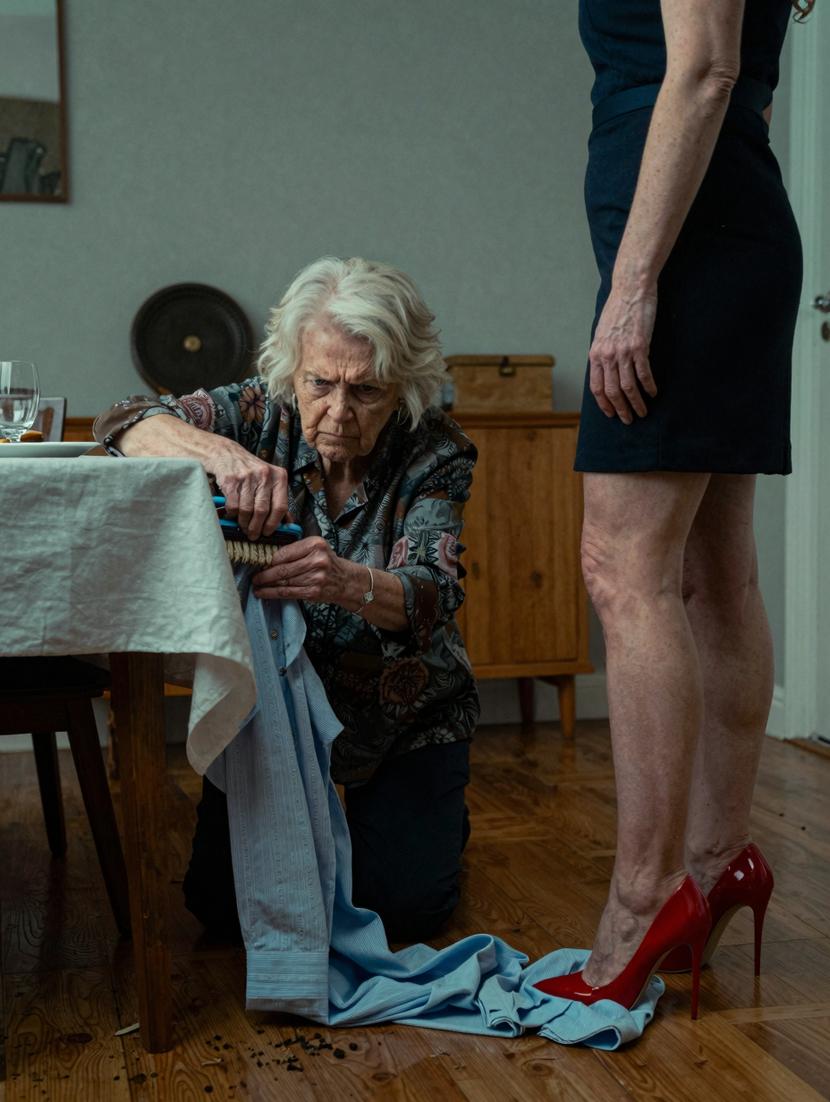
With a deliberate motion, Nadia stepped toward the sideboard and stooped to pick up the gift I’d set down just an hour earlier—a delicate table runner crafted painstakingly from my late husband’s favorite blue shirt. Each square inch of its soft cotton whispered memories. Every stitch was a thread of my aching hands, bruised by arthritis but determined. I had poured three weeks into it, weaving silent pleas for connection into every seam.
Without hesitation, Nadia dropped it to the floor. Then—slowly, cruelly—she placed her sharp red Louboutin heel on the fabric and ground it in.
‘You want us to keep this trash as a legacy?’ she hissed. ‘Take your lies and these cheap crafts and get out.’
That moment, with her cruel heel pressing on my husband’s memory, something inside me shifted—not anger, not sorrow, but a profound turning point. A pivot from suffering in silence to reclaiming my power.
I didn’t shed a tear. The years had sapped away my strength for that. Instead, I looked toward Ethan, my son—the boy I’d raised through storms and hardships, now seated solemnly at the head of the table. His gaze was fixed on his plate. No word of defense came from him.
Slowly, I bent to retrieve the ruined runner. A crescent of dirt marred the fabric like a bruise. I brushed it away tenderly. My eyes burned—not with shame, but something fiercer.
Standing tall, I smoothed the tissue back around the runner and reached inside my coat pocket.
There, folded crisp and unassuming, was a cream envelope. Inside—one page of legal instructions I had penned three years prior.
Clause 22.
This was my insurance. My quietly held promise. And it had to speak now.
—
Part 1: The Thief and the Baker
To understand why I carried that envelope, you must know who Nadia was before the glitz and glam.
I still recall the first time I saw her name on a resume. She was nineteen then, applying for a cashier position at my modest bakery, Clara’s Hearth. She showed up late, stumbling over lies about experience, unable to name a single type of sourdough. But her smile? It could slice through the thickest gloom. I hired her. I believed in second chances, just as someone had once believed in me.
But three weeks later, the till was short. I stayed late, watching from the back kitchen as Nadia slipped two twenties from the drawer into her apron.
I didn’t call the cops. Instead, with flour-dusted hands, I confronted her softly.
‘I could ruin your record,’ I said, ‘but I won’t. Leave. And don’t come back.’
Three years after that, Ethan brought her home.
‘Mom, this is Nadia.’
She had changed—polished and refined, claiming to study marketing. Ethan was enamored. He looked at her as if she were the moon and stars.
I said nothing.
How could I tell my son that the woman he loved was once a thief? Would he believe me? Or assume jealousy? So I stayed silent, letting them marry.
Nadia slipped into our lives like a shadow morphing the light. She began to reshape Ethan—then his house, then everyone around her. She asked pointed questions about money. Ethan’s startup had imploded, leaving him drowning in debt.
Unbeknownst to them, I wasn’t simply a baker. Though my late husband had left debts behind, I had paid them all. Quietly, I had transformed a humble life insurance policy into a portfolio worth millions. I lived simply in my small cottage, but on paper, I was powerful.
When Ethan’s company collapsed, I stepped in to save him. I created the Maren Caldwell Trust, funneled funds through shell investors to hide myself from his awareness.
But my lawyer, Elliot, warned me.
‘Mara,’ he said, ‘if he marries Nadia, you need legal protections.’
So we crafted the Emotional Equity Agreement. Ethan signed, likely without reading the small print, granting operational control of assets only if Clause 22 wasn’t triggered.
Clause 22 stated: if the beneficiary or spouse publicly humiliates, abuses, or estranges the grantor—in this case, me—all assets and control revert immediately and irrevocably to the grantor.
Nadia was oblivious. She saw only the fortune and the house, the cars and the lifestyle. She thought she’d won the lottery and I was just a burdensome, poor mother-in-law to be tolerated.
—
Part 2: The Dinner of Truths
That Thanksgiving was Nadia’s grand stage. She invited twenty guests—friends, neighbors, potential business partners. She craved the spotlight.
Upon arrival, the air buzzed with forced smiles and fragile performances.
‘Oh, Mara,’ Nadia crooned, her tone thin and brittle. ‘You brought… another one of your little projects? How quaint.’
She snatched the gift from me and carelessly tossed it onto the sideboard like yesterday’s trash.
Throughout dinner, I was marginalized—seated at the far end beside a stranger’s toddler. Nadia toasted to ‘success’ and ‘building empires,’ locking eyes with Ethan as she ignored the woman who had quietly built the bricks beneath their feet.
Then came the blow.
Glass chimed sharply as Nadia stood.
‘I have a surprise,’ she announced, brandishing a document. ‘A DNA test.’
A hush fell like a heavy curtain.
‘Ethan,’ she said, ‘your mother has been lying. She never told you who your real father was. The story of the high school sweetheart? Fabrication. That man never existed.’
I froze. The truth was a secret I’d guarded my entire life.
Back in 1983, a terrified nineteen-year-old janitor—me—had been assaulted and pregnant with no one to turn to. I fashioned a story to shield my son from a harsh truth, a phantom father to hold onto hope.
‘She’s a fraud,’ Nadia spat, eyes sharp and cruel. ‘Not a saint, just a woman hiding shame. You don’t belong in this house, Mara. You’re a mistake.’
Ethan looked at me, then away, shame clouding his face.
‘Mom,’ he murmured, ‘maybe it’s time to consider other arrangements. A retirement community, perhaps. Somewhere… controlled.’
Controlled. Like a caged child or trapped animal.
I watched my son turn his back on me. And with that, my hope died.
I stood up; the chair’s scrape echoed with finality.
‘I’m leaving,’ I declared.
‘Don’t forget your trash,’ Nadia sneered, dumping the box with my table runner to the ground. Her red heel stomped viciously on the blue fabric.
I reached into my coat, producing the cream envelope with quiet resolve. Walking past Ethan, I placed it softly near his wine glass.
‘Just a thank you,’ I said softly. ‘For the hospitality.’
Without a backward glance, I left.
—
Part 3: The Activation
Back in my humble cottage, I brewed a calming cup of tea. My hands trembled not with fear, but with purpose.
My phone buzzed. A message from my grandson, Noah.
‘Grandma, I’m so sorry. I recorded everything. Do you want it?’
I tapped back a single word: Yes.
Moments later, a video arrived—Nadia’s venomous words, Ethan’s cold suggestion to ‘manage’ me, and the red heel crushing that delicate fabric.
On my laptop, I composed an email to Elliot.
Subject: ACTIVATE CLAUSE 22.
Attached were the video, timestamped photos of Nadia’s eviction threats from weeks before, and everything needed.
At 8:06 the next morning, while Nadia likely luxuriated in silk pajamas in the master bedroom of the very house she thought was hers, a courier rang their bell.
Elliot later recounted what happened.
Annoyed, Nadia opened the door to find a thick packet.
‘Mrs. Turner,’ the server said, ‘you and your husband have 15 days to vacate.’
‘What? This is my house!’
‘Ownership was revoked under Clause 22. The Maren Caldwell Residential Grant is terminated.’
Ethan appeared, bewildered, and received a separate packet.
‘Mr. Turner, your voting rights in Valecrest Systems are suspended immediately. All assets revert to the Primary Trustee: Mara Caldwell.’
‘Reverted?’ Ethan stammered. ‘But she’s just a baker.’
‘She is the grantor,’ the server replied firmly. ‘She owns it all. You violated the terms of your allowance.’
By midday, their bank accounts were frozen. Company cards declined. Even Nadia’s Range Rover lease canceled.
Local gossip exploded by evening. Yet the real storm brewed when the local paper, tipped off by Elliot, published the scoop:
“Local ‘Self-Made’ Tech CEO Exposed as Trust Beneficiary; Thanksgiving Tirade Sparks Corporate Coup.”
The article linked to Noah’s video.
Social media erupted: #Clause22 trended. People condemned Nadia’s cruelty, mocked her shoes, and mourned the labor of love she had destroyed.
Ethan called five times, each ringing to voicemail.
Nadia’s rambling apology texts claimed stress and regret. I blocked her.
—
Part 4: The Peace
I left my small cottage—not because I had to, but because I wanted a new beginning. I purchased a sprawling farmhouse at town’s edge, with vast gardens and a sewing studio bathed in sunlight.
Though I had twenty-two million, I kept only what I needed for comfort. The rest I funneled into a trust for Noah—untouchable by his parents.
The remainder seeded the Maren Foundation, dedicated to housing, legal aid, and job training for older women cast aside or financially abused by family. We named our shelter The Indigo Thread House.
Six months later, Ethan appeared at my gate looking weathered and broken. Living in a cramped apartment since Nadia abandoned him, she was now embroiled in a failed lawsuit and dating a used car salesman.
“Mom,” he said through the intercom, voice trembling, “I’m sorry. I was weak. I let her poison me.”
I saw my son—but also the man who silently watched me suffer alone.
“I forgive you, Ethan,” I replied. “But forgiveness doesn’t mean access. You made your choice. Now live your life—and pay your own way.”
I didn’t open the gate.
Returning to my garden, the scent of lavender and hydrangeas wrapped around me. Tuesday’s sewing circle awaited.
They tried to bury me. But they forgot—I am a seed.
Sometimes, the most potent revenge isn’t noise or fury. It’s reclaiming what’s yours and firmly closing the door.
I am Mara. Not a ghost. I am the owner of this house.
And finally, at last—it is quiet.


