
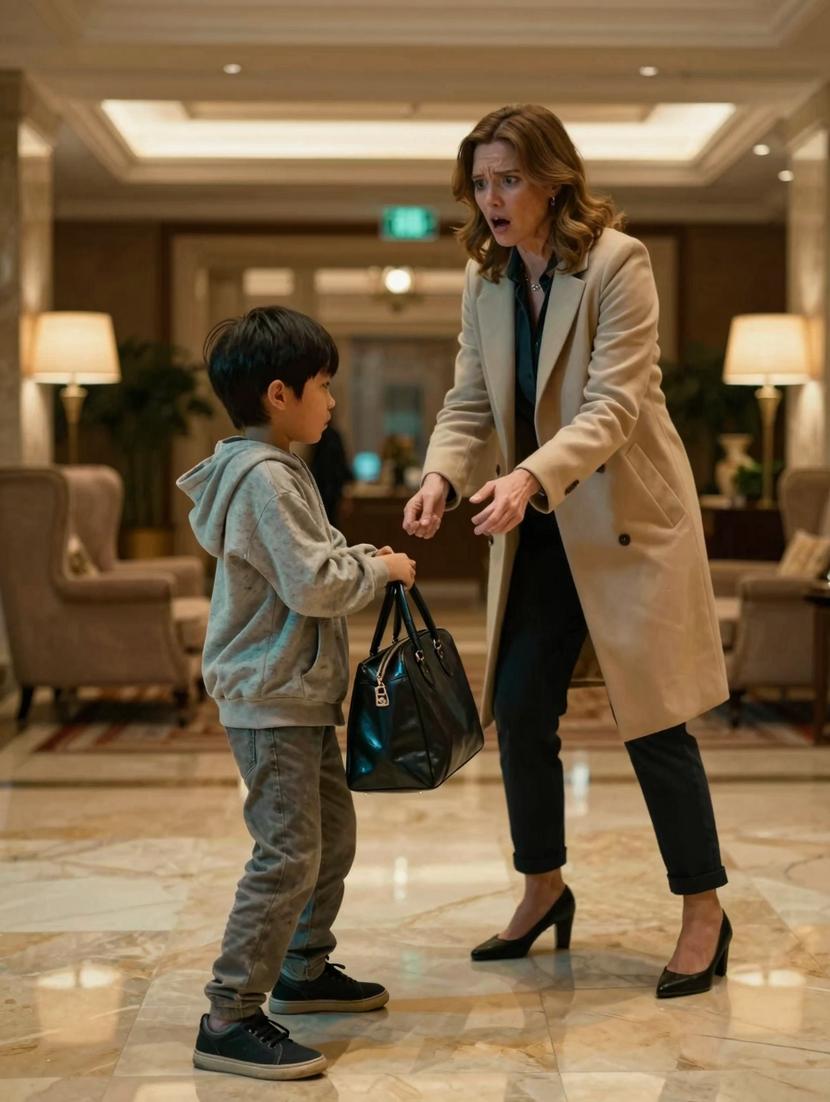
The woman was already making her way out of the grand lobby of The Alderwick when the moment shattered the ordinary. Her heels clicked out a steady, unhurried rhythm against the polished marble floor—a rhythm of innocence and the luxury of having nowhere to rush. The designer handbag hung from the crook of her left elbow, its supple leather gleaming softly under the golden lobby lights, while her right hand tightened her beige coat’s lapel against the chilly rush of air from the revolving door.
Just seconds earlier, everything had been as serene as any Saturday afternoon at one of the city’s most prestigious hotels could be.
The Alderwick’s lobby was alive with the comfortable murmur of quiet conversations drifting between plush armchairs, the relentless rumble of suitcases being ferried by weary travelers, and the delicate clink of glasses from the hidden restaurant around the corner. Somewhere, a pianist coaxed a slow, melancholy tune from ebony and ivory, thick European notes weaving through the warm golden light cascading from tulip-shaped fixtures. Guests floated in and out, entranced in their comings and goings, too wrapped in their own worlds to notice anyone else.
No one paid any attention to the woman in the beige coat.
And no one noticed the small boy sitting alone by the entrance.
For at least twenty minutes, he had occupied the edge of a wingback chair near a potted fern, swallowed into the relentless flow of lobby life—a still stone in a rushing river. Not fiddling with a phone or fidgeting nervously, just watching—silent and unblinking.
Then, without warning, he sprang up and dashed across the lobby.
Fast.
Directly toward her.
Before any startled guest could react—before the doorman could step forward, before the receptionist could raise her eyes—the boy’s small hands clamped tightly on the handbag. His stance widened, feet planted firmly like a sailor bracing against a rising wave.
She spun, startled, eyes wide.
“Let go of it!” she snapped sharply.
Her voice cracked through the soothing piano notes. Heads turned. Conversations paused mid-word. Even the pianist’s hands hovered, silenced.
The boy didn’t budge.
He couldn’t have been more than ten. Thin and fragile-looking—the kind of thin birthed by hunger, not health—his dark hair tumbled in unruly tangles over eyes wide but calm, not frightened. His threadbare grey hoodie and faded canvas trousers bore the dust of hardship, like someone who had known nights without warmth.
Still, his grip on the bag never wavered.
The woman yanked the bag with sudden force.
“Hey!” she barked, her polished composure cracking, something sharp and raw beneath the surface showing through. “Let go of me—right now!”
But the boy remained rooted, the bag stretched taut between them, pulling violently.
To an onlooker, it looked like a simple act of a scruffy child causing trouble—a thief or a prankster caught red-handed. Faces flickered with surprise, then irritation.
Until their eyes met the boy’s face.
There was no fury. No panic. Not even fear.
Only certainty.
With a firmer grip, the woman tugged again, knuckles whitening.
“I said let it go. Now.”
The boy’s head shook slowly.
His voice, quiet, careful, and unnervingly composed for one so young, cut through the hushed lobby.
“It’s not yours.”
The words sliced through the air like a dagger through silk.
Silence crashed down, immediate and absolute.
Only for a heartbeat.
But long enough to freeze the temperature in the room.
The woman stiffened. Color flushed deep into her neck. Her eyes blinked, and a practiced mask slid back into place—but slightly askew.
“What did you say?” she demanded, voice cold but tremulous.
The boy swallowed but held her gaze unwaveringly.
“I saw you take it. From the lounge. Someone left it unattended when she stepped away. You passed by, glanced around, then slipped the strap under your arm. I saw you.”
A corpulent man at the reception desk, silver cufflinks gleaming, radiating the air of a man used to dominance, stepped forward.
“Is there a problem here? Call the manager.”
Neither respondent spoke.
This was no longer just a scuffle over a handbag in a hotel lobby. It had transformed into a weightier, slower moment, prickling with tension—the kind of moment demanding truth.
The woman forced out a lingering laugh, sharp and practiced, dripping with condescension designed to deflate the boy’s confidence.
“You’re mistaken, dear,” she said smoothly. “This is my bag. I have had it with me all day. You must have seen things wrongly.”
“I saw you,” the boy repeated, voice steady. “Two hands. You tucked the strap under your coat. You walked toward the elevator, but then turned back through the lobby, like you changed your plan.”
Near the elevator, a young couple—fresh from their honeymoon—fell still. The receptionist now hovered nearby, her expression anguished behind a wall of caution, clearly wishing for a supervisor’s intervention.
The woman’s grip on the handbag tightened until the leather groaned. Her jaw clenched hard.
“This child is disturbed,” she declared, projecting her fury outward. “I don’t know where he came from or what nonsense he’s spun, but I’m a guest here. Someone should remove him.”
A new voice cut through the tension from the lounge area.
“That bag.”
Heads swiveled.
An elegant, silver-haired woman in her late sixties had risen from a low linen sofa. Small and poised, the kind of woman whose movements were measured by cautious knees, she approached slowly, eyes fixed on the handbag with dawning disbelief.
“That bag,” she repeated, voice rising softly but steadily. “That’s mine.”
The lobby’s bustling sound drained away.
Only the hum of the air conditioning filled the expansive room.
The woman in beige took a reflexive step back, not large, but unmistakable—a retreat.
“You’re wrong,” she said quickly, but the tremor in her voice betrayed her.
Fear had crept in, clear as day—the sidelong glances toward the revolving door, uneven breathing barely perceptible.
The older woman stopped before them, scrutinizing the handbag—more closely than the brand or sleek design, focusing on a small detail.
A tiny blue satin ribbon, tied neatly around the base of the left strap.
“I tied this ribbon myself this morning,” she said softly, voice quavering on the last word. “My granddaughter gave it to me for Christmas. She said it would help me find my bag in a crowd.”
No one dared speak.
The boy looked up at the older woman. Recognition flickered across his face—not triumph, not relief, but something deeper.
Slowly, deliberately, his fingers unfurled their clutch on the bag—one hand, then the other—as if truth itself demanded patience to reveal.
Within minutes, the hotel manager arrived—a tall man in charcoal grey who assessed the scene at a glance before signaling two security officers from a side corridor. He spoke quietly but firmly to the woman in beige, who replied with shrinking composure. The security officer took the handbag gently and placed it on the reception desk.
“Ma’am, we need to open this for verification.”
“That is absolutely not nec—”
“Ma’am.”
Her protest died in the sudden, authoritative insistence.
The manager unclasped the bag with clinical neutrality, pulling from inside its depths one item after another.
A burgundy passport, gold-embossed name gleaming.
A small midnight-blue velvet jewelry case, its flower-shaped clasp delicate.
A hotel room key card, and a neatly folded slip of paper with a room service order penned in a practiced, elderly hand.
No one breathed.
The older woman pressed a hand to her mouth, then cradled the jewelry case to her chest—the way one holds something too precious to lose.
The woman in beige was silent—still and diminished, shrunk beneath the weight of truth, smaller even than the boy beside her, who, though no taller than her shoulder, possessed no phone, no authority, no documentary proof—only his eyes and the courage to speak.
Within fifteen minutes, police arrived, and the lobby slowly resumed its rhythms—the suitcases rolling, conversations whispering back to life, the pianist tentatively striking up his melody once again.
The hotel manager crouched to face the boy at eye level.
“What’s your name, son?”
The boy looked up.
“Tuan.”
“Tuan,” the manager repeated gently. “Where are your parents?”
A long silence followed.
“I don’t know,” came the honest, unembellished reply—words from a child who already knows the hardness of truth.
The manager was quiet, then motioned to the receptionist, who nodded and disappeared.
The older woman—Mrs. Aldridge, as it turned out, a solo traveler from Edinburgh journeying to see her daughter after two years—lowered herself beside Tuan in the wingback chair beside the fern, still clutching the jewelry case.
“You saw me,” she said softly, a statement that carried no question.
“Yes,” he replied.
“You could have told someone. The staff. The doorman.”
He thought carefully. “I tried to reach the desk, but you were already moving. There was no time.”
Mrs. Aldridge studied Tuan—his worn-out hoodie, scuffed shoes, dark eyes unshadowed by fear but instead heavy with watchfulness and an ancient wisdom startling in someone so young.
“Are you hungry?” she asked quietly.
A pause.
“Yes,” he admitted.
She stood, smoothed her skirt, and extended a hand.
“The restaurant is just around the corner,” she said kindly. “And I owe you far more than a meal. But it’s a start.”
For a moment, Tuan hesitated, eyes on her hand.
Then he stood and took it.
Outside, the lobby swirled on around them—the rolling suitcases, the golden light, the guests absorbed in their own stories—while two unlikely allies walked toward the restaurant: an old woman and a boy who refused to stay silent.
Behind them, resting on the reception desk, lay the small blue satin ribbon beside the velvet jewelry case.
A tiny token bearing an ocean of truth.


