
The Dawn a Secret Whispered Into My Home
The first ripple of a baby’s cry in my bedroom that morning felt unreal—like a haunting echo born from relentless fatigue. Years of fractured sleep had sharpened my mind’s worst illusions, making the silent hours before dawn sound louder than life.
I’m Adrian Cole, a thirty-eight-year-old man who lived alone in an imposing stone mansion perched above the still waters of Lake Briarwood. Once bursting with laughter, chaotic dinners, and the mud of childhood adventures at its threshold, the house stood now as a solemn monument to loss—its silence only broken by the creak of forgotten footsteps.
That Thursday started like any other: I awoke restless before the sun crowned the horizon. As I ascended the grand staircase, a faint wail—a fragile, pleading sound—drifted from the half-open door of my bedroom. It was unmistakable: a baby crying.
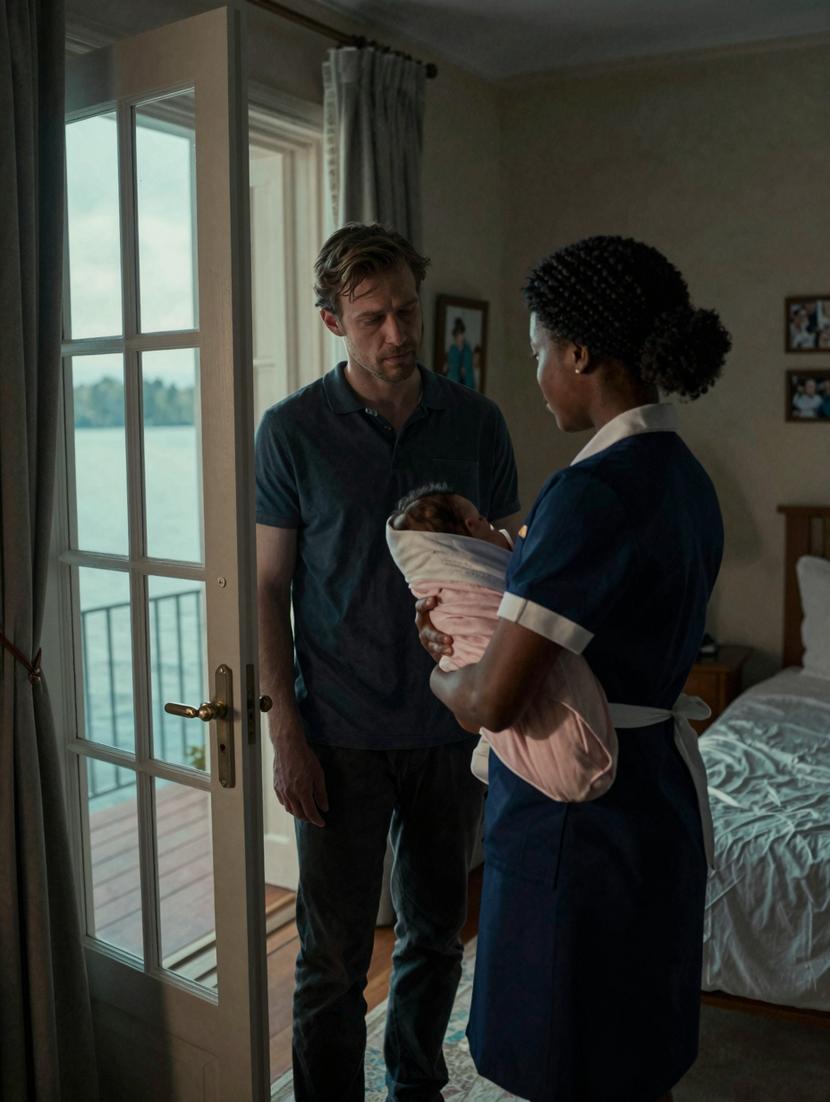
Pushing the door ajar, I found Nora Whitman, my housekeeper, standing rigid beside the dresser, her navy uniform neat but her face etched with raw fear. She cradled a tiny, swaddled bundle in a faded pink blanket. Instead of defiance, her eyes held terror, as if rehearsing a goodbye she never wanted to say. “Mr. Cole, please, I can explain,” her voice trembled, the revelation heavier than any words I’d heard before.
For two months, Nora had maintained the household’s rhythm like clockwork—quiet, respectful, unseen except in the careful precision of her work. Always entering before dawn, leaving at dusk, she kept her life beyond these walls shut tight—and I never pressed.
Now, that distance shattered with the fragile sound of a child’s cry.
‘The daycare shut down without warning yesterday,’ Nora began hurriedly, as if faster words might dilute the weight of what she confessed. ‘I couldn’t afford to miss another shift. And…I’m behind on rent. My landlord already gave notice. I had nowhere else to turn.’
The infant, no more than eight months old, had stopped crying and now studied me with solemn gray eyes—a pure, unfiltered curiosity that pierced the dim room.
The rules of trust were broken; this was no small trespass. Yet beneath my frustration stirred a raw, aching chord I hadn’t felt in years—an ache of recognition deeply buried behind ribs long guarded.
“How old is she?” I asked, voice low, almost hesitant.
Nora blinked, surprised by my gentleness. ‘Eight months, sir.’
Eight months. Ethan had been four months old when a silent heart betrayed him—gone in a breath. Years later, time still divided before his death and after, as sharply as a scar.
The baby reached out one tiny hand to me, as if my presence was something to explore, not fear.
“What’s her name?”
‘Maya,’ Nora answered, uncertainty shadowing the fear in her eyes.
Repeating the name under my breath, it felt foreign yet strangely stirring—as though a long-buried memory curved in response.
My gaze shifted to the walk-in closet, the door hanging slightly open, revealing rows of photographs pinned with quiet reverence: smiling babies, clippings from parenting magazines, precious stills from the brief life Ethan had.
After losing him, I’d collected these images in vain attempts to grasp the fleeting warmth of fatherhood, to hold onto a feeling that had slipped beyond reach.
Nora glanced toward the closet, then back down, whispers escaping her lips. “I didn’t mean to look—I just saw it open.”
Slowly sinking into the armchair by the window, I finally let my guard fall. ‘I had a son. He would be about her age now.’
Nora’s fear softened, replaced by a shared sorrow that needed no words.
‘I’m so sorry,’ she whispered.
Maya giggled lightly, tugging at a loose thread on my tie. The bright sound shattered the room’s heaviness like dawn breaking through night’s hold.
When Nora started packing her bag, resigned, expecting dismissal, I surprised her.
“You’re not going anywhere.”
Her body stiffened. ‘Sir?’
“If childcare fails again, bring her here,” I said, voice steadier than I felt. “This house has been too quiet for too long.’
Tears welled as she struggled to find words, silenced by hope.
What I didn’t share was the truth that the silence defining my life wasn’t sanctuary anymore but a cage of my own making.
The next day, my sister Evelyn arrived like a storm, sharp heels echoing purpose as she took in the sight of Nora on the floor with Maya, who laughed at a wooden rattle.
“Tell me this is temporary,” Evelyn demanded.
“It’s not,” I answered firmly.
Her eyes narrowed. ‘Adrian, you’re still grieving. You can’t hold onto the first child who walks into your life.’
Her words struck points I’d been battling alone in the quiet nights that swallowed me.
But when Maya crawled into my lap and gripped my pant leg with trust unmeasured, everything became clear.
“This isn’t about replacing anyone,” I said, determination firming inside me. “It’s about stepping back into life.”
Evelyn left unconvinced, warning about reputations and clients, about the risks of mixing business with personal ties.
For the first time in years, public opinion mattered less than the warmth rekindling in halls that once echoed loss.
Then came the visitor on a mundane Tuesday—Samantha Reed, an investigator from a nonprofit helping families search for missing children.
She asked for Nora by name, carrying a slender folder that ominously hinted at unraveling.
‘This may be difficult,’ Samantha warned as Maya played quietly at our feet, ‘but this child may match the description of a baby taken from a hospital eight months ago.’
The room shifted. I saw panic flicker across Nora’s face where I had expected denial.
“That’s impossible,” I said sharply.
Samantha slid a photo across the coffee table. The resemblance was chilling.
Silence fell, heavy as winter’s frost, until Nora broke down. ‘I found her outside a church, wrapped only in a blanket. She was cold and alone,’ she sobbed.
Samantha clarified, “She wasn’t abandoned—she was taken by a nurse suffering a psychological crisis who vanished after leaving the child.”
A fragile hope collapsed.
“You never reported this?” I asked, voice brittle.
Nora’s gaze dropped. ‘I told myself I would… I went to a station once. But when she stopped crying in my arms, I couldn’t give her up.’
Her confession cut deep—betrayal mingled with an undeniable love.
DNA tests confirmed the truth: Maya was not Maya, but Julia Bennett, the daughter of Daniel Foster and Hannah Mercer, who had searched for her for half a year.
When social services arrived to begin the painful transition, Julia reached for me, uttering a sound close to “Dada.” I looked away, fighting the tide of heartbreak.
Love doesn’t vanish with circumstances—it clings fiercely, stubbornly, even without rightful claim.
In the weeks that followed, I stood beside Julia in supervised visits, watching as the threads of her past life gently weaved back—for her, her parents, and even for me.
Daniel and Hannah met me with a grace I hadn’t deserved.
‘You kept her safe,’ Hannah said quietly one afternoon. ‘We will always be grateful.’
Nora and I drifted apart during that time, distance a necessary balm to untangle betrayal and affection.
When Julia finally left with her parents, I drove lost on winding roads by Lake Briarwood, wrestling with the bittersweet truth that what I felt had been real, even if born from deception.
One evening, I knocked on Nora’s apartment door. She looked fragile, stripped bare of the grounded strength she once wore.
‘I never meant to hurt you,’ she said before I could speak.
And I believed her.
What she did was wrong, but born of desperation and grief—a grief hidden beneath silence. She had lost a pregnancy months before finding Julia; a loss cloaked in shame too heavy to speak aloud.
We talked for hours—as two souls forever touched by the same fragile child.
‘If we try again,’ I told her, ‘there can be no secrets.’
‘There won’t be,’ she promised.
Our healing was quiet, unfolding in soft moments: morning coffee talks, walks along the lake, and cautiously rebuilding trust one day at a time.
Evelyn remained wary until she heard certainty in my voice when I spoke of Nora. Eventually, she accepted that happiness, once found, must be guarded fiercely.
Months later, Nora announced she was pregnant—this time carrying mine. Old fears stirred but were tamed by a steady resolve.
Our son arrived healthy, and we named him Ethan James—a tribute that honored both memory and new beginnings without confusion.
Julia stayed a part of our lives. Daniel and Hannah welcomed us to birthdays and holidays, embracing the belief that love is limitless, never divided or diminished.
The house by Lake Briarwood transformed in ways no renovation could dictate.
Toys appeared in corners; drawings adorned the refrigerator; laughter filled rooms once hollow with sorrow.
One evening, watching our children chase golden light beneath sprawling trees, Nora took my hand.
‘Do you ever wish that day had gone differently?’ she asked.
I thought of fear, anger, and loss nearly too vast to bear.
‘I wish there had been no lies,’ I admitted, ‘but I don’t regret where those lies led us.’
Because sometimes, the hardest truths reveal greater ones: that love transcends biology, that forgiveness is strength, and that even a house silenced by grief can learn to sing with life once more.
As the sun sank behind Lake Briarwood, flooding the lawn in amber, I understood: the secret carried up my staircase was not an ending, but the fragile beginning of a family forged through pain, courage, and relentless hope.


