
Chapter 1: The Slow Fall
My name is Mia Hart, and just six months ago, the word ‘homeless’ wasn’t even in my vocabulary. Back then, I was a nursing assistant with a worn-out vanilla-scented car, a modest savings stash, and a life that seemed predictable and manageable. I paid rent on time, clipped coupons like a pro, and thought I had adulthood figured out.
But life doesn’t always follow the script.
The descent was no sudden plunge but a gradual, merciless slide: a rent increase that swallowed a large chunk of my paycheck, a car that demanded costly fixes, and then a sick day that stretched into a week. Slowly, the ground beneath me crumbled until, one bitter morning, it simply disappeared altogether.
Trying to get my six-year-old daughter, Naya, ready for school from the confines of a shelter is like running a chaotic airport where passengers cry and the security line is shame itself. And that day, to make matters worse, Naya was missing one sock.
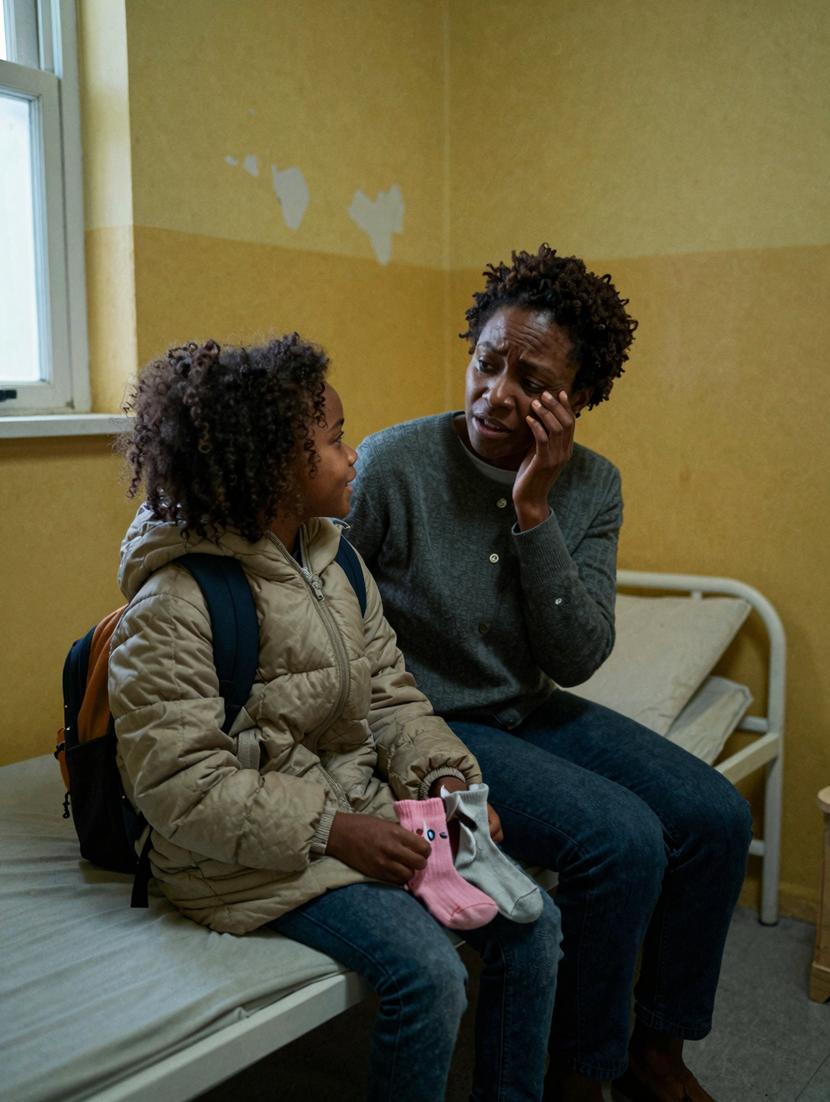
We huddled on the edge of a cot in Room 3C of St. Branna Family Haven, a gloomy concrete room painted a tired institutional yellow, peeling at the edges like our hopes. The air was tinged with bleach and boiled cabbage mixed with whispers of despair that clung like a shadow.
Outside, the sky was bruised, heavy with snow. Inside, I frantically rummaged through a plastic bin, fingers trembling from caffeine and anxiety.
“Mom,” Naya whispered, her voice small but strong, trying to be the grown-up for once. “It’s okay. I can wear different socks.”
She held up a pink sock decorated with a unicorn, a fragile remnant of our past life, and a grayish-white athletic sock that had clearly lost the battle against the wash cycle. I stared at them like evidence of a crime scene—a telltale sign that our world was unspooling.
‘It’s a bold fashion choice,’ I managed, forcing a smile as fragile as spun sugar. ‘Very… rock star rebel.’
Naya returned a brave little smile that didn’t quite reach her eyes. ‘Very.’
For a brief moment, I almost forgot where we were. Then, a harsh buzz sliced through the silence—the shelter door unlocking—and reality crashed down again.
We stepped out into the biting pre-dawn air, sharp and metallic like winter had scrubbed the world with steel wool. Naya adjusted her oversized backpack; I zipped her coat tight, avoiding the heavy sign above us: FAMILY SHELTER. It wasn’t the word ‘shelter’ that wounded me most but ‘family,’ as if we were branded failures, boxed and discarded.
‘Okay,’ I said, checking the cracked screen of my phone. ‘School bus in five.’
Naya nodded. Her quiet resilience sparked both pride and crushing guilt in me. Then, she asked the question I’d been dreading.
“Do I still have to say my address when Mrs. Dalton asks?”
My stomach clenched, knotting tight and cold. The school knew, of course. The McKinney-Vento Act guaranteed her education continuity, but it couldn’t shield her from the curious stares of classmates or the pity in teachers’ eyes.
‘I don’t think she’ll ask today,’ I murmured—a soft lie, cushioning us both from bitter truths.
Naya lowered her gaze to her mismatched shoes then studied my face as if scanning for remnants of the mother she knew.
“Mom, are we going to move again?” she whispered.
I opened my mouth to answer with hopeful words of adventure, but my throat tightened like iron. How could I promise certainty when I had none? The shelter’s ninety-day limit loomed over us; we were only halfway through.
And then, the black sedan eased to a stop outside like a shark gliding into shallow water.
Chapter 2: An Unexpected Arrival
Not a taxi. Not a rideshare. A sleek, gleaming Mercedes stood out sharply against the cracked pavement. The windows were dark, reflecting the faded streets back at themselves.
The back door popped open and out stepped a woman who seemed pulled from another world.
Vivian Hart. My grandmother.
I hadn’t seen her in over a year—the two halves of my life cleaved by hardship. She belonged to a universe of country clubs, boardrooms, and crises resolvable with a pen and checkbook. Elegance embodied in midnight-hued wool and heels that clicked with authority. Her silver hair was swept into a chignon so perfect, it might have been carved from marble.
Her gaze locked on me, flicking from recognition to confusion, then to my daughter Naya.
In an instant, her composed face cracked like a flawless pane shattering. She glanced at the St. Branna sign, then back at me with weighted intent.
‘Mia,’ she said—my name felt strange on her tongue, heavy with questions I wasn’t ready for. ‘What are you doing here?’
I wanted to disappear beneath the weight of shame.
‘We’re fine,’ I lied, voice breathless and brittle. ‘It’s just a rough patch. Temporary.’
Vivian’s eyes dropped to Naya’s mismatched socks, then to my chapped hands. Her voice lowered, more commanded than questioned.
‘Mia, why aren’t you living in your house on Willowbrook Avenue?’
The ground shifted beneath me.
‘What house?’ I whispered, a thin thread breaking.
She repeated, slower, every syllable sharp as winter air: ‘The house on Willowbrook Avenue. 140 Willowbrook.’
My heart thundered in my throat. Willowbrook Avenue—the neighborhood of leafy oaks and pristine sidewalks.
‘I don’t have a house,’ I croaked. ‘Just a bin of clothes and a number on a waitlist. A car that might not start tomorrow.’
Vivian stared as if hearing tongues. Behind her steady gaze, I glimpsed a storm of calculation.
Naya tugged my sleeve, eyes wide with fragile hope. ‘Mom, do we have a house?’
My chest ached anew.
‘No, sweetheart,’ I whispered.
Vivian, frozen yet poised, stepped closer and shocked me by crouching before Naya. The matriarch who ruled in polished boardrooms lowering herself to the dirt-stained coat hems of a homeless child.
‘You’re Naya, right?’ she asked gently.
‘Yes,’ Naya whispered, clutching her backpack.
Vivian’s face softened briefly. ‘That’s a beautiful name. You look just like your mother did at that age.’
Then the steel returned.
‘Get in the car,’ Vivian commanded.
‘But Grandma, I have to get her to school, and I have work—’
‘Get. In. The. Car,’ she insisted, no room for argument.
A rush of conflicting emotions—anger, humiliation, relief—flushed me. Vivian opened the car door. Naya looked up at me.
‘It’s okay,’ she said, steady. ‘She looks like a boss.’
That was all I needed. I nodded.
We slid into the leather-cushioned, silent cabin. Vivian did not immediately start the engine. Instead, she clasped her hands over the wheel, her gaze fixed ahead.
‘By tonight,’ she said quietly, ‘I will know who did this.’
Chapter 3: Unmasking Betrayal
My stomach twisted.
‘Grandma, I don’t understand,’ I began. ‘Who did what? I just—couldn’t pay rent. Prices went up…’
‘No,’ Vivian interrupted, eyes meeting mine in the rearview mirror. ‘You don’t understand. That’s exactly why I’m involved.’
She dialed her phone and spoke firmly. ‘Call Ethan.’
A man answered on the first ring.
‘Ms. Hart,’ he greeted.
‘Ethan, get the property manager for 140 Willowbrook Avenue on the line. I have three questions: Who has the keys? Who is living there? And where has the rent money gone?’
My blood ran ice cold.
The voice answered: ‘Keys signed out to Sandra Hart-Collins in July. Property occupied by tenants on a twelve-month lease. Rent deposited into an account ending 4099.’
Vivian ended the call, the air thick with unspoken rage.
‘I bought that house for you,’ she revealed quietly. ‘Six months ago. I trusted your parents to hand you the keys, to help you move in, to give you and Naya the stability you deserved.’
My grip tightened on the door handle. ‘They kicked me out. Said I needed to be independent. Said they needed the space.’
‘Lies,’ Vivian stated unequivocally. ‘They took the keys, rented the house, and collected the rent while you two were homeless.’
I felt like vomiting at their betrayal — my own parents turning my hardship into profit.
Vivian started the car. ‘Where to?’
‘Breakfast?’
‘Yes. Then, a party.’
Chapter 4: Taking Back Control
The day unfolded in a whirlwind. Vivian secured a luxury hotel suite where Naya reveled in tiny soaps and buttery pancakes while I sat numb. Vivian orchestrated calls with lawyers, bankers, and investigators as if leading corporate warfare. She ordered me a phone, arranged for a stylist—everything fit for a queen reclaiming her kingdom.
‘Why didn’t you call me?’ she asked softly during a lull.
Sandra’s gatekeeping had been impenetrable; she’d told Vivian I was ‘settling in beautifully’ and ‘too busy with the new house.’
The betrayal was raw and physical.
That evening, Sandra and Daniel hosted the annual Harmony Family Dinner, a carefully staged facade of family unity.
Vivian presented me with a navy-blue dress. ‘You need dignity, not armor,’ she advised.
We arrived fashionably late. Naya was cared for in a nearby room, shielded from the looming confrontation.
I entered the banquet hall alone. The chatter stilled as Sandra’s smile faltered, Daniel stiffened. They watched, expecting pleas or breakdowns.
Then Vivian entered, poised and unstoppable, accompanied by Ethan, her attorney.
‘Sandra,’ Vivian’s voice cut through the silence. ‘Before dinner, let’s clear something up.’
Ethan linked his laptop to the projector. The screen filled with a photo: 140 Willowbrook Avenue.
Murmurs rippled.
‘You told me Mia lived here, that she was happy,’ Vivian said, eyes blazing. ‘You sent pictures of a garden.’
Sandra faltered, stammering excuses.
‘Let’s look at facts,’ Vivian pressed.
The slides shifted: keys signed to Sandra, tenants’ lease, deposits into Sandra and Daniel’s joint account totaling $18,000.
The room fell deathly silent.
‘You didn’t just take the keys,’ Vivian said icily. ‘You converted your daughter’s home into profit while she and your granddaughter lived in a shelter.’
Gasps echoed.
Red-faced, Daniel rose. ‘This is a private matter! We were protecting her assets until she could handle responsibility!’
‘You made it public when you cashed those checks,’ Vivian snapped.
Turning to everyone, Vivian declared their cut-off—no inheritance, no trust, no family resources. They would repay the stolen rent with interest and face the consequences.
Sandra broke down crying, unraveling the carefully constructed life they’d built on deceit.
Ethan handed Daniel legal papers: fraud, embezzlement, eviction notices to tenants.
Sandra pleaded with me. ‘We’re family! How can you do this to us?’
I looked at the faces that had abandoned us and profited from our pain.
‘You should have remembered that,’ I said softly, ‘before you made a business out of my homelessness.’
I walked away, leaving behind the shattered illusions.
I gathered Naya and left with Vivian.
On the car ride, Naya rested her head against me, tired and safe.
‘Grandma,’ I whispered, ‘what now?’
Vivian’s eyes, though tired, sparkled with resolve. ‘Now,’ she said, ‘we reclaim what’s yours.’
Chapter 5: Rebuilding
Six months later—and our life is finally peaceful in the best way.
We live on Willowbrook Avenue in a charming brick colonial with a welcoming porch. Naya has her own lavender room, walls adorned with her whimsical drawings of crooked houses and smiling suns. She walks to school without fear, freely sharing her address and inviting friends over.
I’m still a nursing assistant, but now I’m finishing my RN degree—thanks to Vivian’s insistence. It’s an investment, she calls it, but it’s really the chance to build a future on my own terms.
Vivian visits Sundays, bringing pastries from Briarwood Bakery and pretending it’s all for Naya. But she always lingers, sipping coffee and asking about school and classes, forging a relationship grounded in dignity and respect—not obligation.
Daniel and Sandra? They faced consequences no one saw coming. Forced to repay stolen rent, their local reputations shattered, debts revealed by Vivian’s cut-off. They sold their big house, relegated to a small condo miles away.
They tried to call once—to negotiate, to explain. I blocked the number.
In that shelter, I learned a brutal truth: arrogance won’t stop you from falling. But truth is the solid ground we rebuild on.
Yesterday, Naya asked if Vivian liked our new house.
‘Yes,’ I told her, gazing around at sunlight streaming through peaceful rooms. ‘She loves it.’
And for the first time in a long time, I do too.


