
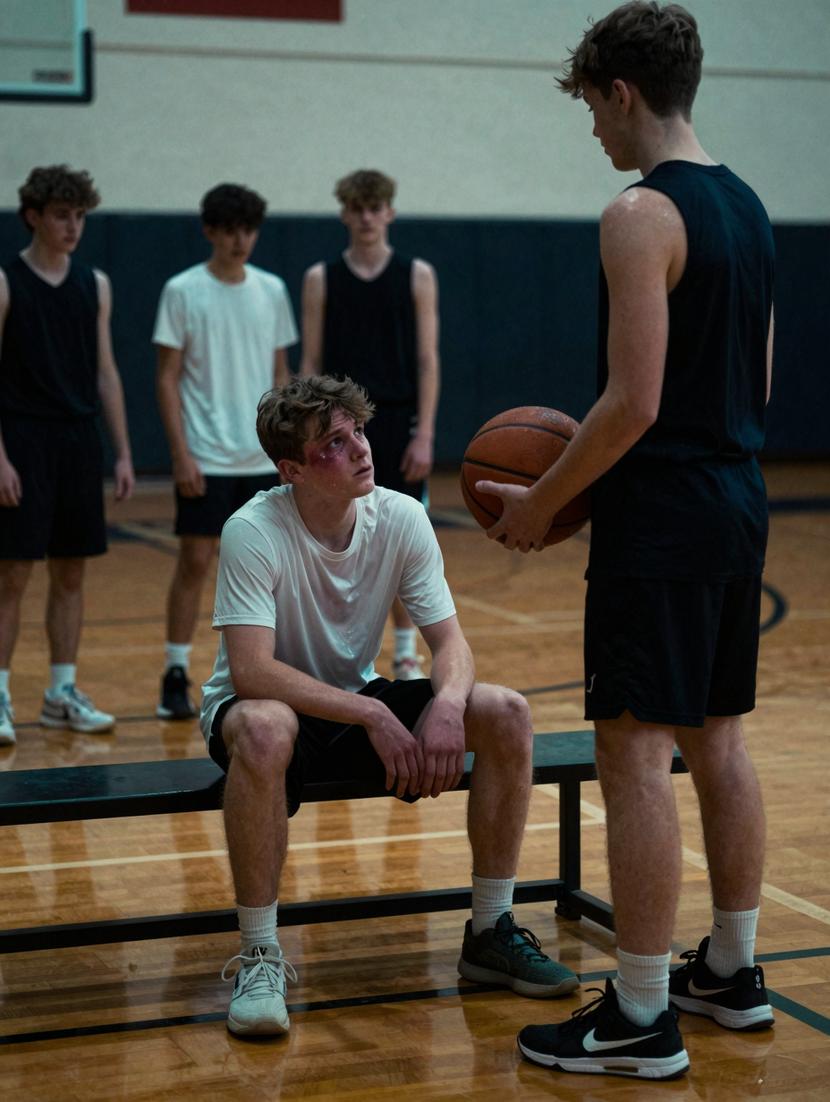
The gym buzzed with the careless chaos of adolescence—loud music echoing off gleaming walls, sneakers squeaking on polished floors, and the chatter of teenagers lost in their own worlds. For most, it was just another rowdy hour of physical education, a break from the monotony. But for him, the noise wasn’t background; it was a storm he had learned to endure. The weight of invisible judgments and an unspoken hierarchy pressed down on him like suffocating air.
That day, he ran faster and longer than he ever had before. Not to win a race or gain attention, but to escape the whirlwind of thoughts pressing on his mind. Sweat stung his eyes and soaked through his shirt, heartbeat pounding like a fierce drum in his ears. When exhaustion finally forced him to stop, he collapsed onto the bench, gasping for quiet—a brief respite that felt long overdue.
What happened next was swift and unexpected.
Across the room, he caught a glimpse of a boy holding a basketball, the mischievous glint unmistakable. But by then, a chilling laugh was already surfacing among the crowd, a ripple of amusement that stretched out and wrapped itself around the space between them. Without warning, the ball slammed against the side of his head—a dull thud that reverberated deeper than pain. His breath hitched, and then came the sound that pierced him sharper than the blow: laughter.
Not the kind that asks if you’re okay. Not the kind that offers kindness or concern. This was laughter that assumed he’d stay broken, stifled, invisible.
Phones whipped out, capturing the moment like a cruel trophy. Somebody cracked a joke—a line as familiar and exhausting as every humiliation he had swallowed since he could remember.
The boy who had thrown the ball wasn’t some dark villain straight out of a storybook. He wore confidence like armor, exuding the easy dominance of those who belong and have claimed their unchallenged place. That was what twisted the pain sharper—the cruel certainty behind a face that smiled without remorse.
Still seated, he refused to give them the spectacle they craved. He didn’t clutch his aching head, didn’t scan the room for sympathy. On the surface, he seemed calm, almost detached. But inside, something tightened slowly, like a knot being pulled taut with every second the laughter dragged on, heavier and heavier.
For years, silence had been his shield.
He believed that if he didn’t respond, if he bore the weight without complaint, the torment would fade. Patience would fray the cruelty. Quiet endurance was his protection.
But sitting there, sweat dripping and laughter ringing like an unbearable echo, the harsh truth crystallized in his mind: silence had never been safety. It was a signpost—a permission slip—that told others how far they could go.
This revelation came not in a storm of fury, but in a cold, clear wave of understanding.
His breath evened out. His jaw clenched with deliberate resolve. The room’s noise felt distant, as if he was hearing it from somewhere far away.
He rose. Not in anger, not in desperation, but with a steady, intentional calm. The laughter faltered, unsure now. The crowd noticed the shift—no shame spread across his face. No pleading. No fragility.
His eyes locked onto the boy who had hurled the basketball, cool and unwavering.
“You’re making a very big mistake,” he said, his voice carrying a quiet strength that filled the space between them.
Silence almost swallowed the gym. There was no uproar, no cheers, no taunting comeback. For one suspended moment, it was as if the room itself held its breath, sensing that an invisible line had been crossed—an unspoken truth had been spoken aloud.
He didn’t wait for an apology. Didn’t linger to explain. He just walked away, each step a declaration.
Not all moments cry out for grand gestures or fiery speeches. Some only demand a choice. That day, for the first time, he refused to vanish into the background. He chose to stand, to be seen—not as the silent victim, but as someone who would no longer disappear.


