
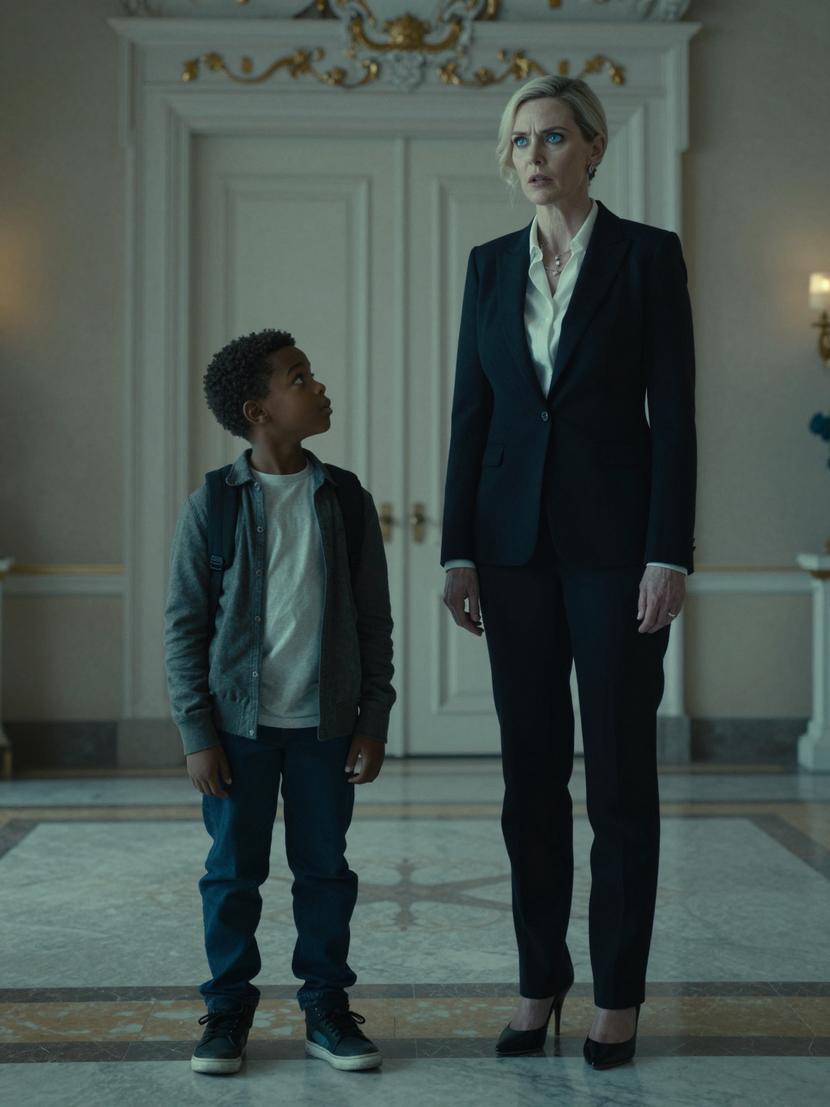
“Do you honestly expect me to believe some superstitious nonsense from a street kid?” Evelyn Whitford’s voice sliced through the cavernous mansion like a shard of ice, her cold blue eyes drilling into the 12-year-old boy who stood unflinching in front of her.
Ethan Carter had just delivered the boldest proposal of his young life. For three days, he had watched the bitter woman discard plate after plate of untouched food, while he and his grandmother suffered hunger just across the street.
Finally, resolving to act, Ethan had knocked on her ornate door.
“Ma’am, I’m serious,” Ethan said with steady calm. “I can help you walk again. All I ask is for the food you’re about to throw away.”
Evelyn’s laughter was sharp and cruel, reverberating off the marble floors, mocking him.
“Child, I’ve poured over fifteen million dollars into the care of the world’s finest doctors for eight long years. You think a ragged boy like you can achieve what they couldn’t?”
What Evelyn didn’t realize was that Ethan was no ordinary boy. As she looked down her nose with disdain, he scrutinized every nuance of her daily life—the small details her team of specialists had failed to notice.
“She takes her medication every day at exactly 2 p.m.—three white pills, one blue,” Ethan said softly. “And she always complains her legs feel ice cold, no matter the season.”
A flicker of doubt clouded Evelyn’s arrogance. “How do you know this?”
Ethan’s eyes gleamed with quiet confidence. Weeks of careful watchfulness had taught him much—not from idle curiosity, but because she mirrored the symptoms his grandmother, Hazel Bennett, had endured before surgery saved her life.
“You don’t need more drugs,” he declared. “You need someone who truly understands that sometimes healing doesn’t come from medicine alone.”
Evelyn slammed the door in his face, but Ethan caught a glimpse of something darker beneath her fury: fear. Fear that a poor boy had uncovered what her elite doctors had missed.
—
Back at their humble apartment, Ethan sat quietly on the porch beside Hazel Bennett.
“Grandma, tell me again about pseudoparalysis,” he urged.
Hazel smiled—a warm, proud glow lighting her face. Her wisdom was a legacy from generations of Louisiana midwives and herbalists, passed down mother to daughter.
“You’re a clever one,” she said softly. “You noticed what I did, didn’t you? Her legs twitch when she thinks no one’s watching. The muscles respond—but only subconsciously, tied to feelings she won’t admit.”
Ethan nodded slowly. Evelyn was trapped within her own mind—her body still worked, but her psyche had forged invisible shackles.
“Exactly,” Hazel confirmed. “Three generations of healers taught me this: sometimes the body lies, but the mind always tells the truth.”
—
That afternoon, a new set of tests arrived with Dr. Caldwell, Evelyn’s private neurologist.
“Evelyn,” he said, pushing his glasses up his nose, “there is no physical cause for your paralysis. Neurologically, your nervous system functions perfectly. This suggests your trauma has taken on a physical form.”
Evelyn’s world teetered. Eight years confined to a wheelchair, and it had all been psychosomatic? Worse still, a poor boy had identified the truth within minutes, something her multimillion-dollar specialists had missed.
That evening, she stared across the street at Ethan’s modest apartment—lights flickering inside, shadows moving.
A family with nothing, yet armed with knowledge money couldn’t buy.
For a fleeting moment, humility softened her pride. Then anger flared anew.
“That boy won’t humiliate me,” she whispered under her breath.
—
What followed was a covert battle of wills.
Evelyn launched a silent assault: calling Ethan’s private school to accuse him of trespassing and harassment; pressuring the building manager to evict them.
“He’s trying to push us out,” Ethan confided to Hazel one evening as she brewed their herbal tea.
Hazel’s eyes were calm, steady. “She’s scared,” she said quietly. “When the powerful fear the powerless, it’s because their consciences are stained. And when they fear the truth, they will stop at nothing to silence it.”
—
Hazel shared a lesson forged from her own past struggles.
“When I was your age,” she recalled quietly, “a white doctor once tried to silence me because I knew remedies he didn’t. I watched, learned, documented everything. And when the moment came, I used his own knowledge to prove the truth. The truth always finds the light.”
Ethan’s resolve deepened—Evelyn wasn’t just afraid he could heal her; she feared the exposure of uncomfortable truths.
—
That night, curiosity and courage led Ethan to dig deeper.
Evelyn hadn’t been born into wealth. The daughter of poor European immigrants, she had married Jonathan Whitford Sr., heir to a fortune built on the darkest foundations of slavery.
Her accident had occurred just a day after discovering Jonathan planned to divorce her for a younger woman. Suspiciously, he died two years later—leaving her the vast Whitford fortune, thanks to a will changed only a week before his death.
Even more shocks awaited: generations of Ethan’s family had served the Whitfords as loyal workers, their heritage intertwined yet concealed by wealth and power.
—
Ethan understood the tangled web of pride and pain fueling Evelyn’s hostility.
She was wealthy, proud, and deeply wounded—but he carried within him generations of forgotten wisdom and an unyielding gaze where others looked away.
And he had a plan.
Because healing is never just about the body.
Sometimes, it means unraveling the silences and revealing the truth.
And Ethan Carter knew exactly how to do that.


