
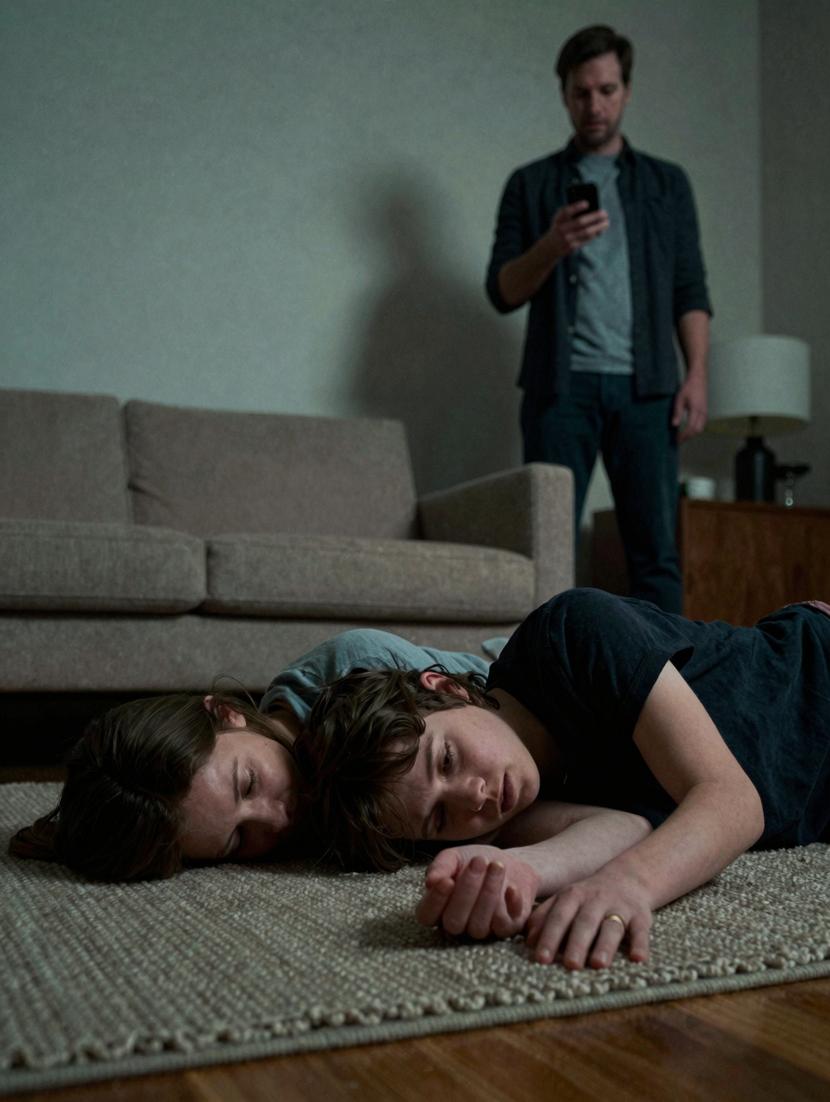
For a fleeting moment, the evening air in our home felt ordinary—almost warm. Calvin moved through the kitchen with the precision of a man determined to convince us that everything was normal. He hummed softly, wiping the counters with such deliberate care it seemed rehearsed, setting the table with actual dishes—not our usual, weary plastic sets. When he poured Noah a small cup of apple juice, it was accompanied by a smile that stretched too wide, too forced.
“Look at Dad,” Noah teased quietly, a small grin lighting his face. “Chef Calvin.”
I returned the smile, but beneath it, a quiet tension knotted my insides. Calvin hadn’t grown kinder in recent days—he had simply become more guarded, like a predator tiptoeing around his own dark design.
We ate chicken and rice—the kind of dinner meant to comfort, to anchor us to safety. But Calvin barely touched his own plate. His eyes flicked with restless anxiety to the phone lying face down beside his fork, as if awaiting silent command.
Midway through the meal, a heavy fog clouded my mouth. My tongue thickened. My limbs felt as though weighed down with hidden chains, sluggish and distant, sinking beneath an invisible current.
Noah’s lids fluttered, confusion blooming in his eyes. “Mom,” he murmured, “I’m… sleepy.”
Calvin’s hand brushed gently over Noah’s shoulder, light as a secret blessing. “It’s okay, buddy. Just rest.”
The word sent icy dread slicing through the haze.
I forced myself upright too quickly—pain and dizziness crashed over me like a wave. My knees gave way beneath me. I grasped at the table’s edge, but it slipped like mist through my numb fingers. The floor rushed up to swallow me whole.
Darkness stretched its cold fingers toward me.
And then, in that final moment before I succumbed, I made a silent choice: my body would fall limp—dead to the world—but my mind would hold fast. Awake. Alert.
My cheek touched the rough fibers of the rug, faint detergent scent grounding me in the chaos. Nearby, Noah’s small frame sank beside me, emitting a faint whimper before stilling. My instincts screamed to reach for him, to scream, to fight—but I held my breath and forced myself still.
Through the haze, footsteps approached—deliberate and slow, as if Calvin feared disrupting a staged scene. His shadow darkened my face; a polished shoe nudged my shoulder, testing.
“Good,” he whispered, voice a thread of satisfaction.
He lifted his phone and moved toward the hallway. From the depths of my forced unconsciousness, I caught the chilling exchange.
‘It’s done,’ Calvin said quietly into the receiver. ‘They ate it. Soon, they’ll both be gone.’
A woman’s voice crackled with urgency on the other end: ‘Are you sure?’
“Yes,” he replied, cold and methodical. ‘I followed the dose exactly. It’ll look like an accident. I’ll call 911 after… after they’re beyond reach.’
Almost a sigh came through. ‘Finally. Then we can stop hiding.’
Calvin exhaled, heavy with years of repression. ‘I’ll be free.’
The sound of a door creaking open—the closet, then a drawer sliding. Metallic clinks echoed ominously.
He returned dragging something that scraped the floor—an evidence of his sinister preparation, maybe a duffel bag. Standing over us again, his silence weighed suffocatingly, like a hand closing around my throat.
“Goodbye,” he whispered, before the front door slammed behind him, releasing a breath of cold air.
The silence that followed was deafening.
My heart thundered so fiercely, I feared it might betray us from the street.
Summoning every shred of strength, I barely whispered to Noah, “Don’t move yet.”
Then I felt it—his fingers twitching faintly against mine. Alive.
Noah’s weak but determined squeeze gave me the light of hope I desperately needed.
“Quiet,” I breathed, scarcely forming the word. “Pretend.”
His shallow, uneven breaths told me the toxin hadn’t fully claimed him. Perhaps he ingested less, or spilled some juice—divine luck finally tipping scales in our favor.
We remained still until the house settled into a deep silence—no footsteps returning, no door creaks, no shifting keys. Then I cracked open my eyes just enough to glimpse the microwave’s red clock glow: 8:42 p.m.
My limbs felt like leaden weights, but I managed to reach behind for my phone, moving with painstaking slowness. The screen flickered alive, and my heartbeat spiked—quickly dimmed again.
No signal. One faint bar—then gone.
Classic dead zone—the living room’s curse, something Calvin once joked about.
Dragging myself, pulling with elbows, every movement screamed too loud. Noah followed silently, trembling. At the hallway, a single bar stubbornly appeared.
I dialed 911.
Failing at first, hands trembling with panic, I tried again.
Finally, a steady voice answered, calm amidst my fear: “911, what’s your emergency?”
“My husband poisoned us,” I whispered, voice fragile yet resolute. “He’s gone. Noah’s alive. We need help.”
“Your address? Are you safe now?”
“I don’t know if he’ll come back. He’s talking to someone. Said he’d call to make it look accidental.”
“Stay on the line. Help is on the way. Can you get fresh air or reach an unlocked door?”
I glanced at Noah. His pupils were dilated, skin cold.
“Noah, can you stand?” I coaxed.
His knees shook as he tried. “I feel strange,” he murmured.
“We’ll move to the bathroom. Lock the door. If you feel sleepy, keep your eyes on me, okay?”
We stumbled into the bathroom, locking it tight. I ran water slowly. Noah sipped as I steadied my trembling hands. Years-old first aid lessons echoed: don’t be a hero with poison—seek help, buy time.
The dispatcher questioned what we’d eaten, when, any allergies. I answered through nausea and ringing ears.
Suddenly, my phone buzzed—a cryptic message from an unknown number:
“CHECK THE TRASH. PROOF. HE’S COMING BACK.”
My stomach twisted into knots. Who was watching? The same woman on the phone? A neighbor spying on the nightmare unfolding?
Desperate, I opened the medicine cabinet and found an old bottle of activated charcoal from a past stomach bug scare. I hesitated briefly—then acted. Noah’s life wasn’t a gamble.
Sirens pierced the distance, growing louder by the second.
Then, downstairs—the front doorknob rattling.
Calvin was back.
Not alone.
Two sets of footsteps crossed the living room.
The dispatcher cut sharply through my panic: “Officers are arriving. Stay in the room unless told otherwise.”
I pressed my hand lightly over Noah’s mouth—not to silence, but to remind him: stillness, quiet.
Outside, footsteps stilled. An unfamiliar low voice muttered, “You said they were out.”
“They are,” Calvin whispered darkly. “I checked.”
Ice coiled in my veins. He hadn’t come alone—he’d brought an accomplice, someone to cover the tracks and silence any signs of survival.
Calvin’s shoes paused at the bathroom door. Fear seized me—would he try the knob? Realize it was locked?
But he didn’t.
His whisper was chilling, almost tender: “In a minute, we call. We cry. We say we found them like this.”
The other man chuckled darkly. “You sure the kid won’t wake up?”
Calvin’s voice hardened. “He ate enough. He’ll be gone.”
Noah’s wide, tear-filled eyes met mine. Stay with me. Not yet.
Suddenly, loud, commanding knocks shattered the tense quiet.
“POLICE! OPEN UP!”
Chaos erupted. The stranger cursed, Calvin hissed back. Footsteps scrambled, a drawer slammed, a metallic clatter fell to the floor—possibly a bottle.
The dispatcher’s voice urged: “They’re here. Do not leave the room.”
The door flung open. Officers poured inside, voices sharp and authoritative.
“Sir, step away from the hallway. Hands where we can see them. Who else is inside?”
Calvin’s practiced calm tried to fool them. “Officer, I called—my wife and son collapsed, I—”
An officer cut him off harshly. “Your wife’s 911 call brought us. She’s alive.”
Silence fell. Then the breath Calvin sucked in tasted like defeat.
I unlocked the door and stepped out, Noah trailing, legs shaky but moving. Officers swarmed the hallway. One knelt before Noah, speaking softly; another guided me toward waiting paramedics.
Calvin remained in the living room, hands raised half-heartedly, face a mask of fake shock. His eyes met mine—not remorseful, not pleading—just simmering rage.
“You lied,” he snapped, the illusion cracking.
Paramedics swathed my arm with a cuff, asked about the food. Another fitted oxygen to Noah. Watching them work, a fragile thread of hope loosened inside me—time now an ally, not an enemy.
Detectives moved swiftly. They searched the trash, just like the warning text had urged. Hidden beneath paper towels was a ripped label from a pesticide concentrate Calvin had claimed was for ants. Photographed, bagged—evidence painstakingly secured.
Phone records followed. The woman on the call? Lena Hart—Calvin’s ex, the “ancient history” he’d insisted was dead past, “just a friend.”
The stranger aiding him? A coworker agreeing to “clean up.”
And the anonymous text?
A neighbor across the street. Ms. Calloway—the very woman we barely exchanged polite nods with, who tended her roses at dawn and fiercely shooed raccoons away. She had witnessed Calvin carrying chemical containers, heard his tense phone laughter, and chose intervention over silence.
As the ambulance doors closed and Noah’s hand tightened around mine, I glanced back at Calvin being handcuffed and escorted away. He babbled pleas and half-truths, charm like armor, delusions of escaping justice.
But my only thought was Noah’s breathing—steadier now.
Tonight, darkness had far exceeded any nightmare I imagined.
And we had survived.
What would you have done? Frozen longer to gather clues or moved sooner to flee? Should Ms. Calloway remain a shadow or be hailed as the guardian who saved us?
The hospital smelled of sterile bleach and whispered machines—a facade of comfort nothing could match. Sleep evaded me. Every breath, every beep of the monitor reminded me: we were alive. Not safe. Alive.
Around 3 a.m., Detective Lane appeared again—soft eyes, unyielding focus.
“We’ve secured your home,” she said quietly. “You won’t have to return soon.”
I nodded, voice trapped in shards.
Noah dozed beside me, crayons scattered below with sketches of bright creatures. Today, his world was shaded gray.
Detective Lane mentioned the mysterious texter.
“We traced it,” she said.
My heart stuttered. “Who?”
“Ms. Calloway.”
The woman who’d tended roses and scolded raccoons was our silent guardian.
“She wishes to remain anonymous. Fearful of retaliation.”
Fear—a small word for Calvin’s ominous preparation.
“Two months ago, he bought chemicals, studied toxic doses, ways to mask them. He used burner phones and a coded app to Lulu, Lena Hart. He aimed for a clean break—insurance money, no custody, a fresh start in darkness.” Lane’s voice softened. “I’m sorry.”
A cold wave swept me. Months of planning hidden behind bedtime kisses and laughter.
“Will he get bail?”
“Not tonight. Probably never.”
Still, no comfort came.
When Lane left, the room hollowed. I kept tracing Noah’s pulse, tethered to life.
My phone buzzed again—the unknown number:
“NOW I’LL TESTIFY. MAKE SURE HE CAN HURT NO ONE ELSE.”
Ms. Calloway wasn’t silent anymore.
I typed shakily: “Thank you. You saved us.”
Instant reply:
“No. You saved yourself. You woke up. You fought. Now finish it.”
Not revenge. Survival.
A choice, again and again.
Days later, Detective Lane sat with me in a gray interview room. Noah was downstairs, his crayons filling the silence with heavy, gray animals.
Lane placed a sealed evidence bag on the table—inside, a small but haunting symbol: Calvin’s key. Not for our home, but a secret storage unit rented under a fake name.
“We executed a warrant,” Lane said softly. “You need to see this.”
I dreaded it already. But the look in her eyes warned the darkness ran far deeper.
The storage unit reeked of cold mildew and forgotten oil. Under a flickering bulb, two identical duffel bags waited. One empty, the other filled with horrors:
—Manuals on undetectable poisons
—Fake IDs with Calvin’s face, under multiple aliases
—Three burner phones
—A notebook detailing dates, doses, grim notes: increase next time
—A photo of Noah and me—taken outside our window
My breath caught. “He stalked us?”
“He tracked your routines—meals, outings, sleep.”
A cold void consumed me.
Lane handed me a worn recipe card, Calvin’s handwriting jagged across it:
Trial 1 — too bitter
Trial 2 — increase ratio
Trial 3 — perfect
Not a meal refined, but a deadly poison.
Nausea surged. I covered my mouth.
“There’s more,” Lane continued.
She unfolded a chilling message thread between Calvin and Lena Hart. At first, an affair rekindled—but shifted:
“She won’t leave. She thinks marriage can be saved.’
‘If she’s gone, no divorce fights. No custody.”
‘The kid too?”
‘He can’t stay. He’s her anchor.”
Anchor—love for my son was the threat.
Tears burned behind my eyes. Lane offered a tissue.
“We’re charging attempted murder of a minor. This is undeniable.”
“How long has he been like this?”
Lane paused. “We found notes—before Noah was born.”
The icy weight of betrayal crushed me.
I hadn’t lived with a husband.
I’d lived inside a blueprint for murder.
Blueprints don’t vanish easily.
But I wasn’t the woman who collapsed pretending to be unconscious.
I was fully awake now.
Awake—and dangerously alive.
Six months later, the courtroom was merciless—a stark, cold shell of stone and papers. Trials rarely erupt in chaos. Instead, it’s the slow unraveling of a man.
Calvin entered, diminished, a shadow of himself in a dull suit. Yet his eyes burned with that same ruthless control—the poison of a man who still believed he could talk his way free from attempted murder.
He smiled—a thin, venomous curve.
My attorney leaned close. “Don’t look at him unless you have to.”
But I did. Once. Because staring down the monster is the first step to ending him.
Days passed as prosecution dismantled Calvin’s empire: storage unit, phone records, recordings, recipe cards, pesticide, poisoned dinner, my whispered defiance—all pieces fitting together like iron chains.
Ms. Calloway testified anonymously behind a screen. Her voice trembled, but she stood firm.
Defense tried to paint Calvin as confused, overwhelmed.
Detective Lane presented the notebook.
The courtroom fell silent.
You don’t document three years of poison experiments by accident.
Then, it was my turn.
I stood, palms clammy, throat tight, but voice unwavering.
I told the jury everything: the dinner, the dizziness, the collapse, the phone call, the locked bathroom, the terror, the fragile grasp of Noah’s hand.
When I whispered, “Don’t move yet,” I saw jurors flinch, swallowing the invisible weight of fear.
Calvin remained emotionless, eyes cold, as if I was merely a problem to solve.
When I stepped down, knees trembling, my attorney steadied me, whispering, “You did it.”
But the fight wasn’t over.
Three days later, the jury returned with verdicts knocking down every lie:
Guilty on all counts.
First-degree attempted murder.
Attempted murder of a child.
Conspiracy.
Premeditation.
Calvin didn’t move as the verdicts were read. Only a slight jaw clenching—a crack in the mask.
As officers led him away, he glanced back with venom.
“You should’ve stayed down,” he hissed. “Both of you.”
For a moment, the old fear clawed its way up my spine.
Then a voice, distant but steady: Now finish it.
Ms. Calloway had been right.
Survival was defiance.
Noah and I stepped out of the courthouse into a sunlight too pure for the shadows behind us.
He grasped my hand, steady and resolute.
“Are we safe now?” he asked.
I met his gaze, the only honest answer trembling from my lips:
“We’re safer than ever.”
Not safe.
But safer.
Because monsters don’t vanish behind bars.
But neither do those who survived them.


