
The roar of a Harley-Davidson is unmistakable—a deep, raw thunder that vibrates through the air, rattling glass and stirring nerves. In the still, sterile parking lot of Saint Cecilia Hospice House, its arrival was more than sound; it was a challenge hurled across a silent battlefield.
I lay motionless in my bed. Walter James Bennett, once a man of vigor and purpose, now nothing but flesh clinging to weary bones. Stage four lung cancer had stolen my breath, my muscle, my pride. But it could never steal my senses.
“He’s here,” I murmured, my cracked lips struggling for a smile.
Marlene, my nurse, glanced toward the window, her expression mixed with concern and weariness. “That thunder again? Gideon? Are you certain? He looks like—well, like trouble.”
“He’s the only trouble I want now, Marlene,” I rasped. “Let him in.”
Gideon was a towering figure, six-foot-four of leather and denim, skin adorned with ink that crept up his neck like living ivy. His beard descended in wild waves to his chest, smelling of gasoline, tobacco, and endless miles on the open road.
My children—Elliot, Martin, and Clara—would recoil at his presence. They’d slam their car doors, lock every bolt, and maybe whisper a frantic call to the police.
But they weren’t here.
Not once, in six months.
“Hey there, old man,” Gideon said, striding in without a shred of hesitation or pity. No soft steps, no murmured condolences, just the scrape of metal chair legs against cold floor as he seated himself beside my bed.
“Gideon,” I croaked, “did you bring it?”
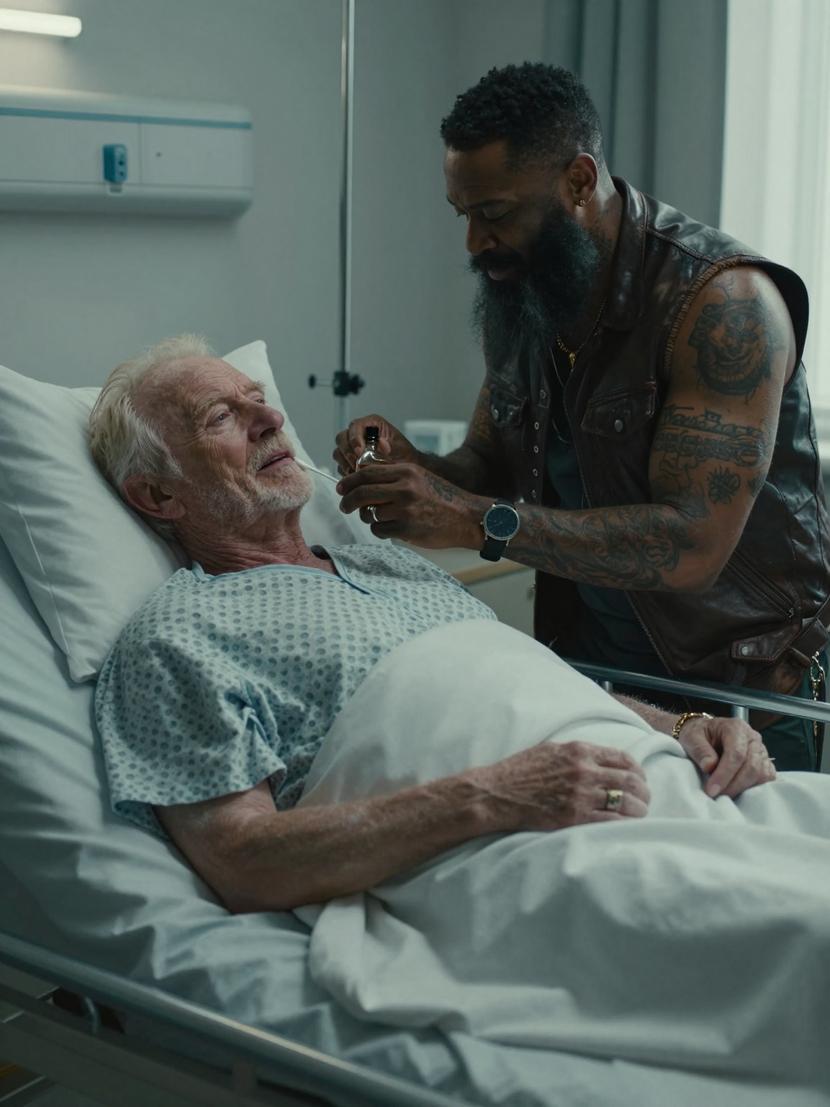
From beneath his leather vest, he produced a small, weathered flask. With practiced calm, he dipped a cotton swab into its amber contents—aged single-malt scotch—and gently brushed it over my chapped lips.
It burned like fire and reignited forgotten memories.
“Thank you,” I breathed.
“Don’t mention it,” he grinned, a flash of warmth in his gravelly voice. “Any sign of the heirs today? The usual circus?”
My tired eyes found the silent phone resting nearby. No vibrations, no missed calls.
“No,” I said quietly. “Elliot is ‘closing a deal’ in Tokyo. Martin claims he’s ‘renovating the summer house.’ And Clara… Clara is ‘too emotional’ to face me in this state.”
Gideon snorted bitterly. “Too emotional to come see you, but not too emotional to cash the checks for her kids’ expensive schools?”
“Exactly.”
We had met only a week earlier. Gideon belonged to The Last Road, a group of motorcyclists who volunteered to sit vigil with the dying who were abandoned by family and friend alike. He was a stranger — yet, in seven days, he had shown me more compassion than my own flesh and blood had in twenty years.
“Is the lawyer coming?” Gideon asked, his features shifting into something sharper, serious.
“He’s waiting just outside. Poised for my command.”
His hand reached out, coarse and steady, the size of a catcher’s mitt enveloping mine.
“Are you certain, Walter? Once you sign, there’s no turning back. They will despise you.”
I gazed at the empty chairs surrounding my bed. Memories flooded—the birthdays spent alone, the calls that came only to ask for loans or favors, the hollow echoes of broken promises.
“They don’t hate me, Gideon,” I whispered. “To hate someone, you need to care. They don’t care. I’ve been nothing but an ATM with a pulse. And the ATM is now out of order.”
I squeezed his hand.
“Send him in.”
—
Three days later, I slipped away.
There was peace in those final moments. Gideon sat quietly by my side, the hum of a vintage car magazine filling the room. As words about a 1967 Mustang faded into the air, my eyes closed — and never opened again.
But the drama igniting after my death was anything but peaceful.
The funeral was staged two weeks later at the city’s most opulent funeral home, paid for by my estate. Though I was absent, Gideon became my eyes and ears, recounting every biting detail from a video I arranged beforehand.
Elliot, Martin, and Clara sat prominently in the front row, draped in designer mourning. They dabbed at their eyes with silk handkerchiefs, accepting condolences with a practiced ease, uttering phrases like “He was our rock” and “We are devastated.”
But beneath the guise of grief lurked performance—waiting for the true spectacle: the reading of the will.
They expected their inheritance to be simple: split evenly, millions in real estate, stocks, and a vintage car collection worth fifty million dollars.
After the prayerful quiet, the room shifted to a stark conference room where Mr. Calloway, my attorney, presided over the gathering.
Gideon was there too — a lone wolf among sheep, sitting silently in the back corner, his arms crossed and eyes dark with resolve.
“Who is he?” Clara hissed, her manicured finger trembling as she jabbed toward Gideon. “Security! Remove this… person.”
“He stays,” Mr. Calloway said coolly, adjusting his glasses. “He is an invited guest of the deceased.”
“Dad knew a biker?” Martin scoffed nervously. “He hated motorcycles. Said they were dangerous.”
“Your father,” Mr. Calloway said icily, “changed a great deal in his final days. A fact you are all ignorant of.”
Silence dropped like ice upon the room.
“Let’s get this over with,” Elliot muttered, checking his watch. “I have a flight.”
“Very well,” Mr. Calloway agreed, opening the thick leather folder.
“I, Walter James Bennett, being of sound mind and body, do hereby declare this my Last Will and Testament, revoking all prior wills.”
The siblings leaned forward, greed practically pulsing from their pores.
“To my eldest son, Elliot,” Mr. Calloway read aloud, “who was too occupied to visit during my chemotherapy but had no trouble leveraging my name for his own gain…”
Elliot stiffened.
“…I bequeath my gold cufflinks, those enviable trinkets you so admired. May they remind you that appearances are hollow.”
A small velvet box slid across the table. Elliot stared dumbfounded. “That’s it? Just cufflinks?”
“To my middle son, Martin,” the lawyer continued, “who was busy renovating the summer house while I was too weak to stand…”
Martin paled.
“…I leave you the property deed to the summer house.”
Martin exhaled with relief. “That’s at least two million.”
“But not so fast,” Mr. Calloway interrupted. “The house is granted with a Life Estate condition. You may not sell, rent, or mortgage it. You must maintain it yourself. If it falls to neglect, ownership reverts to the state.”
Martin’s jaw dropped. “I can’t sell it? It’s a liability!”
“To my daughter, Clara,” the lawyer read on, “who claimed to be too emotional to see me pass…”
Clara’s tears flowed anew. “I loved him!” she wailed.
“…I bequeath a box of tissues, to aid you in your tears.”
A box of Kleenex sat on the table.
She screamed. “This is a mockery! Where is the fortune? The assets?!”
Mr. Calloway turned the page solemnly.
“The residue of the estate—cash, portfolio, city properties, and vintage cars—is left to the only person who held my hand without asking for a cent. The one who saw me as a man, not a bank.”
All eyes swung to the back of the room.
They found Gideon.
—
“That man?” Elliot jumped up in outrage. “A thug! Dad was manipulated! This is undue influence! We’ll fight this! We’ll destroy you!”
Gideon remained unshaken. He rose slowly, every step firm and measured.
“Your father wasn’t manipulated,” Gideon said, voice deep and calm. “He was lonely. Heartbroken.”
“You’re lying!” Clara screamed. “Who are you to him?”
“I’m Gideon,” he said simply. “A mechanic. A volunteer. I sat with Walter for six hours each day. We shared Jeopardy, talked cars. He told me about you.”
His gaze was heavy with pity.
“He spoke of paying for your educations, your weddings, your divorces. How he waited every day for that door to open. Kept his phone loud, hoping.”
He pulled Walter’s phone from his vest pocket and set it on the table.
The call logs were revealing.
Elliot: zero incoming calls.
Martin: zero incoming calls.
Clara: zero incoming calls.
Next, the draft texts:
Draft to Elliot: “I’m scared, son. Can you come?” Unsent.
Draft to Clara: “The pain is bad today. I just want to hear your voice.” Unsent.
“He didn’t send them,” Gideon said softly. “Because he knew you wouldn’t answer. Or worse, you’d say you were busy.”
“We have lives!” Martin barked defensively.
“So did he,” Gideon replied quietly. “Until he didn’t.”
Mr. Calloway cleared his throat.
“The will is ironclad. Walter underwent a psychiatric evaluation the day of signing. He was lucid and determined. The estate legally belongs to Mr. Gideon.”
Gideon scrutinized the documents.
“I don’t want the fortune for myself,” he said.
Hope flickered in the air among my children.
“Then give it to us!” Clara pleaded. “We’re family!”
“No,” Gideon said unwavering. “Walter and I made a plan.”
He looked toward Mr. Calloway.
“Execute the Phoenix Protocol.”
—
“What is the Phoenix Protocol?” Elliot asked, voice trembling.
Mr. Calloway explained, “Mr. Bennett instructed that the entire fortune be liquidated and placed in a charitable trust.”
“Charity?” Martin groaned.
Gideon smiled faintly. “The Walter Bennett Foundation for Abandoned Seniors.”
His eyes locked onto each of them.
“We’ll build hospices,’ Gideon said, ‘free havens for the forgotten elderly, whose children are too busy to visit. Each wing will bear your names.”
He pointed.
“To Elliot: The Elliot Bennett Wing for the Neglected.”
“To Clara: The Clara Bennett Center for the Ungrateful.”
“You cannot associate my name with that!” Clara gasped.
“It’s in the mandate,” Mr. Calloway confirmed. “If you contest the will, the names grow larger—and billboards go up.”
Gideon held up the keys to Walter’s prized 1967 Mustang—the only tangible token he kept.
“Your father was a good man,” Gideon said quietly. “He deserved better children. When he couldn’t change you, he chose to teach you.”
As he reached the door, Gideon paused.
“Walter left one last thing—a letter. For all of you.”
He slid a sealed envelope across the table to Elliot.
With trembling hands, Elliot opened it and read aloud:
“Dear Kids,
If you are reading this, you are likely angry. Seeking someone to blame. Don’t look at Gideon. Look in the mirror.
I spent my life building wealth to protect you from the world, but forgot to protect myself from you.
I leave you the one thing you gave me in my final days: Nothing.
Love, Dad.”
Gideon exited. The thunderous growl of his Harley blended with the shuddering windows one last time.
My children sat in stunned silence, surrounded by fifty million dollars in untouchable assets, clutching a pair of cufflinks, the deed to a burdensome home, and a box of tissues.
They were finally visiting me. But it was far too late.


