
A trauma bay carries a scent unlike any other—a haunting blend of metallic copper mingling with the sharp, clinical sting of antiseptic, burnt rubber lingering like a ghost from the wreck outside, all wrapped in the icy breath of a winter storm. That smell is seared into my memory, marking every moment a life hangs in the balance.
For twelve relentless years, I have been Dr. Hannah, the lead trauma surgeon at the busiest Level 1 trauma center in New Aurora. I’m no stranger to mangled bodies, twisted steel, and shattered glass. I thought I understood numbness, believed my heart armored itself against every tragedy. Until one bitter winter night changed everything.
It was a frostbitten Tuesday in late January, the thermometer mocking us at a brutal negative ten degrees. Highway 47 had transformed into a silent death trap—black ice waiting for a calamity. And calamity arrived in the roar of sirens and chaos: a devastating twenty-five-car pile-up.
The ambulance bay doors slammed open amidst the howling wind, freezing every breath we took. Paramedics raced in, their voices overlapping urgent commands.
‘Trauma One! Clear the way! Central line kit, now!’ shouted a paramedic, pushing a litter almost skidding on the linoleum.
I snapped on my gloves and ran to the stretcher’s head. Around it swarmed my team—nurses and residents buzzing with purpose.
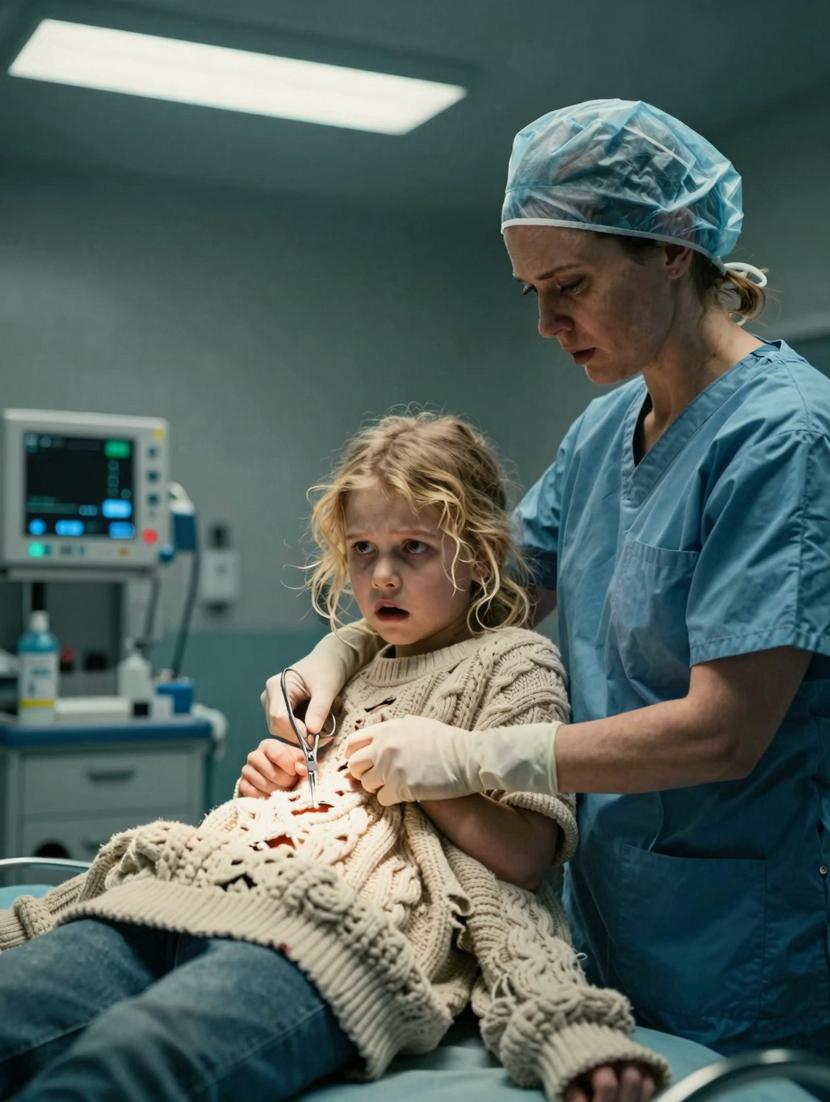
On the stretcher lay a fragile echo of innocence—a girl no older than seven. Blonde curls matted against her clammy forehead, her skin ghost-pale under the harsh fluorescent lights.
But it was the oversized cable-knit sweater that caught my eye—an adult’s garment drowning her tiny frame, torn and sodden with frozen slush and debris from the wreck.
‘Talk to me,’ I urged gently, lifting my penlight to her glassy eyes.
They struggled to stay open.
‘Female, about seven, trapped in the back of a sedan crushed between two semi-trucks,’ the paramedic panted. ‘Parents in front. No survivors. She was stuck nearly forty minutes in freezing cold. Blood pressure dropping, tachycardic, suspected internal bleeding and hypothermia.’
My heart clenched, but my training sharpened. The golden hour—in trauma medicine, the difference between living and dying.
Step one: expose the patient.
‘On three! One, two, three!’
We transferred her small body onto the trauma table. A soft whimper escaped her lips.
‘Clara,’ I whispered as I introduced myself softly, ‘I’m Dr. Hannah. We’ll help you. Please try to hold still.’
My hand closed around my trusty trauma shears—designed to rip through the toughest winter wear in seconds. There was no time for gentleness.
‘Let’s expose,’ I commanded.
Sliding the bottom blade beneath the heavy collar near her collarbone, a sudden jolt froze me. Her eyes burst open—frantic, wild, terror raw and vivid.
Before I could press the shears closed, tiny icy hands clamped fiercely onto my wrist.
‘No! Don’t cut it!’ she screamed, voice cracking, raw with desperation.
My resident, Dr. Turner, stepped forward. ‘Sweetheart, we have to see your injuries. We can’t treat what’s hidden.’
‘No!’ Her screams grew louder, thrashing violently, kicking thin legs as she shielded her chest beneath the towering sweater. ‘You can’t take it!’
‘Hold her gently,’ I instructed nurses, voice calm but heart hammering. Her monitor beeped wildly—every second wasted was blood lost.
‘Listen, Clara,’ I leaned close, voice low but steady. ‘I need to cut this. You’re hurt badly. If I don’t take this off now, you might not make it. Can you understand?’
Tears streamed down her bruised cheeks as sobs shook her frame.
‘Please,’ she begged, locking eyes with me. ‘If you cut it… he’ll die. I promised Mommy I’d keep him safe.’
The shears hovered in mid-air as silence swallowed the trauma bay.
He’ll die.
My gaze dropped to the sweater engulfing her—so large, bulging oddly at her center. A pulse of ice ran down my spine.
I set the scissors down with a clatter.
‘Nobody move,’ I whispered.
Slowly, hands raised in surrender, she parted the wooly fortress.
And there, nestled against Clara’s bare chest—was a tiny, fragile face.
An infant boy, no more than weeks old, curled against her, swathed in the oversized wool that must have belonged to their father. His lips were a chilling dusky blue, and his shallow, rapid breaths barely whispered life.
The trauma team gasped, disbelief etched on every face.
‘Call the NICU! Neonatal team—now!’ I barked. Nurses sprinted, phones blaring.
Clara’s eyes met mine, exhausted but pleading through trembling shivers. ‘I kept him warm,’ she whispered. ‘Mommy said… keep Ethan warm.’
Tears blurred my vision. Twelve years of cutting through carnage had never revealed such raw, unyielding bravery.
She had endured freezing darkness for forty long minutes, witnessed her parents perish, and in that bitter cold had stripped off her own coat to shield her newborn brother, pressing him close to her skin under that immense wool sweater.
‘You did perfectly,’ I said, voice catching. ‘You saved him. Now, I need to help him. Can you let me?’
Her grip loosened slowly.
‘Turner, warm blankets—now!’
Carefully, I lifted Ethan from the frigid wool cocoon. His skin was an icy marble beneath my gloves. As the trauma room’s cold air hit him, a raspy, weak cry escaped.
‘Got him,’ said the lead pediatric nurse, wrapping him in heated blankets just as the neonatal team burst through the doors with their isolette.
They whisked Ethan away in seconds.
I turned back to Clara, who no longer resisted as I finally cut away the ruined sweater to reveal a ghastly sight—a massive, dark purple bruise stamped across her abdomen in the ominous shape of a seatbelt.
The ‘seatbelt sign.’
The brutal force had essentially sliced her from within.
Her belly was rigid, a silent scream of hidden internal bleeding.
‘Blood pressure dropping—sixty over forty! Heart racing at one-forty! She’s slipping into shock!’ Dr. Turner yelled.
Her brave heart fought on, fueled by the desperate need to protect Ethan. Now that he was safe, her body’s defenses faltered.
She rolled unresponsive.
‘Start massive transfusion protocol! Rapid O-negative blood! Pediatric intubation kit!’ I commanded.
The trauma bay descended into frenzied urgency. Dr. Turner secured her airway. The respiratory therapist bagged her lungs.
‘Pressure dropping—forty over palp,’ a nurse called out.
We cut all imaging—racing straight to Operating Room 3.
Pushing the stretcher through sterile halls echoing with harsh clatters, I whispered, ‘Hold on, Clara. Hold on.’
Surgeons and nurses awaited us, already prepared for the fight ahead.
I scrubbed furiously, adrenaline fueling every move. Pulled on sterile gown and gloves, I approached the table to face the storm inside her.
The incision unleashed a flood of dark blood—hemorrhage rushing out like a bursting dam.
‘Suction max! Packs!’
I plunged in blind, hands searching through the cold, cruel torrent inside her abdomen, racing against time as hypothermia sabotaged clotting.
Packs stuffed into every quadrant, I ordered Dr. Turner to hold pressure.
Revealing the spleen tear was like unmasking the villain—shattered and bleeding uncontrollably.
I squeezed my fingers over the splenic artery, cutting off the torrent just as clamps sealed the damage.
Slowly, pressure stabilized.
‘Damage control,’ I said. ‘Splenectomy and temporary abdominal closure.’
A vacuum dressing sealed the open wound, a window into fragile survival.
Hours later, I left the OR exhausted. Yet the battle was far from won.
I visited the NICU, entering a serene world softened by gentle lighting and the faint scent of baby lotion.
Officer Davis stood vigil beside Ethan’s incubator, his uniform still damp with melting snow.
‘He’s a fighter,’ the officer murmured. ‘Core temp’s almost normal. Cold didn’t reach his organs.’
Listening, I pieced together the nightmare from the officer’s haunting words—the blue Ford sedan trapped, parents lost instantly, Clara found huddled behind the driver’s seat, growling like a wounded animal when rescued, clutching Ethan wrapped in their father’s sweater.
‘She unbuckled him. In the dark. Frozen fingers biting plastic to free him.’
‘Clara,’ the officer said, voice breaking, ‘she’s just seven.’
That name felt like a lifeline.
Back in the Pediatric ICU, under a symphony of ventilator hiss and monitors, Clara lay fragile yet fighter, tubes and wires weaving her into this precarious existence.
Over the next two days, her mind stirred restlessly—awakening in terror, thrashing against restraints as if haunted by unseen horrors.
She clawed at her chest where Ethan had been nestled.
‘She’s searching for him,’ I realized, tears threatening anew.
I scrambled for my phone, connecting to Diane in the NICU. Without hesitation, Diane placed Ethan’s image on FaceTime.
Holding the screen before Clara’s wide eyes, the fight in her vanished. Relief washed over her trembling frame.
Through tears, she softly smiled.
‘He’s okay,’ I whispered, voice fragile yet fierce. ‘You saved him.’
For forty-eight grueling hours, I lived by Clara’s bedside—balancing fluids, fighting infection, every moment a tightrope over despair.
On the third morning, light fragile and hopeful, Clara breathed strong enough to part with the breathing tube.
‘How do you feel, sweetheart?’
Her voice a rasp, fragile but alive. ‘Is Ethan really warm?’
‘He is, Clara. Warm and cared for.’
She exhaled slow relief, finally beginning to share her fractured story—the crash’s thunderous violence, the loss of her parents, her mother’s final plea to protect Ethan in the freezing darkness.
Her courage humbled me and all who bore witness.
But the journey was far from over.
Her abdomen’s open wound invited danger—dead bowel revealed necrosis and infection’s deadly tide.
The second-look surgery descended into chaos as sepsis crashed her fragile heart into sudden arrest.
Code Blue.
I stood on the edge of devastation, drilling the dead tissue from her tiny body as compressions shook the operating room.
Defibrillation jolted a spark back from darkness.
Her heart’s weak rhythm returned.
We raced to close the wound, balancing between life and death.
Weeks of vigilance followed—battles against infection, organ failure, the relentless unknown.
Ethan thrived quietly in the NICU, a beacon amid the storm.
On day eight, Clara finally stirred—eyes fluttering, meeting mine with fragile trust.
Terminating sedation, I pulled her from the mechanical breath of the ventilator.
‘Did you keep him warm?’ she rasped.
Nod and tears answered.
The NICU’s head nurse entered, cradling Ethan, warm in soft blankets.
Clara reached out, a trembling embrace wrapping around her brother—a soft, healing reunion that silenced every heart in the room.
Months later, before they left for Northlake County to live with their grandparents, I gave Clara a small piece of that shattered sweater—a token of warmth, courage, and unbreakable spirit.
She gripped it fiercely, whispered thanks, and wrapped fragile arms around me.
As I watched her roll away, toward new life, I knew trauma had shown me its fiercest truth: even in the coldest darkness, the human spirit blazes bright enough to save us all.


