
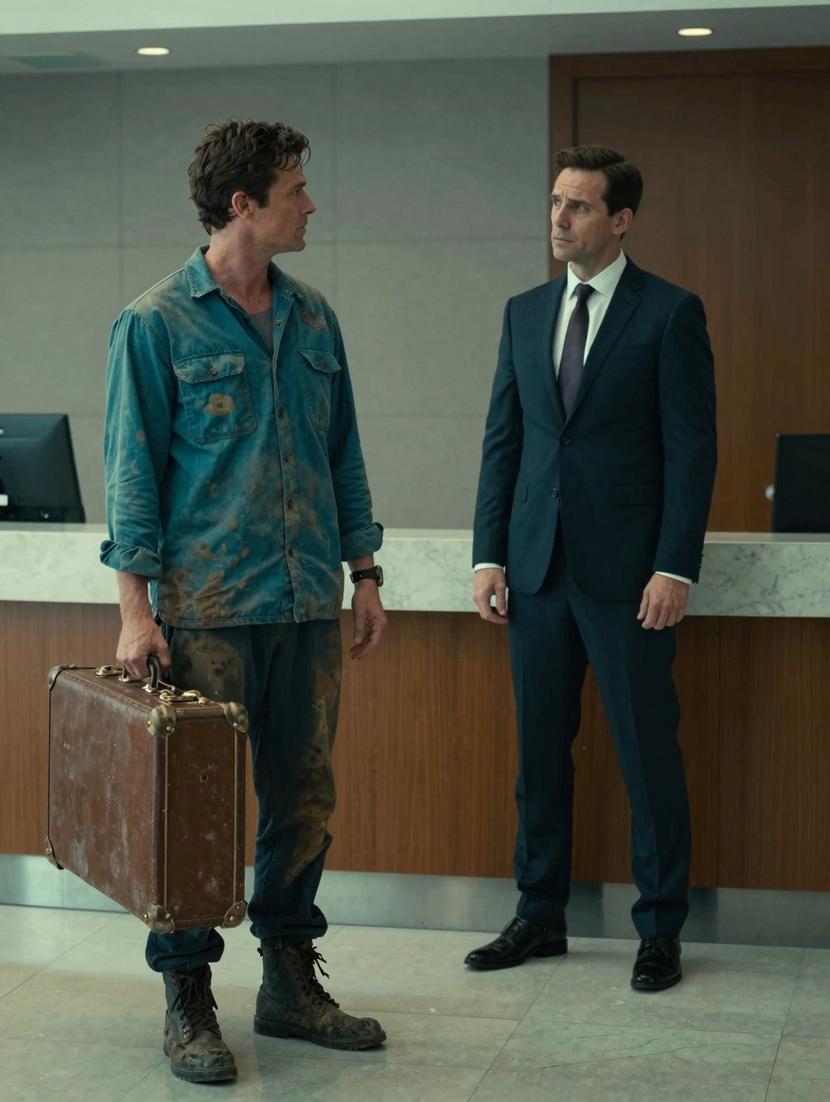
The air inside the Pioneer Savings Hall of Westhaven was stale, heavy with the scent of recycled breath and the cold tang of money waiting to move in somebody else’s hands.
At precisely 11:47 a.m. on a quiet Tuesday, Adrian Bennett pushed open the glass doors and stepped inside. His faded teal work shirt bore the scars of long days—an edge of the collar frayed, his joggers smeared with dark engine grease at the left knee, and boots spattered with mud from that morning’s dawn. This wasn’t the polished image of a preferred client; this was a man carrying stories of labor on his skin.
In one hand, he held an ancient suitcase, metal hinges rusted and stubborn—a relic better suited to a dusty warehouse than a pristine bank lobby.
Adrian fell in line.
The woman just ahead glanced back twice, her eyes flickering with disbelief, clutching her purse tighter as if bracing herself. Then she stepped forward, hastening away.
He didn’t notice. Or if he did, it barely registered.
When his turn came at Teller Station 2, he stepped forward with quiet confidence.
Martin Harrington, the branch manager, had seen him the moment Adrian entered. Martin possessed what he boasted as situational awareness. His staff called it suspicion sharpened into an art form—for reading who belonged in these polished halls and who did not. Adrian did not.
Adjusting his silk tie with a nervous twitch, Martin approached.
‘Sir,’ his tone was polite but cold as frost. ‘Can I assist you?’
‘I want to make a deposit,’ Adrian said simply.
‘A deposit,’ Martin echoed, eyeing the battered suitcase like it might spring open and bite. ‘We have specific procedures for large cash deposits—compliance regulations, pre-scheduled appointments, detailed documentation.’
‘I’ve brought documentation,’ Adrian replied, his hand tapping the breast pocket of his shirt.
‘I’m sure you have,’ Martin’s voice stayed smooth yet his words were carefully edged to keep him away. ‘Today, this branch can’t process this sort of deposit.’
‘Deposit,’ Adrian said again, flat, void of frustration.
Looking around silently, Adrian saw the lobby wasn’t busy: two elderly women at a teller window, a young couple signing papers at a corner desk, a man absorbed in his phone.
‘I can wait,’ Adrian offered calmly.
Martin’s jaw tightened, his gaze flickering with irritation. He gave a subtle nod towards the security desk.
Noah Reed, the bank’s officer, caught the signal and moved toward Adrian.
‘Let’s go, pal,’ Reed’s hand landed firmly on Adrian’s shoulder—not violent, but unquestionably firm. ‘You’re making other customers uncomfortable.’
‘I haven’t done anything wrong,’ Adrian said evenly.
‘I get that,’ Reed’s voice softened, spoken like someone trying to be reasonable in a tense moment. ‘But the manager wants you to leave peacefully, okay?’
‘I just want to make a deposit.’
‘Sir—’
‘That’s all.’ Adrian’s voice was steady, his eyes unwavering.
‘Sir,’ Reed’s grip tightened, ‘it’s time.’
Eyes around the lobby followed the scene: the tellers paused their work, the young couple stopped signing, one elderly woman turned fully, clutching her purse as if for protection.
Adrian did not resist. Gathering his suitcase, he walked calmly with Reed towards the exit.
Martin held the glass door open—a grand gesture of reluctant magnanimity.
The glaring midday sun hit Adrian as the door hissed shut behind him.
‘And stay out,’ Martin mouthed through the thick glass, his expression sharp and unmistakably final. He straightened his jacket, while Reed planted himself by the entrance like a sentinel blocking an unwelcome shadow.
Outside, Adrian stood on the sidewalk, utterly composed. No anger, no humiliation—just the quiet intensity of a man silently recalculating everything.
Ten steps to the curb, and there it waited: a Lamborghini Gallardo. Painted in Arancio Borealis—a fiery, incandescent orange that seemed lit from within, crouching low like a predator poised to leap.
Passersby slowed, caught in the spectacle.
From his pocket, Adrian produced a key fob. The car chirped, lights flickering briefly. Placing the weathered suitcase on the gleaming hood, the latches clicked open as if releasing a secret.
Inside, bundles of crisp, neatly stacked cash gleamed—not disorganized bills, but a fortress of money measured in hundreds of thousands.
This was no casual windfall; it was decades of hard-earned wealth, the kind only forged through relentless toil or a keen eye for investment, or both.
Adrian didn’t flash or flaunt. No theatrics, no counting. He simply stood, hand resting on the suitcase rim, gazing back toward the bank.
Inside, Martin’s eyes were fixed on the orange beast and the man who had just been expelled. Stranger still, both he and Reed were motionless, rooted in disbelief.
A woman on the sidewalk pulled out her phone—already filming. A delivery cyclist slowed to stare.
Finally, Martin stepped outside. His tie remained neat, his jacket unwrinkled, but his stance spoke volumes: the subtle collapse of a man who has glimpsed his own grievous error.
‘Mr.—’ he started, then faltered. ‘Sir, if you’d like to return, we can—’
‘No, I’m good,’ Adrian replied.
‘I want to apologize for the earlier misunderstanding.’
‘There was no misunderstanding,’ Adrian said, voice calm, delivered like a quiet hammer blow. ‘You looked at my boots and made a choice. That isn’t a mistake. It’s a decision.’
Martin’s mouth opened, then closed.
‘I’ve banked with Summit Capital for eleven years. My accountant has urged me to diversify. I thought I’d try local.’ His eyes met the bank’s signage. ‘I guess I got my answer today.’
‘Sir, I assure you—’
‘Adrian Bennett,’ he stated, giving the name space to resonate. ‘You can look that up.’
The blood seemed to drain from Martin’s face, the exact shade of shock that comes when reality shatters carefully laid illusions.
Closing the suitcase, Adrian lifted it gently off the hood, placing it inside the passenger seat, then circled to the driver’s side.
Noah Reed, standing silently nearby, looked like a man burdened with more than his uniform’s duty.
‘I—I’m sorry,’ Noah muttered quietly. ‘I was just doing my job, but… I know it doesn’t make it right.’
Adrian regarded him for a moment. ‘I know,’ he answered—not cold, not warm—just true.
The Lamborghini’s V10 engine roared to life with a deep, controlled growl.
Martin watched as the car eased away, the sound fading into the midday traffic—no rush, no spectacle. Just movement.
The woman’s phone still recorded.
Martin turned back inside, the glass door closing behind him like the final page on a reluctant story.
Noah lingered another moment, eyes on the vacant curb space, the faint trace of exhaust lingering, the subtle scuff on the hood left by the suitcase—a stark mark on a world far beyond his pay grade. Then he too returned inside.
Forty-five minutes later, Martin sat in the regional director’s office as the phone buzzed, ringing insistently.
Ignoring it the first time, it rang again.
‘Martin,’ the director’s voice was measured yet heavy with consequence, ‘I need a full report on today’s events.’
‘It was a misunderstanding,’ Martin began, ‘a walk-in with no appointment, unusual presentation—’
‘Adrian Bennett.’
Martin paused.
‘You know the name,’ the director said plainly.
‘I… looked him up afterward—’
‘He’s been a flagged potential high-net-worth client for six months. His Summit Capital accounts hold nine figures, Martin. Nine figures. And he walked into your branch today.’
Martin was silent—the kind of silence that didn’t mull over facts but mourned consequences.
‘I want a full incident report, and then I want you here today.’
‘Yes, sir.’
‘And Martin,’ the voice softened but bore steel, ‘don’t call him. Don’t email. Don’t try to fix this with gifts or words. You don’t get to fix this.’
The line went dead.
Adrian pulled into the underground parking garage of a glass tower on the south side of the market district. The elevator rose smoothly to the twenty-third floor.
His accountant, Monica, a sharp woman with a wit as quick as her notes, awaited him at a round table, two steaming cups of coffee and a thick folder ready.
‘How’d it go?’ she asked.
‘Cross them off the list,’ Adrian said with a small smile.
Monica made a note. ‘Summit it is then.’
‘Summit it is.’
He took a sip of coffee, gazing out at the sprawling city beneath glass walls.
‘Want to hear something funny?’
‘Always.’
‘The guy who tossed me out—the look on his face. I recognized it the second I stepped in. I’ve worn it all my life.’ He stirred his cup slowly. ‘Shipyard, warehouse, job sites. Walk in dirty, and they decide who you are before you speak.’
‘And?’
‘Used to bother me.’ He set the cup down steadily. ‘Now, I almost feel sorry for them. They’ll never know what they lost. They go home thinking they did right.’
Monica nodded thoughtfully.
‘Almost feel sorry,’ she repeated softly.
‘Almost,’ Adrian agreed.
The next day, a local financial reporter posted a three-minute video. She had been nearby for a mundane story on parking restrictions when the orange Gallardo appeared and the rusted suitcase emerged in full view.
She filmed the entire moment.
The caption read: When the bank judges the cover, not the book.
By noon, the video amassed two million views.
By four, the Pioneer Savings Hall’s regional communications team released a statement highlighting their “commitment to respectful and inclusive client service.”
By six, Martin Harrington was put under administrative review.
No photo, no name in the statement.
But the internet, once engaged, left no detail unturned.
That evening, Adrian sat in his quiet north side home—a modest three-bedroom with a workshop at the back, where weekends were still waged in grease and tools.
The Gallardo rested in the driveway, awaiting a garage he’d yet to build.
His phone buzzed relentlessly—friends, former coworkers, family.
He watched the video once more, then placed the phone face-down beside the table.
Soup simmered on the stove, its fragrant steam filling the kitchen.
He ate quietly, looking out across the street.
No anger simmered within him—not genuine anger, anyway. Anger was for the surprised; Adrian had long stopped being shocked by that look.
What stirred was exhaustion.
Exhausted by the test, the constant proving, the damning measure that a man had to drive a quarter-million-dollar car and reveal a fortune in cash before earning respect.
He rinsed his bowl, dried it, placed it back in the cabinet.
He thought of Noah Reed—the apology made on the sidewalk.
‘That doesn’t make it right,’ he had said.
But it meant something. A little.
Two weeks later, Adrian finalized his new relationship with Summit Capital—establishing three accounts, a tailored investment portfolio, and formal private client onboarding.
His contact, Elaine Winters, bore the quiet confidence of twenty-two years in the business.
During their first call, she asked about his work, his past, and his ambitions.
She listened first, then spoke.
‘I like this bank,’ Adrian told Monica afterward.
‘I know,’ she smiled, ‘I picked it.’
Three months after the incident, Pioneer Savings announced a “comprehensive client experience review”—a corporate euphemism for damage control.
Martin Harrington was reassigned to a compliance post miles from the city’s pulse, stripped of client contact.
Silent. Forgotten. No public apology, no outreach to Adrian.
He sat, day after day, beneath harsh fluorescent lights, haunted by rusted metal and an incandescent orange flash—the quiet judgment in a man’s eyes from the curb.
Most nights, he failed to forget.
Noah Reed requested a transfer eight weeks later. He moved into a community liaison role at a nonprofit aiding the city’s river neighborhoods.
Lower pay. Longer hours.
But he slept better.
The rusted suitcase found its permanent place in Adrian’s workshop—a humble monument.
Not a trophy, not a symbol.
It once belonged to his father, carried across four states’ worth of job sites. Inside lay decades of his father’s cash savings, entrusted to Adrian six months before his passing, with a note: ‘Don’t let anyone tell you what you’re worth.’
That day at the bank had been meant to be a memorial, a final resting place for his father’s legacy.
Though denied that, Adrian no longer minded.
The money rested securely at Summit, diligently working in the background of his life.
But the suitcase stayed—weathered, rusted—next to tools that hummed with weekend life, a quiet reminder that worth is earned, carried, and never just assumed.


