
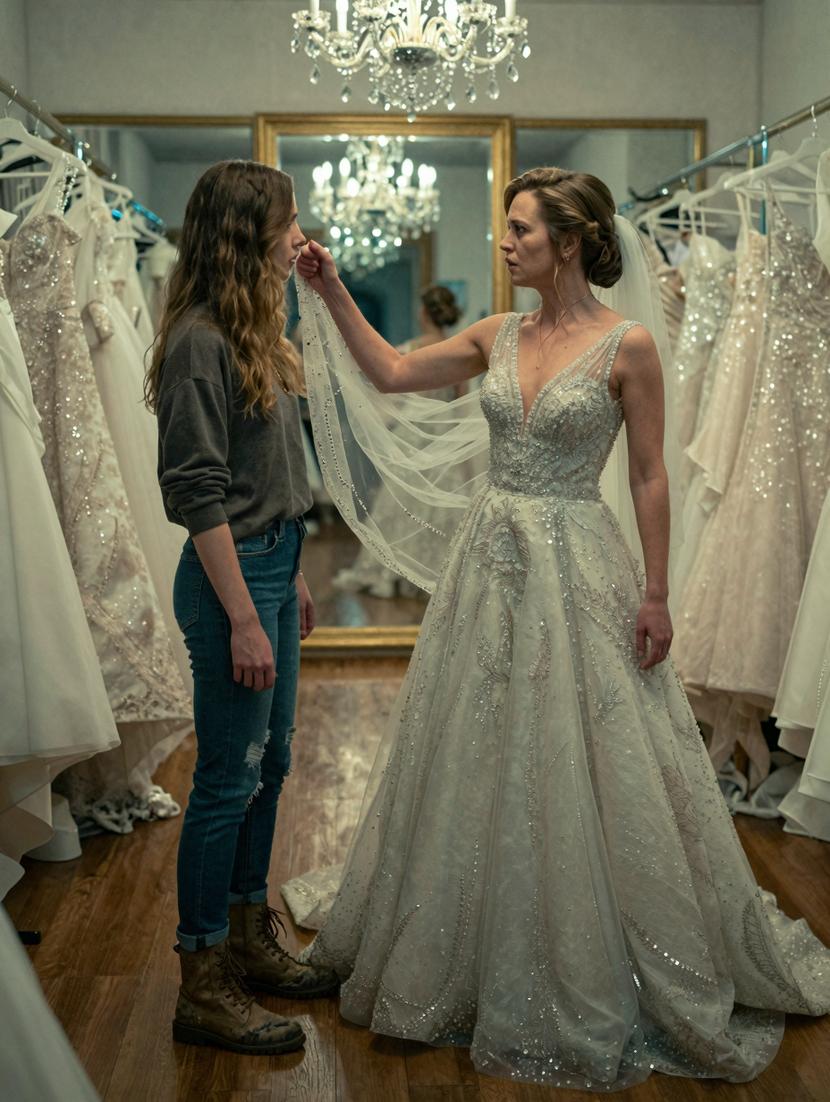
Stepping into Willow & Hart Bridal nestled in Charleston, I dragged my sister’s oversized designer tote as if it weighed a hundred pounds. The air was thick with the scent of expensive perfume and freshly pressed satin, swirling around soft instrumental melodies drifting from hidden speakers. Rows of glittering gowns caught the bright lights, sparkling like jewels in a treasure vault. Among all this glamour, I stood out—a solitary pair of scuffed army boots in a sea of sequins and silk.
Melissa, my sister, was perched on a small platform in front of an expansive wall of mirrors, embodying a queen in a crystal-studded gown that shimmered with each slow twirl. Our mother Linda clapped, her eyes brimming with tears as she whispered, “You look absolutely breathtaking.”
Sales associates swarmed around Melissa like loyal courtiers, ensuring every detail of her royal fantasy was perfect. I remained invisible, only summoned when something was needed—her shadow’s servant.
Without so much as a glance, Melissa snapped her fingers sharply. “Megan, the veil—the beaded one. Hurry up, you’re dragging,” she barked, her tone colder than the boutique’s crystal chandeliers.
The command cut through the air like a blade. I bit my cheek to keep from reacting. I was used to orders, even harsh ones, but being snapped at by my little sister on the day of her $20,000 dress fitting ignited a slow-burning fire deep inside. I grabbed the delicate, absurdly costly veil and approached her throne.
“Here,” I said evenly, holding it out.
Melissa spun toward me, eyes blazing, and with a sharp crack, her palm met my cheek. The room froze. The sting flared hot and sudden, and shocked gasps fluttered like disturbed birds. A cousin dropped her phone in disbelief.
“Just leave,” Melissa’s voice cut through the stunned silence, sharper than ice. “You’re ruining my moment.” Then, as if nothing had happened, she turned back to the mirrors, chin raised in regal defiance.
Heat rushed to my face as humiliation clawed beneath my skin, but I stayed rooted. Combat taught me to hold steady under fire—but this was different. The stares that followed pretended reality away, while Linda suddenly found the bridesmaid rack fascinating and the clerk shifted uncomfortably.
No one dared speak.
I didn’t cry or argue. I simply placed the veil on the edge of the platform and walked out. The door chimed like any ordinary exit, but outside, the vivid sting on my cheek kept me anchored.
Beneath the awning, the Charleston air was cool and sharp—coffee mingled with exhaust in the breeze. My hands trembled slightly, but my mind sharpened. No one inside knew the truth simmering beneath that crystal gown and glossy smiles. The entire luxurious wedding fantasy—the $500,000 dream Melissa adulated—was being bankrolled by me.
Months of combat pay, every cent of my re-enlistment bonus, all funneled quietly into deposits: the dress, venue, catering, flowers, flights for out-of-town guests. While I served overseas, grinding through double shifts and scrimping for myself, I’d built this fairy tale. And today, my one day off became the stage for a public slap—literal and figurative.
I pulled out my phone and stared at the banking app numbers. The card Melissa thought was our parents’ was mine: my name, my savings, my future.
Without hesitation, I tapped “LOCK CARD.” A red banner flashed: CARD BLOCKED. TRANSACTIONS WILL BE DECLINED.
No outcry. No confrontation. Just the cold precision born from years of training.
Leaning against the brick facade, I watched Melissa inside, cradling the gown like a precious trophy, face flushed as she demanded, ‘Run it again!’
Linda hovered, whispering frantic plans about calling the bank. The manager crossed his arms, unimpressed—this was a scene they had seen many times.
My phone buzzed: Transaction Declined: $20,350. Willow & Hart Bridal. I smirked, knowing that number meant the gown.
Inside, Melissa waved the card desperately, her voice climbing as more declines flickered through. Onlookers stole glances while the manager’s voice grew more firm. She paled. Mom looked helpless. Somewhere in that chaos, I imagined them wondering where I’d gone.
I stepped back, fading from sight. My shoulders felt lighter—as though I had shed an invisible weight. Another buzz: a series of declines, a rhythm that soothed instead of tormented.
I made my way toward my truck, polished sunlight gleaming off its hood, boots solid on the pavement.
At the crosswalk, a sharp alert screamed: Balance Overdue. Hawthorne Manor will cancel your reservation in 48 hours if payment is not received. A bitter laugh escaped me.
One last glance. Behind the boutique glass, Melissa was still fighting, desperate, her gown sparkling dimly as it slipped from her grasp. My cheek throbbed—not from pain or shame, but from something colder and clearer.
That slap hadn’t broken me. It flipped a switch I should have flipped years ago.
Traffic hummed in the afternoon sun as I slid into the driver’s seat. The engine’s low rumble filled the cab. I reached into the glove box and pulled out a crumpled bundle of receipts—venue deposits, invoices, flight confirmations—all bearing my name. The paper edges were softened from months tucked in uniform pockets. Why had I kept them? Proof that this wasn’t magic money, but sweat, sacrifice, and long nights.
Memories flickered: flights into Kandahar, nights in cramped tents, endless guard shifts, wiring money back home amidst explosions. The re-enlistment bonus hit my account and vanished within days—engagement party, deposits, photographer. Each month I watched the balance fade while Melissa boasted about our “parents’ generosity.”
I never corrected her. I told myself it was family duty.
Back at base, she sent heart emojis and sweet “Best big sis ever!” texts before asking for more. When I made Sergeant, I tossed my back pay at her bachelorette party in Miami. She posted yacht photos. I sat in plywood offices, filling supply forms.
Now my savings were ghostly empty. I’d bankrolled a fairy tale where my only role was pack mule—and apparently, punching bag. She had even suggested I “help greet at the door” instead of standing beside her at the altar. That should have been my warning.
Discipline means holding the line. Words from leadership echoed. Somehow, I’d held the line everywhere but home.
The light turned green. My phone buzzed—Mom calling. I let it ring out. She’d say I embarrassed them. I felt nothing.
I pulled into a quiet park by the water and sat, engine off, silence heavy.
Texts lit up my screen: Melissa—’Card’s not working. Call me NOW.’ Then: ‘This isn’t funny. I’m at the counter. Everyone’s watching.’ Finally: ‘YOU BETTER FIX THIS.’
I set the phone face down.
I wasn’t fixing anything.
For years, I had been proud to send money home, thinking it noble. Now it was a chain I dragged.
Another text: The manager wants the dress back. Mom’s freaking out. Call me NOW. The words faded as anger cooled into resignation.
I restarted the engine, the cab humming to life. Exiting the park, the highway stretched before me: Fort Mercer, my world, my path. What was crumbling in Charleston wasn’t my problem anymore.
Warm air swept in through the cracked window. My phone kept flashing: Transaction Declined, Hawthorne Manor Overdue, Charleston Catering Payment Past Due. Each alert sounded like quiet explosions, dismantling the fantasy.
I pictured the scene: Melissa’s shrieking voice, Linda’s whispered worries, the manager’s stiff tone, and the boutique slowly realizing the bride couldn’t pay for the very dress she bragged about online.
The phone rang—Mom again.
I answered just to end it.
“Megan! What have you done? Do you know the dress was declined? She’s humiliated! Everyone’s staring! Call the bank and fix this!”
My voice stayed calm. “There’s nothing to fix. That card was mine. I paid for everything—dress, dinner, venue. Every single thing she’s bragged about? It was my money.”
Silence. Then Linda’s voice, trembling with fury. “You selfish girl! How dare you cancel the card right before the wedding!”
I laughed low and bitter. “Selfish? I paid for a wedding that’s not mine. I drained my savings while she treated me like a servant. Do you know what I gave up?”
Then Melissa’s frantic voice cut in, grabbing the phone. “You’re jealous! Always jealous! You think ruining my wedding will make you happy? It won’t! Everyone will choose me over you!”
I didn’t shout. “Melissa, from now on, you pay your own way. Consider this my final gift.” I hung up.
The phone buzzed again—a cousin texted: ‘Is it true? The wedding’s off? Heard the caterer pulled out.’ Then an aunt: ‘Hawthorne Manor calls about unpaid bills. What’s happening?’ Gravity was pulling the threads apart.
I pulled into a roadside turnout by water and parked. Scrolling through my transaction history, the damage sprawled across the screen: $20,000 for the dress, $10,000 for the venue, $8,000 for catering, $4,000 for flowers. Each line was a sacrifice I could have put toward a house.
What I felt wasn’t triumph or spite—it was calm. The peace that follows finally doing what’s right. Not revenge, but an undeniable stop. A line drawn and held firm.
At the small rental I’d taken for leave, silence greeted me. My phone lit up before I dropped my bag—ten missed calls from Mom, five from Melissa, two from Dad, and a flood of texts: “You’re tearing this family apart. You’ll pay. We’ll sue.”
I tossed the phone on the table. When Dad called, his voice thundered through the speaker.
‘Megan, what are you doing? Melissa’s crying, Mom’s hysterical, vendors calling us! Fix this before it’s too late!’
“There’s nothing to fix,” I said evenly. “I sent money when asked. Deposits, dinners, dresses. None of the contracts are in my name. You and Melissa signed them. I’m done.”
“If you think you can humiliate this family—”
“I didn’t humiliate anyone,” I cut in. “I stopped funding a lie.” The line went dead.
My phone buzzed again—Evan, Melissa’s fiancé. ‘Did you really pay for everything?’
I replied simply: ‘Yes.’
Minutes later: ‘I see. Thanks for being honest.’
Then Melissa’s desperate message: ‘He’s threatening to call off the wedding. THIS IS YOUR FAULT. DO YOU HEAR ME? YOUR FAULT.’
My reply: ‘No.’
I locked the screen.
The next day, I drove to Hawthorne Manor. The white sign that once boasted “Reserved for Holt-Lawson Wedding” was gone. The ballroom sat empty. Melissa, makeup streaked, argued with staff. My parents hovered, helpless.
Her gaze snapped to me, twisted with rage. “You! You ruined everything!” Her voice echoed painfully.
“I paid for everything,” I said clearly, loud enough for all to hear. “And when I stopped, this happened.” Gasps rippled. “You slapped me, told me I didn’t belong, and used my army pay to fund your dream without gratitude. This isn’t jealousy. This is the bill coming due.”
Just then, Evan arrived with his parents, dressed casually, scanning the empty room. “I came to tell you all myself,” he said firmly. “The wedding is off. Melissa lied—to me, her family, all of you. I won’t marry someone who builds her life on deceit.” He turned and walked away, his parents following. Guests murmured, departing in small groups. Melissa sank into a chair, face buried in hands.
Dad’s eyes bore into me. “This is your fault.”
“No, Dad,” I said steadily. “This happened because you and Melissa took advantage of me. I drained my savings covering your lies—and what did I get? A slap in the face.”
I walked toward the exit, relatives parting before me. My phone buzzed with a message from my unit’s admin: Report to base. Ranger assessment confirmed. Please check in by scheduled date.
I slipped the phone into my pocket. The harsh sunlight warmed my shoulders as my boots crunched on gravel. Behind me, voices faded into distance. I started the engine, easing down the long drive. Hawthorne Manor disappeared in the rearview mirror as I fixed my eyes on the road ahead.
Before dawn, my alarm shattered silence. Back at Fort Mercer, I laced my running shoes and stepped into the cold morning air. As I ran toward the track, the rhythm of boots on pavement and distant cadence calls embraced me like home.
Breakfast found me with my team, talk flowing about rotations and jumps. No questions about Charleston, weddings, or family drama—just the mission ahead.
Later, resting under a pine tree’s shade, I finally opened my phone. The messages remained, but mixed among accusations were tentative apologies. Our family chat, once an ATM of demands, now felt like a thread of confession. I closed it and opened my bank app. For the first time in years, my balance was inching upward.
I thought back to that slap in the boutique. Once, it had burned with humiliation. Now, it was a door—opened wide. Their debts were theirs. My money, my choices, my life—mine again.
A text from an aunt appeared: ‘We’re proud of you for standing up. Not easy, but right.’ A genuine smile tugged at my lips. Peace bought with silence isn’t peace—it’s control masquerading as love.
I picked up my Ranger assessment packet. Zero-dark-thirty muster, ruck marches, land navigation—all hard. All mine to face.
That slap could have shattered me. Instead, it marked the moment I stopped funding another’s dream—and started building my own. Melissa lost her wedding, her fiancé, and her perfect façade built on my sacrifice. My parents lost their free ride. And I gained something far more valuable than all the money I’d poured in: my freedom.
Crossing the parade ground, a breeze lifted my uniform’s edge. The sun warmed my back. My phone rested silent in my pocket as I stepped toward the training field—the cadence calls rising behind me, matching the steady rhythm of my own determined footsteps.


