
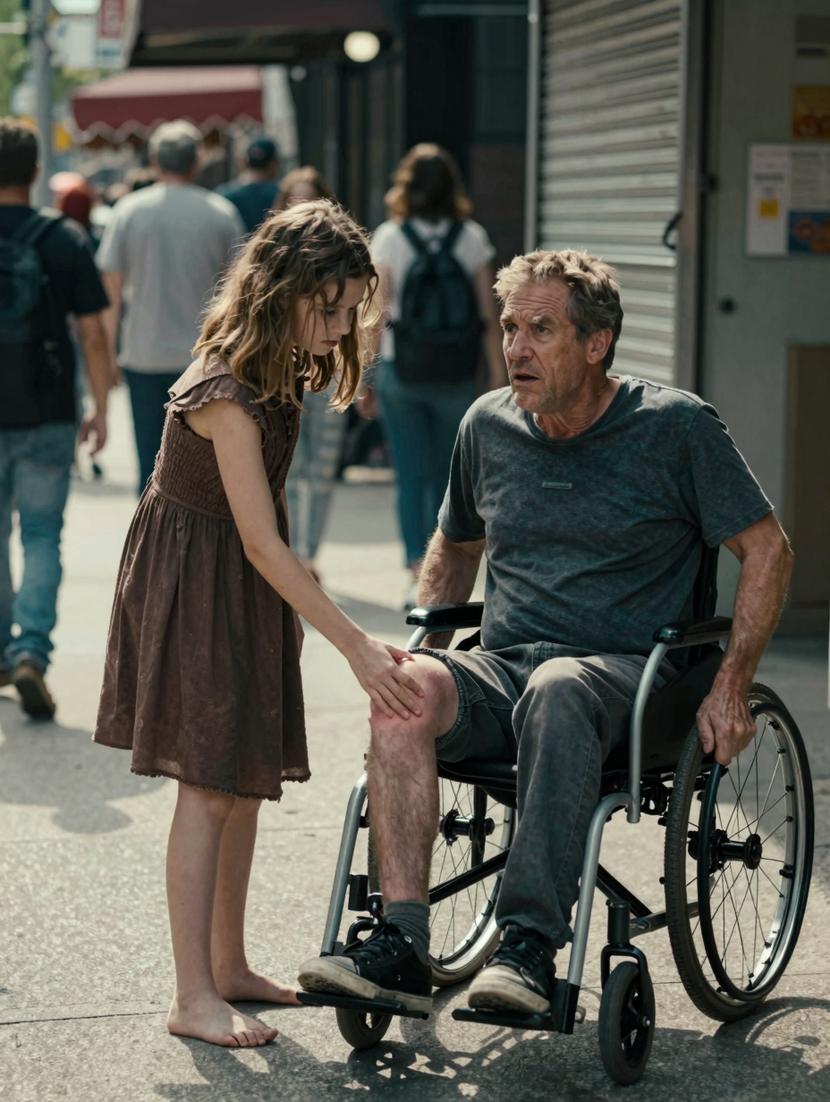
In the relentless rush of a busy Chicago afternoon, no one noticed her—not at first. She stood at the heart of the crowded sidewalk, a ghost among the living, as unnoticed as a shadow slipping between sunbeams. The girl wore a tattered brown dress, the fabric falling off one fragile shoulder. Her bare feet were smeared with grime, and wild, tangled hair veiled her face. She was no older than thirteen.
She stopped before a man in a wheelchair—a man whose young years were betrayed by the deep furrows etched into his face. Daniel Mercer sat just outside a shuttered corner market on West Haven Street. Against the wheel rested a cardboard sign, faded and worn:
“Disabled. Anything helps.”
Daniel had grown used to the world’s indifference, the way eyes slid past him without meeting. Sometimes coins clinked onto his tray. Food appeared on rare, lucky days. Conversation, though? That was unheard of.
So when a soft voice cut through the urban din, he thought he must have imagined it.
“If you give me food,” the girl said quietly, “I can make your legs work again.”
His eyes fixed on her. The city noise blurred, the crowd’s footsteps dimmed. The girl’s gaze was steady—not wild, not pleading—but calm, filled with a certainty that unsettled him.
“Really?” Daniel whispered, his voice cracked and rough. “You can do that?”
The girl smiled, a small, enigmatic curve that held no mockery or false hope.
Daniel laughed bitterly. “Doctors couldn’t fix me.”
Her head tilted slightly, as if weighing his disbelief.
“They didn’t listen.”
A sudden chill slithered up Daniel’s spine despite the warmth of the afternoon. Hesitantly, he reached into his bag, pulling out the only meal he had left—a half-eaten turkey sandwich. His fingers trembled as he held it out.
The girl accepted it with reverence, like a sacred offering.
“Sit up straight,” she instructed softly.
Daniel frowned. “Why?”
“Please.”
He obeyed, curiosity and caution warring in his chest.
Her small, dirt-smudged hand pressed gently on his knee.
Then—sharp, searing pain erupted through his legs.
He gasped, gripping the wheelchair’s arms. “Hey—what are you—”
She leaned closer, whispering words swallowed by the city’s clamor.
And just as abruptly, the agony faded.
Daniel froze, the city sounds flooding back. For the first time in six long years, he felt a warmth bloom beneath his skin. Not the numbness or phantom tingles he had accepted as permanent. Warmth.
His breath hitched.
“I… I felt something.”
The girl stepped back, already turning toward the crowd.
“I’ll come back tonight,” she promised. “If you want to walk.”
Before he could say another word, she vanished into the sea of faces.
Daniel sat there, heart pounding, alive with a flicker of something he hadn’t felt in years—hope.
That night, nestled in his cramped apartment, rain tapping the window like a steady heartbeat, Daniel lay awake wired with disbelief. Doctors had declared his paralysis irreversible—an expressway accident had shattered his spine, and they told him to accept the finality.
He hadn’t meant to hope. Until today.
At precisely 9:47 p.m., a knock shattered the silence.
His heart lurched. Visitors were strangers in his lonely life.
He wheeled himself to the door and opened it.
There she stood, dry despite the rain, her tattered dress and calm eyes unmistakable.
“You came,” Daniel breathed.
“You fed me,” she replied simply. “That matters.”
She stepped inside, taking in the sparse room: no television, no furniture, just a mattress on the floor.
“You lost more than your legs,” she murmured.
Daniel’s throat tightened. “Who are you?”
No answer. Instead, she knelt before him and placed both hands on his knees.
“Stand.”
He let out a dry, humorless laugh. “I can’t.”
“You can,” she said, voice unwavering. “You’re just scared.”
His eyes shut tight, fear crashing through him—fear of falling, of failure, of shattered dreams.
Then came the pain again, but this time it pulsed with life and promise.
His toes curled, calves flexed.
Daniel slammed his eyes open. “Oh God.”
“Now,” her tone sharpened, commanding, “Stand.”
With a cry that shook his soul, Daniel pushed against the arms of the wheelchair. His legs quivered fiercely.
Slowly, painfully—they held.
He stood.
For a breathless three seconds.
Then he sank to his knees, tears spilling freely, hands trembling as they traced the astonishing feeling in his legs.
Looking up, he saw the girl retreating toward the door.
“Wait!” he called out. “Please—don’t go. Who are you?”
She paused.
“My name doesn’t matter,” she said softly. “What you do next does.”
And with that, she disappeared into the night.
Morning brought a miracle the newspapers heralded and the doctors couldn’t explain: Daniel Mercer walked. Not far, not steady. But he walked.
The world buzzed with wonder and disbelief, but Daniel knew the truth was far stranger.
Days and weeks slipped by as he searched the streets, hunting for the mysterious girl.
No one had seen her.
Then one bleak evening, in the dusty stacks of the community library, he found a yellowed newspaper clipping that stopped his breath:
“LOCAL GIRL, 13, DIES SAVING CHILD IN HIT-AND-RUN.”
The photo beneath it pierced his heart.
Same eyes.
Same knowing smile.
Same torn dress.
She had died two years before Daniel’s accident.
He sat back, the weight of realization pinning him in place.
At the article’s end, a line caught his eye:
“Witnesses say the girl whispered something before she passed.”
Daniel closed his eyes—and suddenly, that never-heard whisper became clear in his mind.
“You’re not done yet.”
Folding the paper, Daniel rose—steady, unyielding.
Outside, the city pulsed with endless motion.
But somewhere beyond the shadows, a barefoot girl was smiling, walking beside him, forever.


