
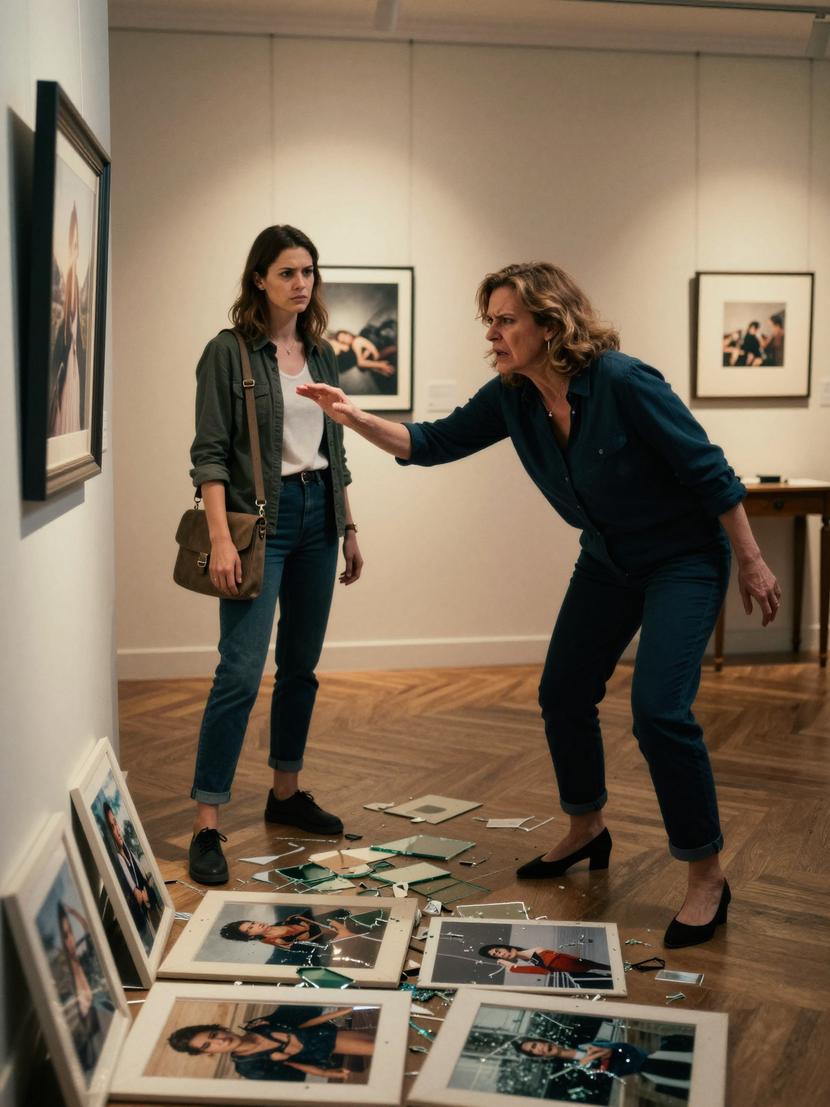
The sharp crash of shattering glass splintered the hushed murmurs of the gallery. With a sweeping, furious gesture, my mother’s arm sent my carefully framed photographs tumbling to the floor like fallen leaves in a storm. The few remaining guests recoiled, slipping away into the shadows, leaving only the harsh rasp of my mother’s heavy breaths and my father’s icy scowl to fill the charged silence.
‘Ungrateful child,’ my mother spat with venom, her elegant fingers trembling with barely contained fury. ‘We’re only asking you to do what’s right. Derek needs that lakehouse far more than you ever will.’
My name is Valeria. I’m 32 years old. Tonight was supposed to be my moment—my breakthrough—a celebration of my first photography exhibition, capturing the soul of our grandfather’s cherished Cedar Lake house through the changing seasons. Instead, the evening spiraled into another bitter family confrontation centered on Derek and his unyielding sense of entitlement.
‘The lakehouse isn’t yours to give away,’ I said quietly, my voice steady, even as anger coiled inside me. I watched my father’s face flush crimson with fury. ‘Grandfather entrusted it to me for a reason.’
‘Derek has a family!’ Dad snapped, stepping over shards of glass to loom inches from me. ‘Three children who need room to grow, space you selfishly refuse to share. What do you need the lakehouse for, anyway? Another one of your absurd pictures?’
The ‘absurd pictures’ had just sold for thousands. They didn’t see. They never did. Derek was the golden boy—the successful businessman with the perfect family. I was the artistic disappointment who dared to defy their rigid expectations.
‘Sign the papers,’ Mom barked, brandishing a sleek folder plucked from her designer bag. ‘They’re ready. Sign and we can move on from this embarrassment.’
I thought of the other folder tucked inside my messenger bag—the environmental assessment I had commissioned months ago. The secret that would change everything.
‘No,’ I said firmly, locking eyes with both of them. Shock flickered across their faces but I held my ground. ‘The lakehouse stays with me. It’s what grandfather wanted.’
Mom’s hand shot out wildly, knocking over another display stand. Another explosion of glass and ruin. The memories, painstakingly captured over countless days—waiting for the perfect light, the perfect moment—shattered in an instant.
‘Your grandfather didn’t foresee what Derek would become,’ Dad growled. ‘He’s built a real estate empire! He could develop the land, make something of it instead of letting it rot!’
Rot. That was their word for my sanctuary. They had never bothered to see the beauty on the north shore—the thriving wildlife refuge I’d nurtured, or the artist retreats that filled the summer air with creativity. They ignored that Derek’s empire was built on shortcuts and greed.
‘Derek hasn’t even visited since grandfather died,’ I reminded them, gingerly stepping over glass to salvage a photo. ‘He only cares because he wants condos.’
‘Development means progress!’ Mom snapped. ‘Better than your childish nonsense! When will you grow up and do something worthwhile?’
I almost laughed. They had no idea about the endangered species nesting there—the wetlands protected by law, soon to render development impossible. They were clueless about tomorrow’s environmental protection order.
‘I’m doing something meaningful,’ I said, holding up a damaged image of loons at sunrise, fragile yet powerful. ‘It’s just not the kind of meaning you understand.’
‘Enough!’ Dad slammed his hand on the wall, making the last photos tremble. ‘Sign tonight or you’re cut off. No family. No support. No ties.’
I looked at the pair who had tried to shape me into their image, who had lavishly backed Derek but dismissed me, who now destroyed my work out of frustration.
‘That’s your choice,’ I said quietly, gathering my bag. ‘But my answer remains no.’ Pausing at the door, I added, ‘Tomorrow, I meet with the Environmental Conservation Council. I need to prepare.’
Confusion clouded their faces. ‘Environmental Conservation Council?’ Mom’s voice wavered for the first time. ‘What are you talking about?’
I stepped into the cool night air, footsteps steady despite their calls behind me. Years they underestimated me, dismissed my passion as a phase. Tomorrow, they’d witness the truth behind that ’empty’ lakehouse. Tomorrow, they’d understand why grandfather chose me to guard his legacy—proof in every photograph.
—
Part 1: The Verdict
The conference room buzzed with quiet tension when I arrived the next morning. Amidst the polished suits and corporate murmurs, Derek huddled with his development team, poring over blueprints doomed to become obsolete. Nearby, Mom and Dad shot me glances sharp as icicles.
I claimed my seat, setting up my laptop and the folder dense with months of painstaking evidence. The night had been spent recovering files—not for the gallery, but for this battlefield.
‘Ridiculous,’ Derek muttered, loud enough for me. ‘Some birds and plants can’t stand in the way of progress. Investors are waiting.’
The Environmental Conservation Council was led by Director Helen Porter, a formidable woman who had become an ally during this fight. Her keen interest lay in my data from the wetlands.
‘Good morning,’ Helen began, voice crisp. ‘We’re here to review the environmental assessment of the Cedar Lake property and its impact on development plans.’
Derek’s confident smirk faded as I fired up my presentation. The screen bloomed with an intimate shot of endangered sandhill cranes nesting in marshes that would soon be off-limits.
‘This property is a vital refuge for protected species,’ I explained, voice unwavering. ‘I’ve documented their lives for the past year with scientific precision.’
Images flooded the screen: rare orchids blossoming, threatened fish darting in crystal waters, an otter family sculpting homes along the shore. Each photo was meticulously logged with dates, GPS coordinates, and field notes.
‘Nonsense!’ Dad blurted, rising. ‘These photos could be faked! Valeria has always been a dreamer!’
Helen lifted an eyebrow. ‘On the contrary, Mr. Harrison. Independent scientific teams have verified every detail. Ms. Harrison’s report is exemplary.’
I revealed more data showing the property’s role as a crucial wildlife corridor, linking adjacent preserves. Derek’s plan would shatter this fragile ecosystem.
‘Moreover,’ I added, producing grandfather’s will and notes, ‘the land comes with conservation conditions. Grandfather entrusted me because he believed in protecting this sanctuary.’
Derek shot up. ‘That’s fiction! The will simply left the property to her—no strings attached!’
I smiled peacefully, sliding the papers toward Helen. ‘He knew exactly what was at stake. That’s why he chose me.’
Mom went pale, the weight of unraveling schemes pressing down. Their pressure, their threats—all meaningless now.
‘In light of these findings,’ Helen declared, voice resolute, ‘the Council formally designates the Cedar Lake property as a protected wildlife sanctuary. Development is prohibited.’
Chaos erupted as Derek’s team scrambled. My father demanded someone in authority. Mom sat frozen, staring at me as if seeing me for the first time.
‘You schemed this,’ Derek accused, storming over. ‘You destroyed everything. Do you realize how much I’ve invested?’
I met his fury levelly. ‘You might have noticed the lakehouse yourself if you’d visited in years.’
‘This isn’t over!’ Dad warned. ‘We’ll appeal, get new assessments.’
‘Try all you want,’ I replied, packing up. ‘Every survey will show the same truth. This place is a sanctuary, just as grandfather intended.’
Helen approached, a folder in hand. ‘Ms. Harrison, the Council would like to discuss establishing a permanent research station here. Your documentation is invaluable.’
I caught Mom flinch at the professionalism I was accorded—proof my passion was no mere hobby.
‘I’d be honored,’ I said. ‘I’ll guide you to the best observation sites.’
Exiting the room, Derek’s angry voice trailed behind me: ‘This is your fault. If she hadn’t been spoiled…’
I smiled inwardly. This wasn’t about revenge. This was about preserving something irreplaceably beautiful, just as grandfather taught me. The lakehouse remained as it should be—a haven for life, a sanctuary for the soul. And my photographs? They had become a powerful testament of that sacred truth.
—
UPDATE: Six Months Later
Standing on the lakehouse deck, I watched animals thrive—the morning mist curling over the water as a pair of sandhill cranes taught their chicks to forage. The sanctuary had blossomed beyond my hopes. Graduate researchers from universities arrived regularly, and my photos had begun appearing in national exhibitions. National Geographic had even shown interest in telling the story.
‘Miss Harrison!’ a bright-eyed researcher called out. ‘That rare orchid you documented? It’s spreading across new wetlands!’
I smiled, recalling when my parents had dismissed this place as barren and wasted. Now it pulsed with life, purpose, and hope.
My phone buzzed—Megan, Derek’s wife, texting. ‘The kids miss the lake. Could we visit this weekend? Just us—without Derek.’
Our family had shifted. Derek refused contact, nursing bruised pride, but Megan admitted she loved the lakehouse as it was. Her children shared my passion for the wild.
‘Of course,’ I replied. ‘The baby otters are exploring. Bring their cameras.’
Mom took longer to adjust. Last month, her Mercedes rolled up surprisingly among the researchers’ rugged vehicles.
‘I don’t understand you,’ she confessed, watching a rare butterfly through my lens. ‘You could have profited millions.’
‘Look at this,’ I said softly, passing her the camera. ‘This butterfly’s habitat exists in only a few places worldwide. What’s that worth?’
She was silent, seeing through the glass for the first time. ‘It’s beautiful,’ she admitted. ‘Grandfather spoke of these things.’
‘That’s why he trusted me.’
This morning, Dad pulled up in his usual BMW, dressing down from his business suit.
‘Valeria,’ he said uncertainly, ‘Mom mentioned you’re giving a presentation today.’
I nodded. ‘It’s the sanctuary’s first educational program for local children. We’re teaching conservation and wildlife photography.’
He looked around at the research gear and photos with something like awe.
‘Derek’s youngest, Tommy,’ he began hesitantly, ‘he can’t stop talking about the photos you taught him to take. He wants to be a wildlife photographer now.’
‘He has a keen eye,’ I said, thinking of Tommy’s excitement snapping his first heron picture. ‘Want to see what we’re working on?’
He agreed, and I led him to the research station housed in the former boathouse, walls adorned with photos and scientific notes.
‘You did all this?’ he marveled at a sequence showing a rare frog’s life cycle.
‘This is what I’ve been doing while everyone else thought I was wasting time,’ I said softly. ‘This is the world grandfather saw here.’
Dad was quiet for a long moment before turning. ‘I was wrong. About this land. About your work. He would be proud.’
Those words settled over me like the morning mist on Cedar Lake.
‘Would you like to stay for the presentation?’ I offered. ‘The kids would love to honor their grandfather.’
He smiled, genuine and warm, for the first time in years.
That afternoon, as I watched Dad helping Tommy frame a shot of deer at the forest’s edge, I realized how much had changed. The lakehouse hadn’t merely preserved wildlife—it was beginning to heal the fractures in our family. Derek stayed away, too proud to admit defeat, but his children returned often, seeing the world through lenses of wonder instead of profit. Mom planted native gardens to attract butterflies, even if she’d never admit how much she enjoyed it. And Dad was slowly learning that true success is measured by more than wealth.
As the sun set over the lake, painting vibrant strokes across the sky no development could improve, I captured one last image—my father crouched quietly with his grandchildren, cameras in hand, watching life unfold.
It wasn’t the future any of us had planned, but it was greater than anything we could have built. The lakehouse had become exactly what grandfather intended: a sanctuary not just for wildlife but for hearts willing to truly see.
Sometimes, the most precious things in life cannot be bought or sold; they can only be preserved, protected, and shared with those who open their eyes to wonder.


