
The heavy mahogany door slammed shut with a force that felt like a thunderclap striking my chest, reverberating down through the soles of my shoes and echoing through the vast, hollow foyer of Beaumont Manor. It was no ordinary door closing; it was a final judgment, a verdict without appeal in the courtroom of my life.
My suitcase, an old, worn leather piece hastily packed in a whirlwind of aching silence, tumbled down the broad limestone steps and spilled onto the meticulously raked gravel driveway. A delicate silk blouse sleeve slipped out, fluttering limply like a white flag of defeat against the stones.
‘You’re a disgrace to this firm, Sabrina!’ Richard Beaumont’s voice boomed from the top of the grand staircase, framed by the towering Corinthian columns he worshipped more than any of his children. Anger painted his aristocratic face crimson—a burning, raw fury that seemed almost cruel.
‘A dropout. A quitter. Don’t you dare imagine you can come crawling back when the real world chews you up and spits you out. You’re cut off. Not a cent will come your way. Understand me?’
I lifted my eyes to him, the late afternoon sun elongating the shadows across the manor’s solemn stone façade — the prison that had held me captive for twenty-four years. No screams, no tears, not even a plea escaped me. I was numb yet fiercely resolute.
My hand slipped deep into my coat pocket, fingers brushing against the smooth, cold glass of my phone. On its screen, hidden from his piercing, judgmental glare, was the biometric interface to my crypto wallet. The subtle buzz vibrated against my palm.
Sixty-five million dollars.
Liquid assets. Paid taxes. Diversified and untouchable.
Richard believed he had banished me into destitution. Little did he know, he was shouting at a centimillionaire—someone who built an empire of bits and bytes under the moonlight, precisely during the hours he assumed I was fumbling my law exams.
‘Goodbye, Richard,’ I said steadily.
Not Dad. Not Father. Just Richard.
I descended the stairs, my heels striking the stone in a measured cadence of departure. Picking up my bag, I zipped it shut with deliberate calm before sliding into the back seat of the sleek black SUV waiting by the iron gates. As the tires crunched away across the gravel, I didn’t glance back at the ivy-draped brick estate. Instead, I checked the itinerary for the private jet waiting at Hawthorne Airfield.
Exile was ending. My reign was just beginning.
As Beaumont Manor receded in the rearview mirror, a notification pulsed on my phone. Not a bank alert, but a stealthy message from a private server hidden in the depths of the very manor Richard was so desperate to cast me out from—a “Dead Man’s Switch.” Stepping outside the geofence had triggered a silent protocol to archive every incriminating email, transaction, and secret Richard had concealed within the firm’s aging mainframe. I caught my reflection in the window and smiled coldly. He thought he evicted me, but I had left a specter behind.
—
The flight to California was like a deep breath after years underwater. Gone was the suffocating silence of the Beaumont dinner table, where each clink of silverware sounded like gunfire, every inhalation judged and dissected. Now, the Gulfstream G650 cruised serenely at forty-five thousand feet, its muted hum a lullaby of liberation.
Sipping sparkling water, I traced the patchwork earth beneath and dissected the last six years—deciding to leave behind not just a place but a legacy of confinement.
Richard Beaumont was the Senior Partner of one of Greystone’s most archaic law firms—an institution as rigid and stifling as the man himself. He worshipped an old-fashioned trinity: Tradition, the Firm, and Men. In his backward vision, women were ornamental, fit only to host charity soirées and smooth social tensions—roles my mother, Daphne, silently endured. Sons like Ethan were heirs, destined to inherit power; daughters like me were liabilities, to be managed, hidden, or married off to balance portfolios.
Ethan, my brother, was the golden boy, bathed in privilege and poised to claim the throne. Private tutors, insider internships, cultivated applause for mediocrity. And me?
When I dared to dream about corporate law in high school, Richard’s dismissive laugh echoed in my ears. ‘It’s a ruthless world, Sabrina. You don’t have the stomach for the kill.’
So, I quit asking. I quieted myself, becoming a ghost in the hallways, a shadow in the library.
Sent to law school as a holding pattern to find a suitable match, I went—but I didn’t study torts or contracts. I studied the broken gears of the real estate market—a world ruled by intuition, handshakes on golf courses, and nepotism cloaked in tradition.
In my dorm, while classmates pored over dusty casebooks, I coded relentlessly. I created EstateEye, an AI-powered engine weaving satellite imagery, municipal data, and predictive algorithms to appraise commercial properties with surgical precision—not guesswork.
By year two, three hedge funds held licenses to my software. By year three, I anonymously sold a minority stake for eight figures, cloaked behind shell corporations and digital veils.
Now, the SUV pulled into my new kingdom at Silverstrand Beach—a $42 million architectural marvel of glass and steel defying the ocean’s horizon.
The cold contrast was staggering: Greystone’s shadowy oak panels and heavy velvet curtains gave way to blinding Pacific light and near-invisible walls.
The gate slid open soundlessly. I entered through the pivot door, the polished concrete floor echoing my footsteps—a stark declaration of a new beginning.
I pressed my palm against the panoramic window, drinking in the ocean’s endless expanse. This was victory. I had shattered Richard’s suffocating orbit and claimed a realm of my own design.
The minimalist Italian furnishings whispered luxury; the chef’s kitchen gleamed untouched. But then, silence settled—a weighty, suffocating quiet, different from the jet’s peaceful hush. Money didn’t buy joy or seal wounds; it only changed the texture of emptiness.
Five bedrooms, seven baths, a screening room, and a wine cellar—all empty. I perched on the vast white sofa, staring at the endless waves indifferent to human triumphs or defeats.
Richard had exiled me not for failure, but because I dared succeed on my terms. Surrounded by proof of my worth, a cold emptiness gnawed at me.
Owning a castle never heals exile; it just offers a grander place to bleed.
My phone lay silent: no calls from Daphne checking in, no smug messages from Ethan—they had erased me with surgical precision.
‘Good,’ I whispered to the empty room. ‘Let them believe I’m dead.’
Because the Sabrina they knew—the quiet, disappointing daughter—was gone. The woman here was the Architect, and her empire was only beginning.
—
Six months later, as I sipped green juice and scanned acquisition targets, a flashing red alert caught my eye on the EstateEye dashboard—a financial alarm from a familiar asset.
It wasn’t a Tokyo skyscraper or Arizona mall. It was Beaumont Manor, my childhood home. The data screamed impossibility: the mortgage wasn’t just late; the property was leveraged against a precarious, high-risk line of credit by an insolvent firm.
I leaned back in my Eames chair, the ocean’s salty breeze teasing the terrace doors, but my mind was icy, zeroed on the screen.
The grim story unfolded: Richard’s firm, once a pillar of prestige, was hemorrhaging cash. The veneer of old money? Fragile and plaster-thin. Desperation had driven Richard to gamble the literal roof of the house to mask the sinking ship. The tragedy was Shakespearean.
Then, my phone buzzed. Ethan’s name appeared. I let it ring once, twice, thrice. Let him stew in uncertainty. Finally, I answered.
‘Hello, Ethan.’
His breath was ragged, the usual arrogance stripped away. ‘Sabrina, thank God. I wasn’t sure this number was still active.’
‘It works. What do you want?’
‘I’m in deep, Sis. Some cash flow problems—gambling debts. Bad luck, I swear. I need fifty thousand for a month. I’ll pay you back double.’
A smirk almost escaped me. Classic Ethan. ‘Fifty thousand is a steep sum for a dropout, Ethan.’
‘I know! But you always saved something from your projects. Please, Sabrina. If I don’t fix this, Dad will kill me.’
He pictured me scrapping by on freelance gigs, living hand-to-mouth. He had no idea the fortress I’d built.
‘I can help,’ I said.
Relief washed over him like a wet blanket. ‘Really? Oh thank you, Sabrina.’
‘On one condition.’
‘Name it.’
‘You sign a promissory note. Securing the loan against your future inheritance—specifically your share in the estate.’
‘Why?’
‘Because I’m no longer your little sister who cleans up your disasters for free. This is business. Sign or find cash elsewhere.’
Silence stretched, then grudging acceptance. He figured fifty grand was a trivial sum against millions in inheritance.
‘Fine. Send it over.’
I hung up, fingers poised over my phone.
‘Execute Protocol Trojan Horse,’ I whispered.
I didn’t merely wire him money. Through Nemesis Holdings, my shell company, I contacted the bank holding the toxic mortgage on Beaumont Manor. They were desperate to offload the asset given missed payments and firm instability.
I clicked ‘buy.’ I purchased the debt, the note, the keys to the house they called home.
On my balcony, salty air filling my lungs, the truth settled. They were sleeping on borrowed time—and in my house.
—
Two days later, a forwarded email arrived from a baffled former classmate: an invite to The Beaumont Law Gala—a celebration of thirty years of ‘excellence’ at the very manor now collateralized by my holdings. The audacity was breathtaking.
I clicked RSVP.
—
No train this time. Private jet to Hawthorne Airfield, helicopter to a landing pad miles from Beaumont Manor. A sleek black town car ferried me to the gates.
The house loomed, unchanged, cold—a monument to outdated power. Bentleys and Mercedes lined the drive, chrome glistening under artful lighting.
I stepped out, dressed in a tailored black Alexander McQueen suit—more armor than fashion.
Valet took my keys. I ascended the steps where years ago my suitcase had crashed.
Inside, judges, politicians, and senior partners swirled expensive wines and stale ambitions. The air reeked of privilege unaware they stood atop crumbling foundations.
Daphne spotted me first. Frail, her smile forced and anxious, she froze mid-smile, a tray trembling in her hand.
‘Sabrina?’ Her voice barely above a whisper, eyes darting like I was a blight she wished to erase. ‘What are you doing here?’
‘I heard it’s a party,’ I replied smoothly, seizing a champagne flute. ‘Wouldn’t miss the celebration of… excellence.’
‘Your father… he won’t be pleased. He believes you’re still struggling.’
‘Let him believe that,’ I said, passing through the crowd like a shark cutting through minnows.
The ballroom was thick with heat and expectation. Richard stood on the raised dais, glass of scotch in hand, flushed and regal. Ethan, nervous and sweating beside him, forced a brittle smile.
Richard rapped a spoon on his glass, silencing the crowd.
‘Friends, colleagues,’ he began, voice booming with practiced authority and a hint of slur. ‘Tonight we honor legacy. Foundations built to outlast us.’
He cupped Ethan’s shoulder—an iron grip disguised as pride.
‘My son embodies strength, fortitude, character. The law demands men of character.’
A polite ripple of applause—heavy with implication.
Richard’s gaze sharpened, landing on me with all the cruelty of a judge jabbing a convict. ‘Unlike those who crumble under pressure. Unlike those who chase childish fantasies and games rather than the hard truths of law.’
The room followed his eyes. The weight of judgment pressed. I was the failure, the dropout, the shame.
‘To Ethan,’ Richard toasted, glass raised high.
‘To Ethan,’ echoed the crowd.
Ethan caught my eyes, smirked, and checked the time on a glinting vintage Rolex Daytona—purchased with my fifty thousand.
My money adorned his wrist while my father mocked me.
The calculated cruelty was deep and precise. I had been erased.
I slipped away before the applause dwindled, moving like a shadow through familiar halls. Upstairs, I found Ethan’s old room—now an office.
The door unlatched, careless.
Inside, his laptop hummed invitingly.
Password protected of course, but Ethan was lazy. Birthday? No. Password123? No. Favorite football team’s name? Access granted.
Plugging in a USB loaded with my custom forensic tech, I bypassed his sloppy defenses.
The screen flooded with red—financial misdeeds, illicit transfers.
Worse than expected: he was running a Ponzi scheme, siphoning new client funds to cover botched settlements.
Then emails: between Ethan and Richard, three months prior.
Subject: The Audit.
Richard: ‘I fixed Jones’ file. Don’t let this happen again. If the Bar finds out, we’re finished. I leveraged the house to cover the shortfall. Last time, Ethan.’
The glow of the screen revealed a terrifying truth: Richard knew. He wasn’t a blind patriarch but an accomplice, a co-conspirator. Toasting his son while hiding his crimes—and casting me out.
I ejected the drive. For the first time in years, I wore more than the Architect’s mantle—I was the Judge.
—
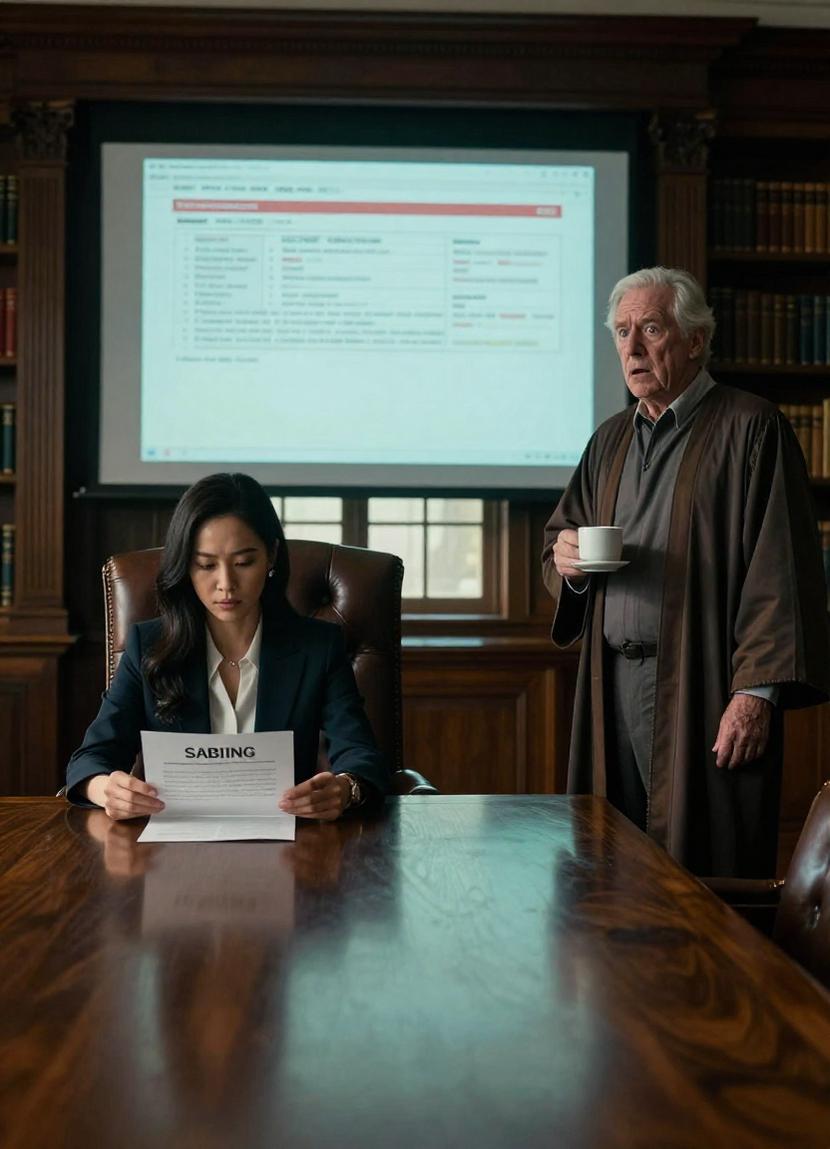
Morning light seeped through heavy velvet drapes in the grand library, dust dancing like fractured memories. I sat in Richard’s imposing leather chair at the head of the oak conference table, waiting.
At eight, the double doors creaked open. Richard entered, robe loosely tied, coffee in hand. His bravado cracked at the sight of me.
‘Sabrina? What are you doing in my chair?’
‘Sit, Richard,’ I said, voice calm, deadly.
‘You’ll leave this house now or I’ll call the police.’
Ethan shuffled in, disheveled, sweatpants replacing his gala suit. ‘What’s happening? Who let her in?’
‘I let myself in,’ I said. ‘I have a key.’
‘I took your key,’ Richard spat angrily.
‘I changed the locks an hour ago. Sit.’
My tone—icy steel—froze them. They obeyed reluctantly.
‘I’ll keep this brief,’ I began, clicking a remote. A projector ignited, casting a bank statement onto the wall.
The firm’s escrow account—highlighted withdrawals singed in bright red.
‘Is this real?’ Ethan whispered, face draining.
‘Felony embezzlement. Forged signatures. Client funds stolen for online poker and a Porsche lease. And a vintage Rolex.’
Richard slammed the table. ‘Where did you get this? Hacking my files? It’s illegal!’
‘Sit,’ I repeated, voice lower. The projector shifted to email threads—admissions of cover-up and mortgage leverage.
Richard sagged, suddenly old and spent.
‘You knew,’ I said, locking eyes. ‘But you toasted him as a man of character.’
‘He’s my son,’ Richard croaked. ‘I had to protect our name.’
‘And me?’ I asked softly. ‘Your daughter?
‘You walked away,’ he stammered.
‘I didn’t walk away,’ I said. ‘I pivoted.’
One last click—the image changed to a Notice of Foreclosure. Lender: Nemesis Holdings LLC.
‘Nemesis Holdings?’ Richard squinted. ‘They own the note. They’ve been pressuring us.’
‘Yes. I am Nemesis Holdings.’
Silence pressed down.
‘What?’ Ethan gasped.
‘I bought the debt six months ago. I own this house. The very roof over your heads.’
‘Impossible,’ Richard whispered. ‘You’re a dropout. You have nothing.’
‘Sixty-five million dollars, Richard,’ I said, each word a hammer strike. ‘I didn’t drop out because I failed—I dropped out because I realized I could buy the school.’
I slid an eviction notice across the table.
‘You have thirty days to vacate. The firm is insolvent. I’ve submitted the embezzlement evidence to the State Bar. Ethan will be disbarred. You face sanctions, possibly jail.’
‘You can’t do this—they’re family,’ Richard whimpered tears of self-pity.
‘Family?’ I laughed bitterly. ‘Family protects. Family doesn’t call daughters a disgrace or sacrifice them to protect fragile egos.’
I rose, towering over two broken men, tenants in a house they no longer owned.
‘The verdict is in,’ I declared. ‘You’re evicted.’
—
Afterward, no more screams, no denial. Just the quiet of packing boxes and signing papers.
Ethan was disbarred within a month, avoiding jail only by turning on an accomplice. He now worked humble shifts at a rental agency in Ravener, lost to the world that once celebrated him.
Richard and Daphne downsized to a modest condo in Sunscape State, the last of their assets swallowed by debts.
Beaumont Manor was sold—not to me, but to a developer who vowed to erase its stagnant past.
Back in Sunnyside Cove, on my balcony watching Pacific sunsets bleed violet and gold, I expected triumph.
Instead, I felt a profound relief, the weight of twenty-six years of judgment finally lifted. Anger faded. You can’t harbor rage against those who no longer hold power over you.
I deleted Ethan and Richard and Daphne from my contacts. I was no longer exiled—I was sovereign. Yet sovereignty can be lonely.
I returned indoors, opened my laptop, and drafted a charter for The Horizon Scholarship—$50 million pledged to women in PropTech who dared to defy expectations: dropouts, outliers, the misjudged. Women like me.
My glass fortress was still vast and echoing, but now it felt alive—a blank canvas waiting for a life reborn.
I had survived. I had built an empire. Now, it was time to build a legacy.


