
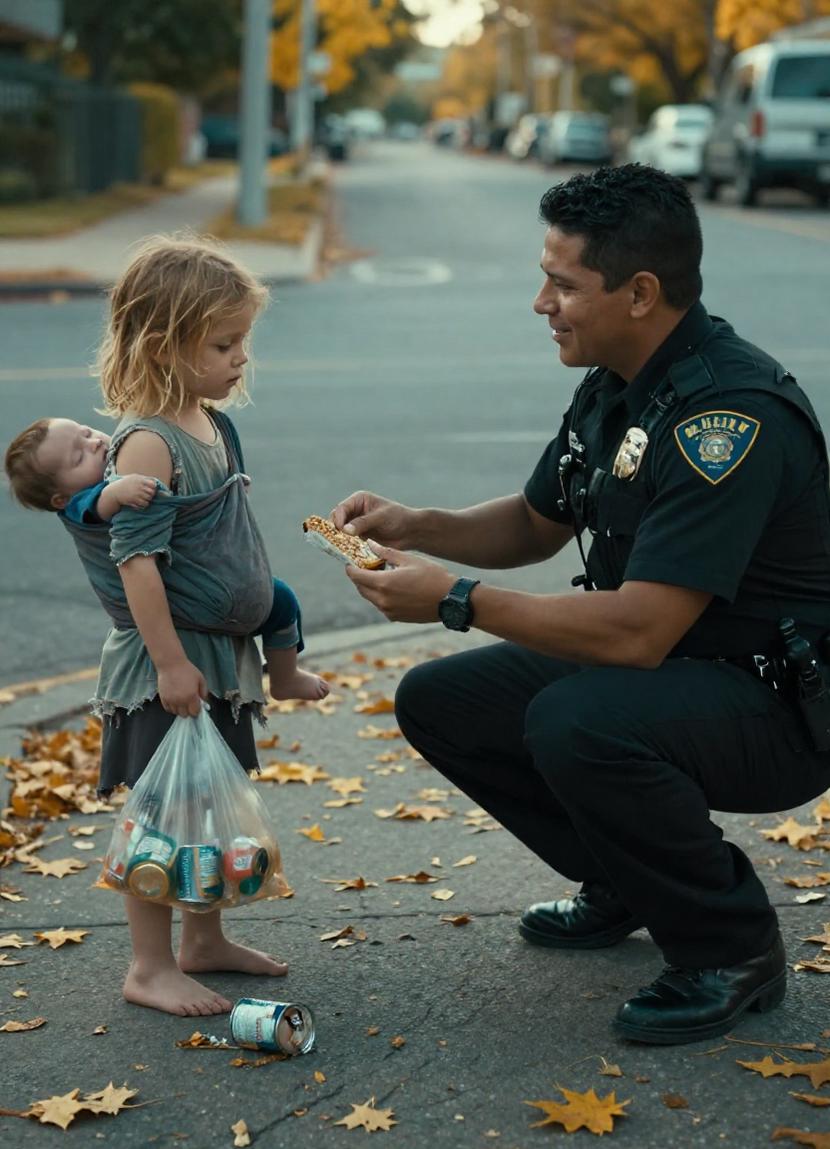
The sharp autumn wind sliced through the nearly empty street, twirling yellow leaves like forgotten memories along cracked sidewalks and scraping past the weary brick façades in a long-forgotten neighborhood. Officer Carlos Moreno had worn his badge for twelve grueling years. He had faced the worst—overdoses that blurred the lines of life and death, twisted wrecks, and domestic battles that left marks far deeper than broken skin. Yet, nothing, absolutely nothing, had ever stopped him in his tracks like that morning did.
Up ahead, beneath a canopy of fiery gold and dying rust, a tiny silhouette shuffled barefoot over the chilly concrete. Barely five, she moved slowly, each step fragile and deliberate. Her once blond hair hung in tangled dirty strands, clinging to cheeks stained by recent tears. In one grimy hand, she dragged a torn plastic bag packed tight with crushed cans and scraps, weathered by many days’ collection.
Then Carlos’s eyes caught the sling.
An old blue T-shirt, knotted awkwardly over her shoulder and across her chest, cradled a baby nestled against her—so small that his fragile head tucked just beneath her chin. His skin was pale and mottled; his lips cracked and dry. Even in sleep, exhaustion clung to him like a shroud.
Carlos’s breath hitched.
He had witnessed hardship before. Seen children scraping by with little hope. But never this.
Never a child bearing the weight of another—a sister and guardian all at once, moving through a world that ignored her, scavenging scraps just to survive.
He’d been dispatched to what should have been a routine call—a report of suspicious activity by the community park bins. He’d expected a homeless adult, maybe some unruly teenagers causing trouble.
But there, standing quietly, was this fragile girl.
She bent down slowly, fingertips grazing the cold ground as she picked up a battered soda can and slipped it into her bag with practiced ease. This wasn’t new—this was all she knew. Her oversized shirt slipped off one shoulder, exposing the sharp outline of ribs beneath skin stretched thin by hunger.
The baby stirred softly, a faint, desperate sound escaping as he nestled closer to her chest.
Carlos’s eyes caught the raw details—the cracked lips, the flushed but chapped cheeks, the way her body instinctively curved forward, a shield against the biting wind. This bore beyond mere poverty.
This was abandonment.
At first, she didn’t notice him. Her searching eyes scanned the scattered detritus on the sidewalk, hunting for anything that might buy a few precious pennies. When her gaze finally lifted and met the badge, her frame stiffened painfully.
Fear swept across her face like a shadow.
Her deep brown eyes flicked over his uniform—badge, radio, holster—and her grip tightened on the frayed plastic bag. Carlos recognized that look immediately. It wasn’t just fear of a stranger.
It was fear of authority itself.
He held his ground and lowered himself a fraction to avoid looming over her, waiting silently. A gust rattled the bare branches above, and she shivered, readjusting the sling as the baby’s shallow breaths stirred.
Carlos thought suddenly of his own daughter, six years old, safe and warm, probably bickering over cartoons and snacks in their cozy home. The starkness hit him like a shard of ice.
Finally, he spoke softly, asking her name.
Her voice was little more than a whisper as she answered, cautious, fractured.
She said she and the baby stayed hidden behind the rusty laundry. The infant was her brother. Their mother had gone out searching for food.
She never came back.
Three nights ago.
She’d been trying to keep her brother warm, feeding him whatever scraps she could muster, wrapping him in tattered cloth pieces she’d found. Someone had once told her you could trade bottles for money. So, she collected them—like she was doing now.
Carlos felt a tight knot in his throat.
This was no simple tragedy.
This was an emergency unfolding in real time.
The baby needed warmth, nourishment, urgent medical care. The girl needed protection—immediately.
But Carlos also understood: one misstep, one wrong word, and she would bolt. And if she ran, the city would swallow her whole.
So he made a choice.
He stepped away from his role as an enforcer of law.
He reached into his jacket and pulled out a granola bar, a small comfort he kept for long shifts. Unwrapping it gently, he extended it toward her, careful not to crowd her.
The girl hesitated, eyes flicking between the officer and the small offering.
Then—tentatively—she took one tentative step forward.
It was the fragile beginning.
The first slender thread of trust in a life woven tight with fear.
What Carlos could not know then was how the next words she spoke—soft, broken, desperate—would lodge deep in his heart, unraveling him in ways no police training could prepare him for.
Those words would ignite a chain of events that would forever change not only her world and her baby brother’s, but his own as well.
Because sometimes, true strength isn’t found in untold riches or endless resources. It rises in those who refuse to turn away.
Carlos could have handled it like any other file—a routine call to tick off his list.
He chose not to.
He chose instead to stay.
And that choice became a lifeline—a boundary between despair and hope.
In a world that rushes past and looks away too often, remember this:
One moment of kindness can rewrite a life’s story.
You don’t have to solve it all.
Sometimes, you only need to stop—and care.


