
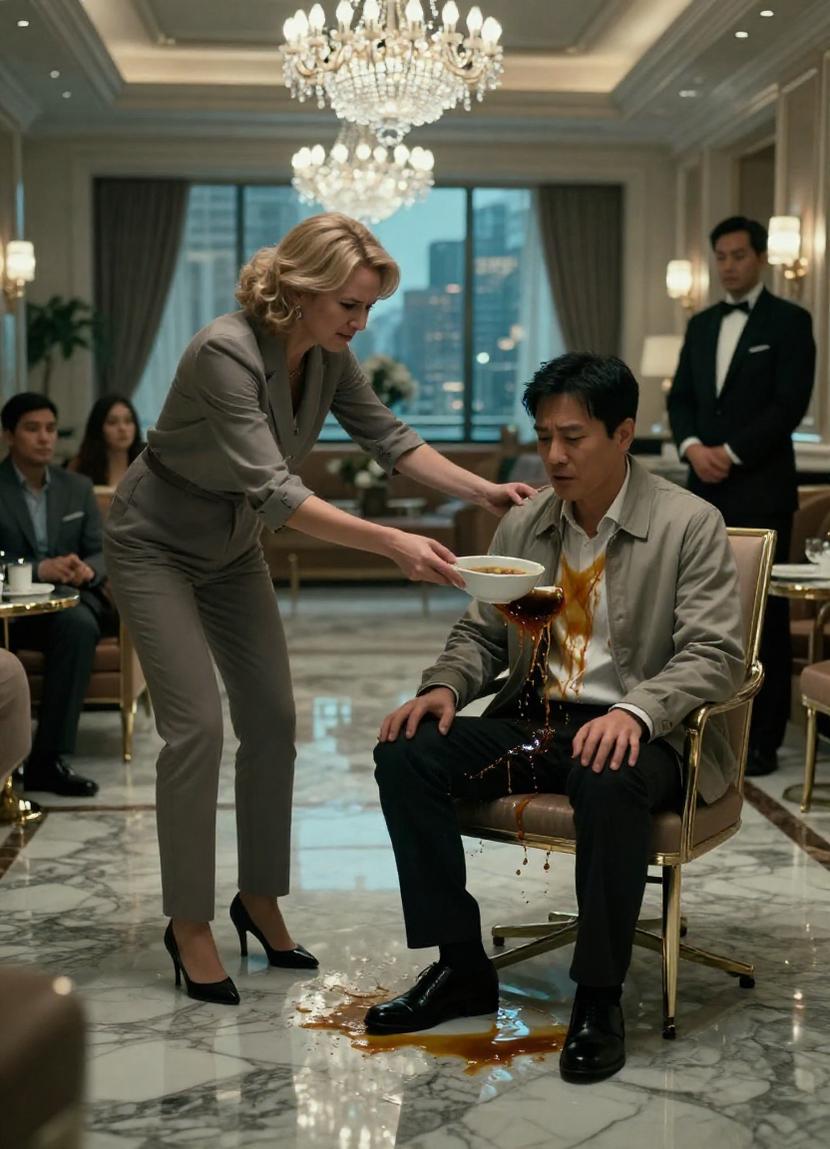
The top-floor lounge of the hospital sparkled with an air of untouchable luxury—like a secret haven reserved for the city’s elite. Crystal chandeliers scattered a constellation of light across gleaming marble floors, while sharply dressed servers weaved silently between small, privileged groups, their silver trays loaded with vintage wines and meticulously crafted hors d’oeuvres. Every detail whispered opulence, every morsel a silent boast that wealth was the true currency tonight.
This was the hospital’s prestigious annual charity gala—an invitation-only event where generosity was flaunted as much as it was given.
Near the grand windows, a man stood apart from all this polished finery. His jacket was neat but plain, absent of any designer flair or bespoke cut. He held no glass, spoke to no one, blending almost like a shadow—quietly absorbing the city’s gleaming lights far below.
That’s when she saw him.
She halted, her footsteps stilled by a sudden, sharp disdain. Her gaze locked onto him with an unmistakable edge, as though he had disrupted an unspoken order.
“Excuse me,” she snapped, voice crisp and cold.
He turned slowly, calm and composed.
“Yes?” he replied, his tone steady, inviting confrontation without fear.
Her voice sharpened, slicing through the hum of conversation. “Who let you in here?”
The murmurs around them dimmed; eyes flicked in their direction.
“I’m here for the event,” he answered simply—with nothing but truth behind the words.
She scoffed, a harsh little sound filled with disbelief. “This is the VIP lounge. Not the lobby. Not the cafeteria.”
More heads turned, curiosity piqued by her boldness.
He didn’t flinch. “I was invited.”
Her lips curled into a cold smirk. “Invited?” She scrutinized his plain jacket as if it were a provocation. “In *that*?”
Impatiently, she lifted the soup bowl a waiter had just placed beside her.
“Honestly,” she muttered, eyes narrowing into slits, then faced him directly once more. “People like you spoil nights like this.”
Phones discreetly lifted; some guests already recording.
He opened his mouth to speak, but she stepped forward, cutting him off with icy determination.
Her gaze sharpened into a glare colder than winter frost as she tipped the soup bowl deliberately. The warm liquid cascaded down his jacket in a dramatic arc, soaking the fabric and splattering cold droplets across the polished marble.
A collective gasp rose, the room frozen in stunned silence.
“There,” she said, voice dripping with spite. “Now you truly don’t belong.”
A whispered murmur floated behind her. “Did she just—?”
“Security!” she barked, voice ringing like a command. “Remove him. *Now*.”
The man remained perfectly still, even as the dark soup darkened his coat and a single drop traced down his sleeve. Not a flicker of anger or embarrassment crossed his face.
Security exchanged uneasy glances, hesitant.
She crossed her arms, a victorious smirk playing on her lips.
“My husband,” she announced loudly enough for the room to hear, “is the hospital’s vice director. This lounge is reserved for donors, not charity cases.”
Some guests nodded awkwardly; others averted their eyes and scrolled absently through their phones.
“That’s harsh,” someone whispered.
Her reply was cold, cutting. “Mind your own business.”
Finally, the man’s voice broke the tension—low, quiet, but firmly carrying weight. “I was told this was a charity event.”
She laughed dismissively. “For *givers*, not gate-crashers.”
The silence thickened like fog.
Suddenly, hurried footsteps echoed from the far end of the room.
The doors flung open. The hospital director stormed inside, tie askew, breaths heavy and uneven, eyes scanning urgently before locking onto the man standing drenched near the windows.
He froze.
The director stopped mid-step, a flicker of surprise flashing across his face—no anger, no confusion—only recognition.
Straightening immediately, he approached with respectful urgency.
“Sir,” he said, lowering his voice. “I’ve been searching for you everywhere.”
The room dipped into a hush so complete it felt as if time had paused.
The woman’s confident smile faltered.
“I’m sorry,” she stammered, trying to take control again. “There’s been a mistake. This man was—”
The director silenced her with a raised hand, never looking her way.
“Sir,” he repeated gently, stepping nearer to the man with the soup-streaked jacket, “I didn’t expect you to come without an escort.”
The man inclined his head slightly, a small, dignified nod.
“I prefer it that way.”
The director’s throat worked as he swallowed hard.
“Ladies and gentlemen,” he announced, turning to address the room, “I believe a clarification is in order.”
Every phone was raised, pointed like a spotlight.
“This gentleman,” the director declared, “completed his donation paperwork just an hour ago.”
The woman’s face paled, her voice barely a whisper. “Donation?”
“He has just funded the construction of an entirely new cancer treatment facility,” the director said proudly. “One of the largest single contributions this hospital has ever received.”
A ripple of astonishment spread through the guests, disbelief shadowing their faces.
“That can’t be true,” the woman muttered.
The director looked at her sharply. “It is. And he asked to remain anonymous.”
She let out an uneasy, shaky laugh. “You must be joking.”
The man turned slowly toward her, his voice calm and unwavering.
“I am not.”
The director gestured at the soaked jacket.
“My sincerest apologies,” he said gravely. “This should never have happened.”
The man glanced downward at the ruined fabric, then met the director’s eyes.
“I understand,” he said quietly. “Mistakes happen.”
Relief flickered briefly across the woman’s face.
Then he added, voice firmer now, “But intent matters.”
The director stiffened, sensing the heavy truth.
The man’s gaze locked on the woman. “You seemed very comfortable deciding who is worthy.”
Her hands trembled, her confident façade crumbling.
“I didn’t know who you were,” she whispered.
“That’s exactly the point,” he replied.
A charged silence filled the room.
The director cleared his throat, his tone cold and firm.
“There will be consequences.”
She spun toward him, incredulous. “You can’t be serious.”
“I am,” the director affirmed. “Effective immediately, your husband will be placed under administrative review.”
Her breath caught, shock rooting her to the spot.
“And you,” he continued, turning back to the woman, “are no longer welcome at any hospital function.”
Her knees threatened to give way beneath her.
“This is madness,” she gasped, voice cracking. “You’re choosing him over us?”
Without hesitation, the director replied, “I’m choosing integrity.”
The man stepped forward, voice steady but soft.
“I came tonight because I lost someone here,” he revealed. “And I wanted to make sure no one else would.”
The room held its breath.
“I didn’t come to be applauded,” he said, “but I cannot support a place that mistakes wealth for worth.”
He met the director’s gaze with unshakable trust.
“I’m counting on you to handle the rest.”
“Yes,” the director answered without hesitation. “I will.”
The man turned and made his way to the exit. Guests instinctively stepped aside, their phones quietly following his every move until the doors closed behind him.
Behind, the woman stood rooted in silence—surrounded now by a crowd that wanted nothing to do with her.
By morning, the video would be everywhere.
And when the new cancer center opened, no one would remember her name.
But they would never forget the choice he made.


