
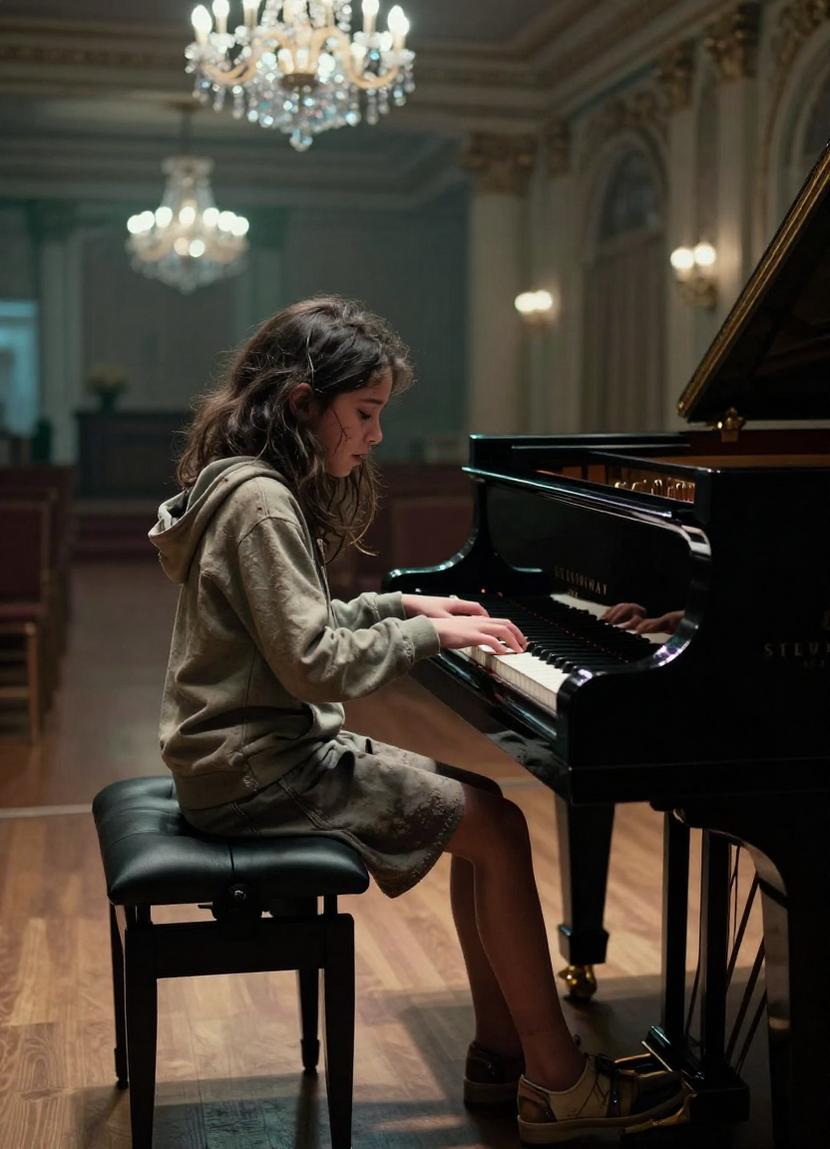
The annual “Pathways for Young Futures” gala unfolded beneath the sprawling crystal chandeliers of the Montclair Estate, a Los Angeles night woven from threads of light and luxury so intense it was almost blinding. The grand ballroom shimmered—a restless sea of champagne glimmers and silk dresses that floated past tables like living portraits, diamonds flickering sharply against the glossy polished wood. This was a stage where every smile was a carefully crafted performance, every laugh a measured note in a symphony of wealth and public virtue. Each pledge echoed with the weight of obligation, designed to impress the right ears in the right moments.
At the heart of this glittering spectacle moved Isabela Montoya, the undisputed queen of the evening, a philanthropic icon whose graceful poise and flawless profile framed eyes colder than the ice melting in her flute. Her presence was a force—a woman who did not merely host the gala; she owned the very air, flitting from one donor to the next like a sovereign bestowing favor. Her silks clung to her like armor, and heirloom jewels gleamed with calculated brilliance, broadcasting a silent declaration of power and untouchable privilege.
The string quartet hummed an elegant, tentative melody, guests murmuring in hushed luxury, and crystal glasses chimed softly in an uneasy harmony. The evening’s choreography was perfect—until the atmosphere fractured with a sudden, jarring intrusion.
Through the velvet ropes, unnoticed at first, slipped a girl no older than twelve—a living paradox wrenched from hardship and thrust into a ballroom of excess. She wore a threadbare hoodie with a torn elbow, pants threadbare and stained, shoes crudely patched with gray tape. Her hair clung damp and unwashed to her narrow face, smudged with dirt and shadowed by hunger that seemed to hollow her fragile frame. Yet in the depths of her dark eyes burned a fierce spark—unyielding, raw, a silent vow that survival would not break her.
Isabela was the first to claim her, the easy smile of a seasoned hostess transforming into a blade-sharp command. “You don’t belong here,” she said icily, her voice slicing through the murmurs like a whip crack. “This is an exclusive event, not a refuge. You are trespassing.”
Her hand flicked almost imperceptibly, summoning two security guards—their large bodies radiating boredom and contempt as they advanced to excise this unwelcome intrusion. Nearby, soft, cruel laughter escaped from privileged lips, a grotesque soundtrack of amusement at another’s disgrace, while fingertips lifted smartphones, ready to cast light and lens on the fragile humiliation of a child.
But the girl stood firm, her chin lifted as if she owned the air beneath the chandelier more than anyone else in the room. Her voice rang out, sharp and unafraid, slicing the practiced murmurals like a bell. “I came to play the piano,” she declared with breathtaking certainty. “I’m going to play a song you’ll never forget.”
The guards grasped her arms, dragging her toward the exit, leather soles scraping the polished marble, but another voice—the calm, measured authority of an unexpected ally—halted the motion.
“Wait.”
From a seat near the stage rose Mateo Delgado, a man whose very presence bent the atmosphere. The legendary concert pianist moved forward, not with pity, but with the sharp curiosity reserved for discord in an otherwise flawless concerto. His public appearances were rare and venerated, lending sacred weight to any space he entered.
“Ms. Montoya,” Mateo said softly, a faint and knowing smile brushing his lips, “tonight’s event is dedicated to ‘opportunity’—the kind we celebrate in speeches and call our mission.”
Unease rippled through the crowd as glances flickered toward cameras, the notion of opportunity suddenly a test rather than a slogan.
“Why not grant her one moment?” he proposed. “One piece. If she’s a charade, we can escort her out with dignity. But if she’s genuine… then we live our purpose.”
Isabela’s composure flickered. The threat was invisible but deadly—a public refusal now would be social suicide, unraveling the careful weave of her polished image, exposed before donors, press, and patrons hungering for scandal. She forced a strained smile steeped in sweetness and venom. “Of course,” she said with pristine charm. “The stage is yours, darling. Surpass every expectation.”
No one offered the girl water or asked her name. Phones hovered like vultures as she took the vast stage, her small frame swallowed by its enormity. On the gleaming Steinway bench, her legs barely reached, feet hovering uncertainly above the pedals. But fingers dirty and trembling settled with sureness on the keys. She closed her eyes, took a breath that quavered, and began.
The first chord was impossible—a mastery far beyond any child’s fumbling. The second unfurled with haunting precision, a melody weaving through the glittering hall, bending time and silence. Her music was a lullaby: delicate and broken, laced with a sorrow too ancient for her years, the left hand dragging chains of grief, the right lifting fragile light above it all.
The ballroom stilled. Conversations vanished; glasses frozen midair. A crystal tumbler shattered, the sound a thunderclap in sacred quiet. The girl never faltered—she poured every ounce of her burden into the notes, fearless and unyielding.
In the crowd, Isabela’s rigid posture cracked. Her fingers twitched toward her throat, complexion draining as though the music unearthed a festering wound. Mateo sprang upward, chair crashing behind him, eyes wide with the ache of an old scar ripped open anew. Both knew this melody intimately—a secret buried and sworn to silence.
As the final note trembled like a whispered accusation, the girl rose—not with the grace of a victor, nor the gratitude of one granted favor—but with a fierce, raw defiance that pressed down on every soul present.
Mateo moved first, his voice rough, trembling with disbelief. “Where did you learn that lullaby?” he demanded, voice cracking with urgency. “That composition was never published. It was private.”
Silence held her words prisoner, until the girl’s gaze locked onto Isabela’s flawless mask, and with a fury that splintered innocence, she confronted her: “Do you recognize it, Ms. Montoya?” Her finger stabbed the air like a pointer to truth.
Isabela faltered. “I don’t know what you mean,” she stammered, voice catching in a way no polished public statement ever had. “It’s just… a simple tune. Anyone could—”
Tears carved dirty trails down the girl’s cheeks, grief spilling over. “THAT’S MY MOTHER’S LULLABY!” she screamed, her voice striking the room like a fist. “The last song she ever wrote! The one you stole after firing her, after you threw us out of the apartment you rented us, after you left us on the streets like we were invisible!”
Pandemonium erupted. Reporters surged forward, cameras flashed mercilessly, chairs scrabbled back on marble flooring. The scandal was a feast, and Isabela’s already fragile empire crumbled under the weight.
“Lies!” Isabela shrieked, her elegance splintering into venomous rage. “Remove her! She’s a filthy fraud! Her mother was a nobody I tried to help! She envied my talent!”
“Enough.”
Mateo’s voice cut through the chaos with the force of a gavel, commanding silence not by volume but power. He interposed himself between the girl and Isabela, a shield forged in truth.
His gaze iced over. “Talent?” he spat, disdain making the room flinch. “Her mother was Lucía Rivera—my most brilliant student, a composer who terrified the mediocre with her genius. Her work? It made Montoya’s so-called masterpieces look like childish scribbles.”
Turning to face the cameras, reporters, and donors who had applauded hollow artistry for years, Mateo declared, “The famous compositions that built your reputation, Isabela Montoya, were written by Lucía Rivera. You are a thief.”
A chill rippled among the guests—stealing money was bad, but thieving another’s soul was monstrous.
Mateo knelt at the stage’s edge, his voice a fragile confession. “Where has she been? Why was she silenced?”
The girl trembled, body shaking with the full force of her grief. “She’s gone,” she whispered, voice shrinking beneath the weight. “Died two months ago. Pneumonia. We couldn’t afford medicine. We were in a shelter near Crescent Alley.”
Mateo closed his eyes tight; a single tear mapped a quiet path down his cheek before his steady voice emerged anew, unshakable though broken.
“Lucía Rivera was not only my student,” he said, addressing the stunned hall, “she was the woman I loved and planned to marry. She vanished while I was abroad. I thought she left me. I never knew she was forced into silence.”
His hand rested gently on the girl’s shoulder, an unspoken vow to shield and reclaim. “And this child you discarded,” he said, eyes sweeping those who turned away from Isabela, “is my daughter.”
The atmosphere shattered. Those who once smiled beside Isabela now recoiled; hotel staff and security shifted from servants to sentinels watching a fallen queen. Cameras converged, hungry for her implosion.
Mateo ignored the spectacle. He removed his tuxedo jacket and draped it carefully over the girl’s frail shoulders—no longer luxury, but a sanctuary between her and a world that had long refused to see her.
Then he embraced her fiercely, a quiet roar carried in the hush, burying his grief in her tangled hair as if clinging could reclaim what was lost.
“Did you come here for food?” he murmured, voice cracking.
She gripped his jacket, forehead pressed tight. “Not just food,” she breathed, a vow forged in hunger and ice. “I saw your name on the library’s guest list. I needed you to hear her song—to know who she was, what they took from her. I promised I’d make our truth impossible to ignore.”
And so, beneath the glittering chandeliers where thousands had paid to witness generosity, something raw and unyielding had risen—no photograph, no check, just a child who refused erasure, and a stolen lullaby returned as a fierce ghost with teeth.


