
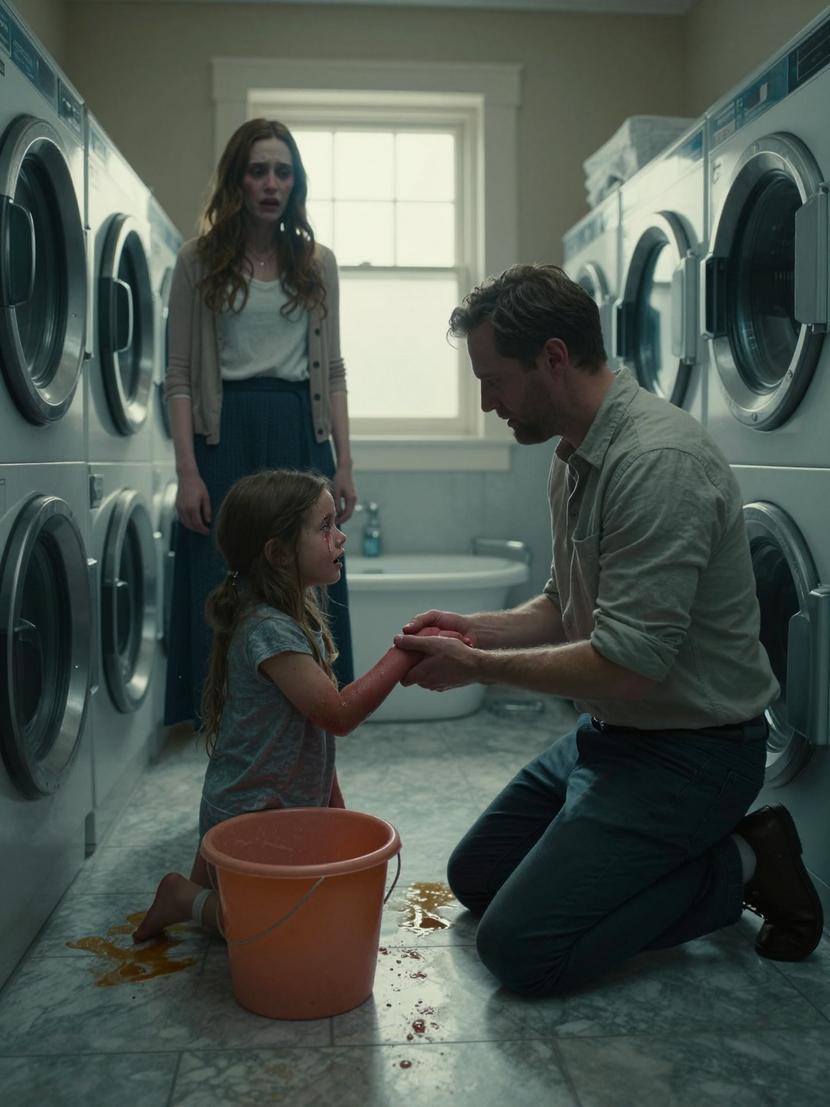
Before dawn broke on a cold autumn morning, six-year-old Isabella Turner knelt on the icy floor of Harrowfield Manor’s laundry room, her small hands raw and blistered from scrubbing the cold marble relentlessly with bleach. Silent tears traced paths down her dirt-smudged cheeks as the harsh words of Veronica Hargrave, her merciless stepmother, cut through the silence like shards of glass. “You’re not one of us,” Veronica sneered, her voice dripping with venom. “You’re a stain that should be washed away.”
Suddenly, the heavy front door creaked open unexpectedly—the familiar rhythm of the estate disrupted by an early return. Edward Harcourt stepped inside, his sharp instincts prickling with unease. His footsteps echoed ominously through the vast foyer until he found Isabella curled against the wall, next to the overturned bucket. Her hand was swollen, red, and trembling. Veronica froze mid-sentence, her face paling upon seeing Edward.
“What’s happening here?” Edward’s voice cut sharply through the tension, ice in his tone.
Veronica stammered, fumbling for a defense. “I was just teaching her… her place,” she said, barely masking her cruelty.
Without hesitation, Edward’s hand rose and landed with a loud smack against Veronica’s cheek. The room seemed to catch its breath. She staggered back, stunned and silenced. Kneeling beside Isabella, Edward cradled her injured hand gently, pulling her close. “Daddy’s here now,” he whispered, his own voice cracking with emotion. “I’m so sorry you had to endure this.”
That night, fueled by heartbreak and determination, Edward filed for emergency custody and pressed criminal charges against Veronica for child abuse. Security cameras exposed the horrifying truth—bleach baths, locked doors, bruises hidden behind forced smiles. For the first time in months, Isabella slept safely in the master suite, bathed in warmth and protection. Edward called Dr. Merrick, the expert pediatrician who specialized in childhood trauma. The examination revealed malnourishment, sprains, and bruises—the damning proof of long-term neglect. Supported by Sofia Delgado’s expert legal guidance, Edward prepared for the grueling courtroom battle that lay ahead.
The trial unfolded in a frigid courtroom thick with tension. Clad in designer clothes and false remorse, Veronica portrayed herself as a stern but caring figure, insisting that her methods were simply ‘tough love.’ Her lawyer tried to paint Edward as a grieving man projecting his pain and instability onto her. But the prosecution’s evidence was overwhelming—medical testimony, the frightened words of the longtime butler, and chilling footage from the manor’s security cameras revealing Veronica’s abuse. By midday, Judge Whitmore delivered her verdict: full custody of Isabella to Edward, and a strict injunction banning Veronica from having any contact with the child.
Outside the courthouse, Edward lifted Isabella into his arms, promising an unshakable fortress of love and safety.
Veronica’s fury did not end in the courtroom. From the shadows of her vacant residence, she launched a vicious smear campaign—buying insiders to leak false stories about Edward’s mental health, orchestrating paparazzi scenes of Isabella “crying on cue,” and enlisting Lucas Drake, a discredited attorney infamous for extortion. Tabloid headlines twisted the truth, questioning Isabella’s credibility, painting Edward as the villain, and casting Veronica as the victim of “billionaire injustice.” Protesters swarmed the gates of Harrowfield Manor, waving inflammatory signs and shouting accusations into the cold wind.
But Edward refused to stoop to her level. With Sofia Delgado’s sharp strategy and Henry Collins’ investigative brilliance, he traced financial transactions and encrypted messages linking Veronica and Lucas to a web of harassment and deceit. Edward leaked irrefutable evidence to trustworthy journalists—proof of hush-money payments and forged documents. As the tide of public opinion turned, Veronica retaliated with dangerous desperation: anonymous photos of Isabella at school, sabotage of power lines, and ominous threats daring Edward to keep Isabella locked away forever. The manor was placed under strict lockdown, yet Isabella’s spirit only grew stronger amidst the storm.
One quiet afternoon, following another torrent of lies splashed across the tabloids, Edward found Isabella in the sunroom clutching her beloved stuffed rabbit. Her voice was tiny, trembling with confusion. “Why do people believe those lies?” she asked.
Edward knelt down, brushing a stray lock from her face. “Lies make a lot of noise, sweetheart,” he said tenderly, “but the truth lives quietly, deep in our hearts.” Together, they repeated a whispered mantra—“I am not alone. I am not weak. I am not what they say I am.” As the words took root, Isabella’s back straightened, and a newfound light sparkled in her eyes — for the first time, unafraid.
In a private hearing, Isabella’s brave recorded testimony was presented. She spoke softly but clearly of Veronica pouring bleach into her bath, locking her in darkness, and threatening to send her away. “He always came back,” Isabella said, her voice steady, referring to Edward. “He loves me.” The courtroom fell silent as the recording played, shattering Veronica’s defense.
The jury returned with a decisive verdict—Veronica was found guilty on all counts: child endangerment, obstruction of justice, and witness intimidation. Within two weeks, she was sentenced to twenty years behind bars.
With justice served, the slow journey toward healing began. Isabella returned to school where Miss Clayton, a kind and attentive teacher, nurtured her artistic talents and love of storytelling. One evening, Isabella revealed a heartfelt dream—to start a club for children who had endured hardship but had found hope beyond it. With Edward and Sofia’s help, the Light Tree Club blossomed at the Maplewood Library, quickly gathering dozens of young hearts eager to share drawings, letters, and stories of courage.
A year after the trial, the Light Tree—a mighty oak—stood proudly in the manor garden, adorned with a plaque dedicating it to resilience, truth, and the sanctuary of home. Isabella, now seven and radiant with quiet strength, addressed a crowd of lawmakers, social workers, and families. Her small voice rang with undeniable power: “We are not just what happened to us. We are what we choose next.” The murmur of leaves echoed her promise.
That autumn, Edward founded the Isabella Turner Harcourt Fund, providing legal aid, counseling, and safe shelter to at-risk children. He joined a statewide task force dedicated to reforming child protective services, ensuring prompt, compassionate action for every report and holding neglectful investigators accountable. Veronica languished behind bars, with Lucas Drake soon following her into custody. But Edward knew the true victory lay in Isabella’s daily life—in her laughter, her bedtime stories, and in the fierce way she claimed her rightful place in the world.
One serene evening beneath the sprawling branches of the Light Tree, Isabella looked up at her father with bright eyes. “Daddy,” she whispered, “do people ever stop hurting kids?”
Edward traced the gentle contour of her hand, pausing thoughtfully. “Some do,” he said softly, “and some don’t. But we will never stop being the ones who protect, who see, who speak.”
Isabella sighed with contentment. “Then I want to be just like you.”
He pulled her close. “You already are.”
In the years that followed, Isabella grew into a young woman whose voice shaped policy, whose art raised awareness, and whose compassion inspired others to break their silence. Edward, once broken by grief, found purpose in devoted fatherhood and passionate advocacy. Together, they ensured that no child in their care would ever again be silenced.
The Light Tree flourished in the manor garden—a living testament to a promise kept: that even amidst cruelty, love endures, truth prevails, and one brave voice can illuminate the path for countless others.


