
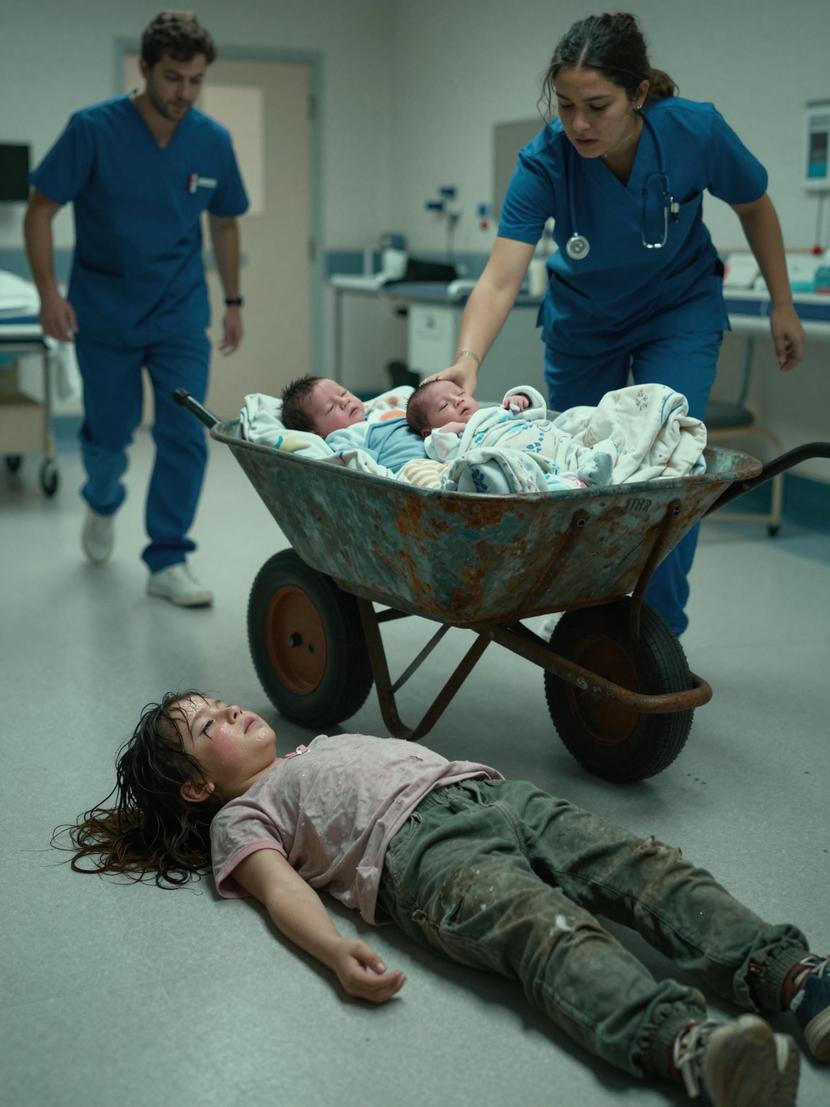
The emergency room at Greenfield Community Hospital had weathered its share of chaos, but nothing prepared the staff for the sight that morning. As the automatic doors slid open, a small figure appeared, struggling against the weight of a battered, rusted wheelbarrow. It was Sofia Calderon, no older than seven, her tangled hair plastered to her forehead by sweat and exhaustion. Inside the wheelbarrow, swaddled in thin blankets, were two tiny lives—newborns Mateo and Elena—pale faces fragile but breathing.
Sofia’s clear, trembling voice broke the stunned silence: “Please… my mom’s been sleeping for three days. Someone has to help us.”
For a heartbeat, everything stopped. Then pandemonium erupted—doctors dashed forward, nurses scooped up the infants with gentle urgency, and a stretcher rolled swiftly into position. Sofia’s knees buckled and she collapsed onto the cold tile floor, unconscious from sheer fatigue.
Hours later, the harsh hospital lights pained Sofia’s eyes as she slowly regained consciousness. A tender voice hovered nearby, soft as a cradle: “Hey there, sweetheart. You’re safe now.”
Looking up, Sofia saw Clara Rivera, a silver-haired nurse with steady, compassionate eyes that seemed to hold a thousand unspoken promises.
“What about Mateo and Elena? Where are my brothers and sister?” Sofia’s voice was fragile but fierce.
“They’re right here with you,” Clara said, gesturing to two tiny bassinets nestled near the bed. “Safe and sound. The doctors are caring for them, and they’re doing very well.”
Relief washed over Sofia in a shaky breath, half sob, half sigh. “I brought them here just in time, didn’t I?”
“Yes,” Clara smiled, her eyes glistening. “You saved their lives.”
Later that day, Dr. Javier Morales, the thoughtful pediatrician, entered the room accompanied by Maria Esteban, a gentle social worker clutching a folder.
“Hi, Sofia. We want to ask you a few questions, to help us understand how to care for your mom and your family,” Dr. Morales said kindly.
Sofia hugged her knees, wariness shadowing her gaze. “Are you going to separate us?”
“Not at all, sweetheart,” Dr. Morales replied quietly, crouching to meet her eyes. “We’re here to help keep you all together. We just want to understand everything that happened.”
Sofia’s voice trembled as she asked, “Is someone helping my mom wake up?”
Maria exchanged a look with Dr. Morales. “Right now, there are people at your house doing everything they can for her.”
Sofia nodded slowly and pulled a crumpled, faded drawing from her pocket. “This is our house,” she whispered—a simple sketch of a blue house, a big tree, and the number 44 beside it. “I kept this number in my pocket so I wouldn’t forget the way home.”
Dr. Morales’s throat tightened. “How far did you walk, Sofia?”
Sofia’s wide eyes grew distant. “I walked until the sun fell asleep and the stars came out.”
That evening, Officer Luis Vega and Detective Carlos Rivas traced the faint footprints Sofia’s bravery had left. Down a dusty, forgotten dirt road outside town, they found the small blue house, silent except for the faint rustling of leaves beneath a broken fence.
Inside, the stillness was heavy. An empty kitchen counter bore the marks of a desperate caretaker—empty formula cans scattered, clean bottles standing in rows to dry, and a refrigerator plastered with a feeding chart. Handwritten in a child’s careful script were measurements, times, and check marks—silent evidence of a child’s unyielding vigilance.
In the bedroom, Isabel Calderon lay unconscious but alive, surrounded by damp towels, tiny spoons, and half-full glasses of water.
“She fought to protect her family until she couldn’t,” murmured Detective Rivas.
Officer Vega’s voice thickened, “No—her daughter did.”
Back at the hospital, Dr. Morales reviewed Isabel’s medical chart: severe dehydration, profound malnutrition, and complications from untreated postpartum depression.
“If Sofia hadn’t kept bringing her water, kept caring for Mateo and Elena, Isabel wouldn’t be here,” he said gravely.
The next morning, Sofia sat beside Clara, her small fingers entwined with the nurse’s.
“They found our house,” Clara said gently. “Your mom’s been moved to another hospital where they’re helping her wake up.”
“Is she still sleeping?” Sofia whispered, eyes downcast.
“Yes, but she called your name when she opened her eyes,” Clara smiled.
Sofia stared at the ceiling. “I used to count every time I tried to wake her. I gave her water with a spoon—just like she showed me to do for Mateo and Elena.”
“You did everything right,” Clara whispered, tears shining. “You saved all of them.”
That afternoon, Dr. Elena Vargas, a child psychologist, arrived with a box of dolls.
“Can you show me what a normal day at home looked like?” she asked softly.
Sofia arranged the dolls with care—a mother doll surrounded by three tiny children.
“On good days, Mom woke early and sang while feeding Mateo and Elena,” Sofia explained, voice tinged with both hope and sorrow. “Sometimes, her heart got heavy, and I’d bring her tea and keep the babies quiet.”
Noticing Sofia place her own doll as a bridge between the mother and the babies, Dr. Vargas’s eyes softened. “That’s a lot for a child your age.”
Sofia shrugged. “Mom always said I was born with an old soul.”
Weeks passed, and Isabel slowly stirred from her long darkness, beginning the difficult road to recovery. But the children still needed a safe, loving home.
That night, Clara, who had spent decades caring for children like Sofia, struggled to sleep. By morning, she made a quiet decision.
Knocking on Dr. Morales’s office door, she said, “I’m a licensed foster caregiver—I want to bring Sofia and the twins to live with me.”
“A serious choice,” he acknowledged.
“I know,” Clara said, her voice fierce with resolve. “They need to stay together. And maybe… I need them too.”
Within the week, Sofia settled into Clara’s warm home on Willowbrook Lane. The guest room was bright and welcoming, with cheerful bedding, a small desk, and shelves just waiting for toys. Nearby, the twins slept peacefully in a sun-drenched nursery.
In those first fragile nights, Sofia tiptoed into the nursery again and again, checking on Mateo and Elena. Clara would find her there, softly singing lullabies that wrapped the room in comfort.
One evening, as Sofia tucked her siblings in, Clara told her quietly, “Your mother is growing stronger each day.”
“When will I see her?” Sofia asked, hope flickering in her eyes.
“Soon,” Clara smiled. “And she’ll be so proud of you.”
Sofia hesitated, voice barely above a whisper. “I just hope she remembers me.”
Clara’s hand brushed Sofia’s cheek, steady and sure. “She could never forget you. You’re the heartbeat that united your family.”
On the day Isabel was moved to Riverbend Recovery Center, Sofia’s hands trembled as she held the stroller with Mateo and Elena nestled inside.
Through the glass, she spotted her mother—a fragile figure in a wheelchair beneath a cherry tree in full bloom. Isabel’s face was thinner and pale, but her eyes shone with recognition.
“Mom!” Sofia cried, rushing forward. Isabel’s arms wrapped around her just as she reached her.
Together they held a silence thick with tears and unspoken words.
“Let me look at you,” Isabel murmured, cupping Sofia’s face gently. “My brave girl—you kept your promise.”
“I did,” Sofia whispered back. “I took care of Mateo and Elena.”
Isabel’s hand trembled as she brushed a loose strand of hair away. “And you saved me, too.”
Later, beneath the cherry tree, Sofia sat with Dr. Morales and pulled a folded letter from her pocket.
“My dearest Sofia,” she read aloud. “If you’re reading this, something has happened to me. None of it is your fault. You are my light, my strength, the best thing that ever happened to me. I’m fighting to stay with you. If the darkness wins for a while, remember—it’s not because I stopped trying.”
Dr. Morales swallowed hard. “Your mother never stopped fighting.”
By summer, Isabel left rehab stronger, moving into a subsidized apartment near the hospital and Clara’s home, supported by the Family Support Initiative.
On moving day, Sofia clutched her butterfly journal, bursting with drawings—the blue house, the hospital, Clara’s cozy home, and their bright new apartment.
Clara hugged her tightly. “You’ll come visit, won’t you?”
“Of course,” Sofia smiled, handing over a folded drawing of two houses connected by hearts. “See? We’re still connected—not dotted lines anymore, but solid.”
Officer Luis Vega and Detective Carlos Rivas arrived soon after, beaming as they presented Sofia with a framed copy of her original crayon drawing alongside a photo of her smiling family.
“From where it all began,” Officer Vega said, “to where you are now.”
One Year Later
At Greenfield Community Hospital’s auditorium, a banner unfurled: “The Sofia Calderon Family Support Program — One Year Anniversary.”
Dr. Morales spoke with pride. “What started with one little girl’s courage has now helped fifty families. Today, we celebrate survival, hope, and transformation.”
In the front row, Isabel sat radiant and healthy, cradling Mateo and Elena. Clara beamed beside her, and between them sat Sofia, now nine, clutching a folder.
Sofia stepped confidently to the microphone. “My mom says family means people who take care of each other when things get hard. But I think community means noticing when a family needs help—and then actually helping.”
She held up her drawings—the blue house, the hospital, Clara’s home, and their sunlit apartment.
“This is for everyone who helped us. So no other child ever has to push a wheelbarrow to find help again.”
Thunderous applause filled the room.
That evening, Sofia sat sketching in the park. Mateo and Elena played nearby while Clara gently pushed them on the swings.
Isabel leaned in, smiling softly. “What are you drawing now?”
“Our family,” Sofia said quietly, “the one we built together.”
Around the twins, a circle of warm hands joined, and in the background, a faint image of a wheelbarrow rested—not as a shadow of struggle, but as a lasting emblem of courage, love, and the strength that carried them all through darkness into the light.
Note: This story is fictional, inspired by real events. Names, characters, and details have been changed. Any resemblance is coincidental. Illustrations are for reference only.


