
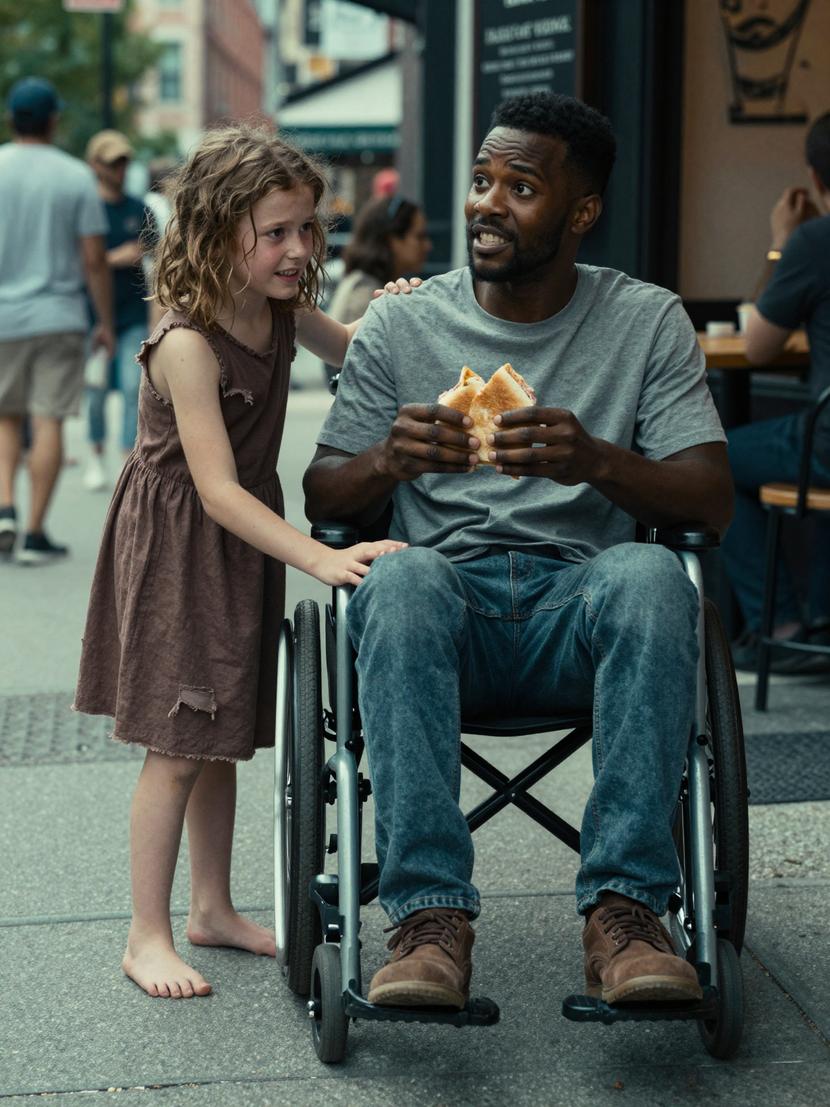
At first, no one really saw her. The barefoot girl stood rooted in the heart of a bustling Chicago sidewalk, yet the crowd surged around her like she was merely a ghostly wisp of shadow. Her brown dress was torn, slipping off one shoulder with a careless grace. Her bare feet caked in grime, darkened by countless steps on dusty streets. Her tangled hair spilled into her eyes, hiding the truth of her youth—no older than thirteen.
She stopped deliberately before a man in a wheelchair.
David Harrington was twenty-nine, though the weight of years and worry was etched deep in the wrinkles and furrows of his face, making him seem older than his years. His wheelchair rested just outside a quiet corner café on East Hill Avenue, a small cardboard sign propped against its wheel:
“Disabled. Anything helps.”
David had long stopped expecting kindness from strangers. Coins would clink occasionally into his hat; food, even less often. Words? Barely ever.
So, when the barefoot girl spoke, her voice barely above a whisper, David blinked, caught off guard.
“If you give me food,” she said softly, “I can help your legs work again.”
David’s eyes narrowed in disbelief.
Disabled men were often met with cruel words—sarcastic remarks or hollow pity—but never a promise like this.
He looked down, really looked at the girl. Her gaze was steady, calm, not wild or desperate. In her quiet certainty lay something powerful and unshakable.
“Really?” he croaked, voice rough and uncertain. “You mean you can actually do that?”
Her lips twitched into a faint, knowing smile—not playful or wide, but a quiet assurance that startled him.
David chuckled, bitter and short. “Kid, even doctors couldn’t fix this.”
The barefoot girl tilted her head thoughtfully. “Because they didn’t listen.”
An eerie chill rippled through the afternoon air. David tucked his hands into his lap as a shiver traced icy fingers up his arms despite the sun’s warmth.
He fumbled inside his bag and pulled out half a turkey sandwich—the only meal he’d had all day. Hesitant but compelled, he extended it.
The barefoot girl accepted it with reverence, as if holding something sacred.
‘Sit up straight,’ she instructed.
David frowned, confusion knitting his brow. “What?”
“Please,” she urged softly.
Swallowing his skepticism, he straightened his back.
She placed one small, grimy hand gently on his knee.
Suddenly—a fierce, stabbing pain radiated through his legs.
David gasped, clutching his wheelchair’s wheels. “Hey—what are you—?”
She leaned closer, lips moving to whisper words lost in the noisy city hum.
Then, as abruptly as it came, the pain vanished.
David was still.
For the first time in six endless years, he felt warmth. Not the cold numbness that had become his constant companion, nor the phantom sensations that tormented him. Real, vibrant warmth.
His breath hitched. “I—I felt something.”
The barefoot girl stepped back, already melting away into the press of the crowd.
“I’ll come back tonight,” she called over her shoulder, “if you still want to walk.”
David sat trembling, heart pounding with a strange mix of fear and hope.
Was it hunger clouding his mind? Desperate yearning? Or did something truly impossible just touch his broken life?
All night, David lay in his modest studio apartment, eyes glued to the ceiling while rain gently tapped the windowpane. Doctors had told him his spinal injury, the brutal aftermath of a freeway accident, was permanent. He’d accepted it. Or so he thought—until today.
At exactly 9:47 p.m., a knock shattered the silence.
His pulse leaped. Visitors were rare.
He rolled to the door and opened it.
There she stood—dry despite the rain, the barefoot girl in the same tattered dress, bearing those unnervingly calm eyes.
“You came,” he whispered.
“You fed me,” she replied, “and that changes everything.”
She stepped inside, surveying the spartan room: no TV, no couch, only a mattress on the floor.
“You lost more than your legs,” she said quietly.
David swallowed hard. “Who are you?”
No answer.
Instead, she knelt before him and laid both hands on his knees.
“Stand,” she commanded gently.
A bitter laugh broke free. “I can’t.”
“You can. You’re just afraid.”
David shut his eyes, overwhelmed by terror—the fear of falling, of failing, of daring to dream again.
Then, the pain returned.
But this time, it was not a sharp blade. It was alive, pulsing, electric.
His toes curled involuntarily.
His calves tightened like ropes being pulled taut.
His eyes shot open. “Oh my God.”
“Now,” the barefoot girl said with unwavering authority, “stand.”
A guttural cry escaped David’s throat. He pushed desperately against the wheelchair’s arms.
Legs trembling uncontrollably, then holding firm, steady.
He was on his feet.
For three precious seconds.
Then, knees buckling, he collapsed, overwhelming sobs wracking his body.
Laughter and tears tangled, hands trembling as he touched the flesh that might vanish any moment.
When he looked up, the barefoot girl was retreating toward the door.
“Wait!” he shouted. “Don’t go. Please. Who are you?”
She paused, the faintest smile tracing her lips.
“My name doesn’t matter,” she said softly. “What you do next does.”
And with that, she vanished.
The next morning, David walked.
Not far, not elegantly, but enough.
Doctors called it a miracle. Reporters labeled it unexplainable. Social media buzzed with wonder.
But David knew the truth.
He searched the city streets for her.
Days stretched into weeks.
No one saw the barefoot girl again.
Until, one night, in a dusty corner of the public library, David discovered an old newspaper clipping.
“LOCAL GIRL, 13, DIES SAVING CHILD IN HIT-AND-RUN.”
His blood ran cold as his eyes locked on her photo.
The same eyes.
The same faint smile.
The same torn dress.
She had died two years before his accident.
David sank into a chair, breath stolen from his chest.
Then his gaze caught the article’s final line:
“Witnesses say the girl whispered something before she passed.”
David closed his eyes.
Suddenly, her whisper echoed in his mind—not just words, but a promise:
“You’re not done yet.”
Folding the paper carefully, David rose to his feet—strong, steady.
Outside, the city pulsed with its usual pace.
And somewhere, just beyond sight, the barefoot girl was smiling.
Walking beside him.


