
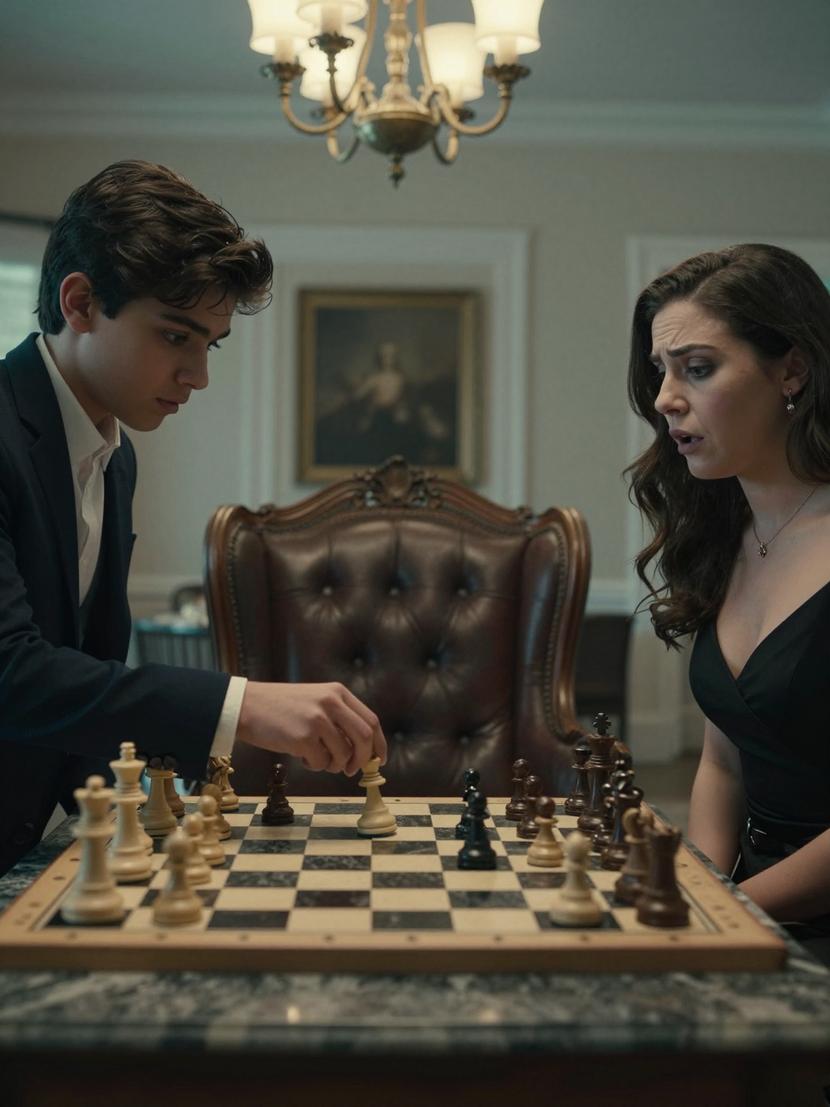
The grand Sunset Ridge estate buzzed quietly with the hustle of a charity dinner, yet beneath the glittering chandeliers lurked a sharp undercurrent of arrogance. Isabella Ramirez, the wealthy socialite whose voice carried the weight of privilege and disdain, scanned the room until it landed on Carlos Mendoza, the 17-year-old son of her trusted maid, Lucia. ‘Come here, boy. Why don’t you show us how chess is played in the slums?’ Isabella’s tone was laced with scorn, echoing through the marble halls as her eyes sparkled with malicious delight.
Carlos, quietly assisting his mother as they served the lavish crowd of businessmen, politicians, and their entitled spouses, paused. The elegant guests sipped champagne, their laughter delicate yet sharp like the edges of the Italian marble chessboard resting on the coffee table—an ironic centerpiece in this evening organized to aid underprivileged youth. Yet nobody expected one of those very youths to be serving canapés tonight in their own home.
‘I suppose the boy can at least move the pieces,’ Isabella sneered, gesturing grandly toward the board. ‘Let’s see how he fares against someone who’s actually studied the game.’ Nearby, Mr. Franklin, a seasoned hotel magnate of the Trinity hotel group empire, smirked and whispered to his wife, ‘I doubt he even knows the knight moves in an L-shape.’
The room rippled with stifled laughter, the privileged amusement of those perched atop social hierarchy. Lucia’s hands tightened around her silver tray, her eyes lowered with the burden of two decades spent cleaning these very rooms and raising a son on a maid’s modest salary, now forced to witness his public humiliation.
Lucia had known Isabella since childhood, seen the spoiled girl blossom into an unyielding socialite fueled by entitlement. ‘Lucia, you can take a break,’ Isabella commanded with a poisoned sweetness. ‘I want you to watch your son get a little education tonight. Maybe he’ll learn something.’
Carlos stood still for a moment, dark, calculating eyes sweeping the room. Silence had long been his ally—a shield revealing more truth than many words could. In this sea of privilege, he saw oblivious faces, blind to the quiet storm before them.
Even some guests hesitated, sensing an unexpected tension beneath his composed posture. His fingers twitched imperceptibly as if mapping invisible strategies. ‘Of course, Mrs. Ramirez,’ Carlos replied, voice calm yet confident enough to raise eyebrows. ‘It would be my honor.’
Isabella sank into a leather armchair, regal and assured. ‘Fine. I bet you’ve never played with pieces like these,’ she remarked, nodding at the luxurious Italian marble set. ‘Worth more than your allowance, probably.’
State Representative Emily Carter, seated by the window, frowned. ‘Is Isabella sure this isn’t cruel? He could be humiliated.’
‘Oh, nonsense,’ Isabella replied as she adjusted her diamond earrings. ‘It’s just a game. He’ll brag to his friends about playing chess in a millionaire’s mansion. An unforgettable moment for him, really.’
But Isabella Ramirez had no inkling that the boy she mocked was no amateur. For eight relentless years, Carlos had devoured every chess book he could find in the public library, his sanctuary from the world. While other kids lost time to video games, he painstakingly studied grandmasters’ every move on a battered computer he had repaired himself. At night, when Lucia was working double shifts, Carlos poured over Kasparov, Fischer, and Carlsen, memorizing over 200 openings and the 50 most renowned defenses.
Tonight, all those quiet sacrifices would come alive on that marble battlefield.
Isabella theatrically arranged the pieces, while Carlos’s eyes scanned the auditorium, calculating not just moves but challenging the very assumptions etched into their faces. This was more than a match—it was a reckoning.
From the start, Isabella’s confidence was palpable. ‘I always choose white,’ she declared, ignoring how chess pros draw lots for colors. Carlos placed his black pieces with meticulous care, provoking a frown from Mr. Franklin. Each piece sat squarely in its marble cell, as though the board were just one in a thousand he’d mastered.
‘Let’s raise the stakes,’ Isabella said with a mocking grin. ‘If the boy scares me even once, I’ll donate a thousand dollars—maybe to a public school.’
The guests chuckled, yet Carlos’s smile was measured, almost absent. Lucia sensed the chilling familiarity of it—the same fierce determination Carlos wore as a child when doubted, the look he had when, at twelve, he declared he no longer needed her help with his math homework.
Isabella’s opening move was a conservative E4. ‘The Indian King, dear. A classic taught at Harvard,’ she explained condescendingly, as if instructing a toddler.
Carlos responded with C5—the Sicilian Defense. A hush fell. This wasn’t a novice maneuver; it was the language of true strategy.
‘Interesting,’ Emily Carter whispered, leaning in. Isabella hesitated, the weight of unknown territory creeping into her expression. She played NF3, a safe, rehearsed response likely picked from a social club tutorial.
Carlos’s mind drifted briefly to the past: eight years earlier, just nine years old, spotting a torn chess book discarded in the library trash. He’d stashed it in his backpack and convinced Lucia to help him grasp the basics.
‘Mij, why chess?’ Lucia had asked, worn thin from her shifts.
‘To be like the rich kids, Mom. They say they’re smarter than us.’
Back then, with no money for lessons or internet, the library was his refuge. Every afternoon, Carlos trekked three kilometers to lose himself in dusty volumes and historic battles.
Isabella’s timid D3 was emblematic of her entire approach: cautious, controlled, anchored in social comfort rather than true understanding. Carlos struck back with NC6, purposefully developing his knight.
His moves came swift and sure, like a symphony directed by years of unseen practice. ‘The boy’s too quick,’ Isabella whispered to her circle. ‘Real chess requires thought.’
Then Carlos played his first psychological hand—pausing fifteen seconds, feigning deep thought, before striking G6, preparing a bishop’s fianchetto. A seemingly beginner’s choice concealing a masterstroke unveiled only after ten more decisive plays.
‘See? No patience,’ Isabella gloated. Yet Mr. Franklin, recalling university chess days, leaned in. ‘Isabella, that’s a Dragon Variation.’
‘A what?’ Isabella snapped, irritation flashing. ‘He’s probably seen it in some movie.’
But as Carlos’s pieces aligned with unnerving precision, Isabella’s assured veneer began to crack. He wasn’t merely reacting; he commanded the tempo, painting the board with a harmony of attack and defense.
Lucia watched in stunned silence, heart pounding. For the first time in twenty years, she saw uncertainty flicker in Isabella’s eyes—a crack in her imperious armor.
Every dismissive chuckle from the crowd only tightened Carlos’s resolve, fuel for the silent storm building beneath his calm exterior.
What the guests failed to grasp was that each sneer spelled Isabella’s own downfall across the sixty-four squares.
When Carlos made his tenth move, sacrificing a seemingly innocent pawn, Mr. Franklin nearly choked on his whiskey. ‘Isabella,’ he hissed, ‘this boy is no novice.’
But Isabella, blinded by arrogance, waved him off. ‘Relax, dear. He memorized a few online tricks. I’ll wrap this up shortly.’
Then Carlos rose and whispered to Lucia in the shadowed corner: ‘Mom, remember what you said? That one day I’d show them who we really are?’
Lucia’s eyes glistened. That day he turned fifteen, with nothing but dreams and no birthday cake, he’d vowed to change everything.
‘That boy has more class than all of us combined,’ Emily Carter murmured to her husband nearby.
Impatient, Isabella tapped her manicured fingers. ‘Can we finish? I have other appointments.’
Returning to the board, Carlos was no longer a mere distraction. He carried the weight of sacrifice and silent perseverance.
His eleventh move, delivered with chilling precision, sealed a double threat: protect the king and lose the queen; save the queen and face checkmate in three moves.
‘Impossible,’ Isabella stammered, eyes wide as she scrutinized the chessboard for the first time truly.
‘You’re being outplayed by a boy who’s never set foot in a formal chess club,’ Mr. Franklin observed with astonishment.
The room’s attention sharpened. Emily Carter leaned forward, captivated. Even frivolous guests dropped their dainty champagne flutes.
Lucia recognized that familiar look—the same he’d worn discovering chess books, grinding through nights on a broken computer, solving puzzles before dawn.
Desperation clouded Isabella’s face as she scrambled to escape an inevitable trap.
‘Check,’ Carlos declared softly, positioning his queen to unleash three distinct winning attacks.
Silence engulfed the room.
Isabella stared, trembling—not from fear but from rage and disbelief. ‘You must’ve seen those moves somewhere,’ she accused.
Carlos smiled, the first genuine smile of the evening, and said quietly, ‘You’re right, ma’am. I learned from Garry Kasparov.’
‘Kasparov?’ Mr. Franklin echoed, incredulous.
‘Not in person,’ Carlos explained, positioning the final piece. ‘But I’ve studied every one of his 1,183 documented games. That sequence was from his 1984 championship match against Karpov.’
Around her, Isabella looked for allies but found only silent judgment. The room had shifted.
Lucia stepped forward, voice steady but ringing with fierce pride. ‘My son woke up at five every morning to study before school. He walked six miles to the library. When I worked double shifts, he stayed awake solving problems by candlelight—sometimes with no electricity at all.’
Total hush.
Carlos glanced at his mother with resolve. Eyes averted with shame elsewhere.
‘Checkmate,’ he whispered, placing his queen firmly.
Isabella stared at the board, as if willing the pieces to move again. Then her gaze locked with Carlos’s calm, unwavering eyes. The room’s energy had transformed—he was no longer entertainment but a revelation that dismantled every assumption about ability, worth, and class.
Embarrassment and disappointment replaced admiration among the guests—an emotion Isabella Ramirez had never faced before.
But this defeat was just a beginning: the first move in a far larger game where the rules of society, privilege, and respect would be rewritten. And Carlos Mendoza—the boy she underestimated—was poised to teach a lesson on true nobility, one that no bank account or surname could buy.


