
Part-2
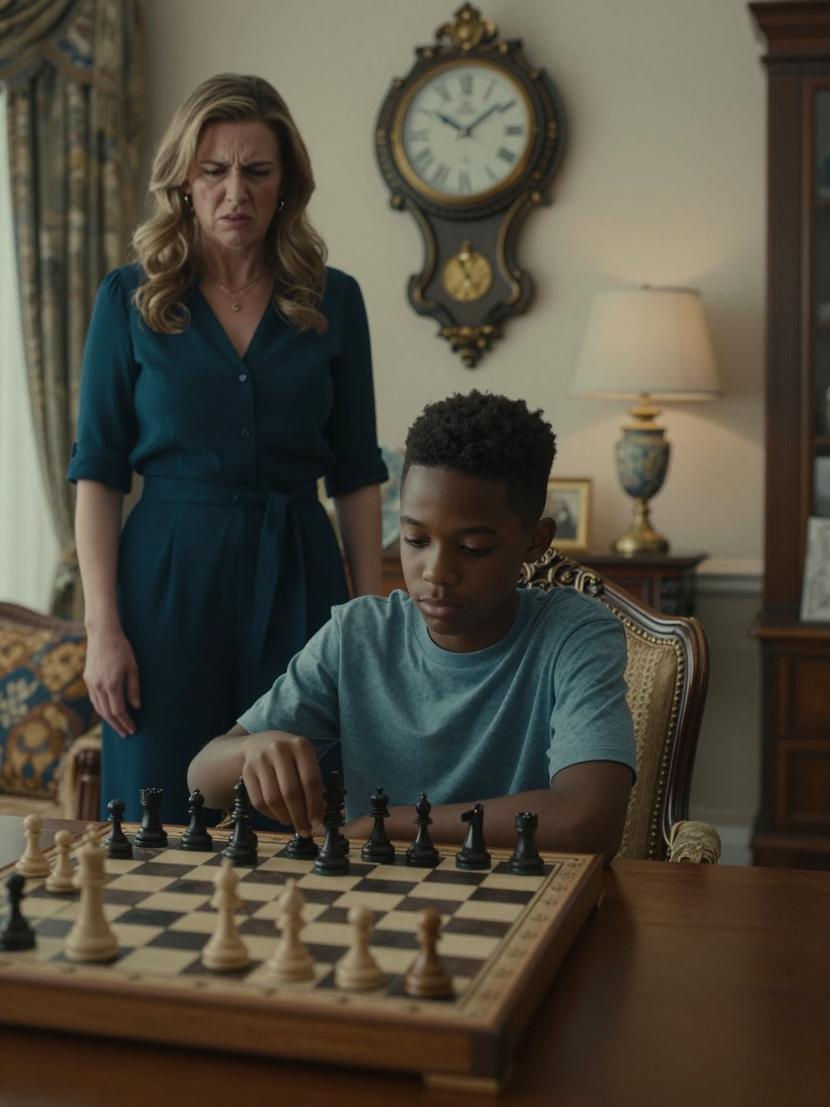
Isabella’s gaze was fixed on the chessboard, her breath caught in her throat as trembling fingers hovered over the fallen king piece, as if willing it back to life. The silence in the lavish Silverpine drawing room was so profound that the steady tick of the $15,000 designer wall clock resounded like a judge’s gavel. “That… that was just luck,” she stammered, voice cracking, her previously unshakable confidence dissolving into thin air. “He must have memorized that opening somewhere,” muttered Bennett, rising from his chair with a mixture of astonishment and admiration. “Isabella, that boy just executed a Sicilian variation even I haven’t encountered in my forty years of playing.”
Senator Ramirez, discreetly raising her phone, began recording before anyone noticed—sensing a story that would ripple across the internet: a haughty millionaire humiliated by the prodigious son of her own maid.
“I won’t accept this,” Isabella declared, standing abruptly and swiping pieces off the board in frustration. “Someone must have trained him specifically to embarrass me.”
Andres remained seated, radiating calm poise. “Would you like a rematch? I can challenge anyone here—or even all of you at once, if that suits.”
A murmur of nervous laughter and uneasy whispers rippled through the crowd, but no one doubted the young man’s quiet confidence.
“You’re full of arrogance,” Isabella sneered, her cheeks flushed with anger. “A boy from the slums doesn’t speak to his superiors that way.”
At last, Luisa stepped forward, locking eyes with Isabella for the first time in over two decades. “Mrs. Wittmann,” she said steadily, voice ringing with dignity, “my son isn’t from the slums; we hail from a working-class community in Cielo Vista. He’s not arrogant—he’s honest about his talents, something you clearly fail to be.”
The oppressive tension thickened palpably. Guests exchanged glances charged with discomfort, realizing this evening was unfolding far beyond a mere game of chess.
Isabella’s eyes blazed with fury as she spun toward Luisa. “How dare you talk to me like that? Have you forgotten your place in this household?”
“Not at all,” Luisa replied quietly. “I simply remembered my worth.”
Bennett, visibly uneasy, interjected before the storm could escalate further. “Isabella, maybe it’s time to acknowledge genuine talent when you see it.”
But Isabella’s bitter laugh cut through the moment. “You don’t see? This isn’t honest—it’s a setup. Someone coached him to make me look ridiculous in my own home.”
Andres rose then, his voice calm but commanding enough to hush the room. “Mrs. Wittmann, if you want the truth, I wasn’t trained to embarrass you. For eight years, I have studied chess, chasing a dream to play with those who respect the game. People who understand that skill transcends race, class, or last names.”
He paused, letting his words sink into the room. “When you invited me to play ‘like they do in the slums,’ I believed I finally had a chance to earn respect. But now I see you never wanted a fair match—you wanted a spectacle to humiliate.”
Senator Ramirez lowered her phone, captivated. “How old are you?” she asked softly.
“Seventeen,” Andres answered.
“And how long have you been playing seriously?”
“Eight years.”
The senator faced Isabella, disbelief and disapproval etched deeply on her face. “Isabella, you’ve just been defeated by a self-taught teenager—a young man you employ and cynically invited as a joke.”
Isabella shrank under the weight of the room’s judgmental stares—no longer full of admiration or envy, but clear and pointed disapproval.
“I— I had no idea he took it seriously,” she muttered, her voice barely audible.
“The real question isn’t whether he plays seriously,” Bennett said, irritation piercing his tone. “It’s why you believed he would be an easy target. Because he’s your maid’s son. Because he’s black. Because his pockets are empty.”
A heavy silence descended. Andres methodically reset the chess pieces, each move precise and deliberate. “Thank you for the game, Ms. Wittmann. It’s been an education.” He turned to Luisa. “Mom, shall we go? I have school tomorrow.”
Luisa nodded, slipping off her apron—the uniform of service—finally shedding the weight of invisibility she endured among these guests. Yet before leaving, she faced Isabella one last time, her voice steady and resolute. “Mrs. Wittmann, thank you. You have shown me beyond doubt that my son is meant for far greater places.”
As mother and son made their exit, Senator Ramirez called out, “Andres, are you interested in scholarships? I know universities that would welcome a talent like yours.”
Stopping in his tracks, Andres’ face blossomed into a genuine smile for the first time that evening. “Very interested, ma’am.”
The senator handed him her card. “Call me Monday.”
Isabella stood frozen, her perfect façade shattered. Within an hour, she had morphed from the admired hostess of Silverpine’s elite into a figure scorned for underestimating a true prodigy.
Once the door shut behind Luisa and Andres, guests exchanged uneasy glances. Bennett was the first to rise. “I think I should take my leave.”
One by one, the crowd drifted away, cold farewells whispering regret and judgment. Isabella was left alone, staring at the chessboard—the battleground where her arrogance was laid bare and systematically dismantled by the very person she deemed inferior.
What Isabella didn’t realize was that this evening was just the opening move in a grander tournament—a game where Andres Morales would rewrite his life story and dismantle the fortress of privilege she had always called home.
Later that night, walking beneath Silverpine’s glittering stars, Andres held the senator’s card like a lifeline. In his mind, he was already calculating new moves—not just on the board, but in the wider game of proving true nobility is earned, not bought.
Six months later, Andres strode the halls of Westbridge University, the pride of a full engineering scholarship shining in his eyes. Senator Ramirez had kept her word, connecting him to mentors who valued raw talent over pedigree.
The recording from that fateful evening went viral—three million views within two weeks—shared first by Senator Ramirez herself, turning Andres into an emblem of triumph over adversity and Isabella into a cautionary tale.
“Young prodigy shatters prejudiced millionaire at chess” blared headlines, the comment sections swelling with praise: “A stunning comeback—he deserves every chance in the world.”
Isabella Wittmann found herself a pariah in Silverpine society. The Cedar Oak Golf Club revoked her membership under mounting pressure. Three prestigious charities removed her name from donor lists. Even Bennett, her longtime friend, distanced himself. At a dinner in Seabreeze, his wife confided, “Isabella’s always been haughty, but I never imagined she’d stoop to humiliating a child live before an audience.”
The cruelest revelation for Isabella was this: Andres had never sought vengeance or spotlight. He had simply played the game he loved—mastered through years of silent dedication. Her downfall was self-inflicted, brewed in her own poisoned prejudices.
Meanwhile, Luisa’s perseverance earned her promotion to cleaning supervisor at the Grand Crest Hotel in Cielo Vista, tripling her income with full benefits—a rightful recognition for her unwavering professionalism by those who looked beyond bias.
Andres launched a groundbreaking free online chess platform, linking underserved youth with college mentors. Within half a year, 1,200 children across the country were honing skills far beyond chess moves. “Chess taught me that every individual holds unique strategic value,” Andres said during a CNN interview. “Isabella Wittmann taught me that sometimes people must lose everything to discover what truly matters.”
When asked if he bore resentment toward the woman who tried to diminish him, Andres only smiled, quiet and composed as that unforgettable night. “Grudges? They’re just obstacles that block your path. I prefer to focus on building something greater.”
Isabella sat alone in her sprawling mansion, abandoned by once-close allies. For the first time, she fully understood her loss—not a game lost at chess, but the priceless chance to grow into a better person.
Bennett called afterward. “Isabella, this was a situation of your own making.”
Andres responded with grace. “A lesson in class you could have shown from the start.”
The lesson echoed far beyond Silverpine’s elite circles. Andres Morales proved that true nobility springs not from names or wealth, but from character forged in adversity and expressed through actions. He transformed humiliation into purpose, prejudice into progress.
Today, Andres sees only boundless possibilities shaped by his unwavering resolve. Isabella tried to belittle him to feel superior, but in reality, she revealed that true greatness lies in uplifting others.
Luisa proudly displays Andres’s first academic honors at Westbridge University alongside a certificate from his chess program—symbols of achievement money can’t buy and prejudice cannot steal.
Andres’s story teaches us all: the best revenge isn’t destruction but creation. Isabella sought to make him a spectacle; instead, he became an inspiration.
That difference—between tearing down and lifting up—defines who truly wins at chess, and in life.
If this story of resilience and justice moved you, subscribe for more tales proving that real power comes from turning obstacles into extraordinary opportunities.


