
There are rare moments in life when misfortune seemingly tires of its relentless chase and grants a fleeting mercy. For Dylan Navarro, that moment came on an otherwise forgettable afternoon at a rundown gas station perched beside a desolate highway. The scratchy voice of the radio announcer crackled through the stale air, reciting the winning lottery numbers.
Out of a habitual flicker of hope, Dylan reached into the pocket of his worn, threadbare flannel shirt and pulled out the crumpled ticket he’d bought a week ago. His fingers, calloused from years of cement and laboring beneath the unforgiving sun, trembled as he checked the numbers once—then twice, then a third time. The paper nearly slipped from his grasp.
It wasn’t a jackpot to make national news or to buy mansions. But it was enough. Enough to wipe the slate clean of debts long overdue. Enough to bring peace where there had been only torment. Most poignantly, enough to repay the invisible toll poverty had extracted from his beloved parents.
Javier Salazar and Lucía Salazar, his parents, had spent their youth enduring the blistering heat as they toiled in endless cornfields. This modest windfall was poised to grant them reprieve from years shadowed by relentless worry.
Dylan didn’t shed a tear. Instead, he stood motionless beside his battered pickup truck, eyes fixed on the distant agave hills where the horizon blurred—a fertile plain on the cusp of rebirth.
His dreams weren’t gilded by luxury. His mind wandered, drawing vivid memories: his mother endlessly patching worn clothes syllabically stitched with hope, his father hobbling home each night with a weary back and sandals worn threadbare.
That very night, he packed everything he owned. It was time to go home.
For eight grueling years, Dylan had breathed dust by day, back breaking work at the border construction sites, sending every extra peso to cling to the fragile threads of his family’s survival. Now with his modest fortune clutched in his hand, he was returning home, heart swelling with pride and relief.
Yet, as he approached the village of Valle Verde, an oppressive chill squeezed his chest. Eyes darted away, hushed voices trailed behind him like shadows, faces marred by pity.
Outside a butcher shop, Mr. Delgado, an old and trusted family friend, beckoned him over. “Your father will be surprised to see you…”
Dylan forced a hopeful smile. “I’m heading straight home.”
Mr. Delgado’s eyes dropped, clouded with dread. “They don’t live there anymore.”
Dylan’s world plunged.
He sped to the home where his childhood memories were etched in every brick. The house still stood but now was painted a garish bright red. Blazing music poured from within, tainting the silence of familiarity. On the porch sat Marina Ortega, his aunt, nursing a beer with a sardonic smirk.
“This house? It’s mine now,” she said, voice thick with triumph. “Your father sold it—to me. Every paper signed and sealed.”
Dylan’s lips pressed into a hard line. Without another word, he turned the key to his truck—and left.
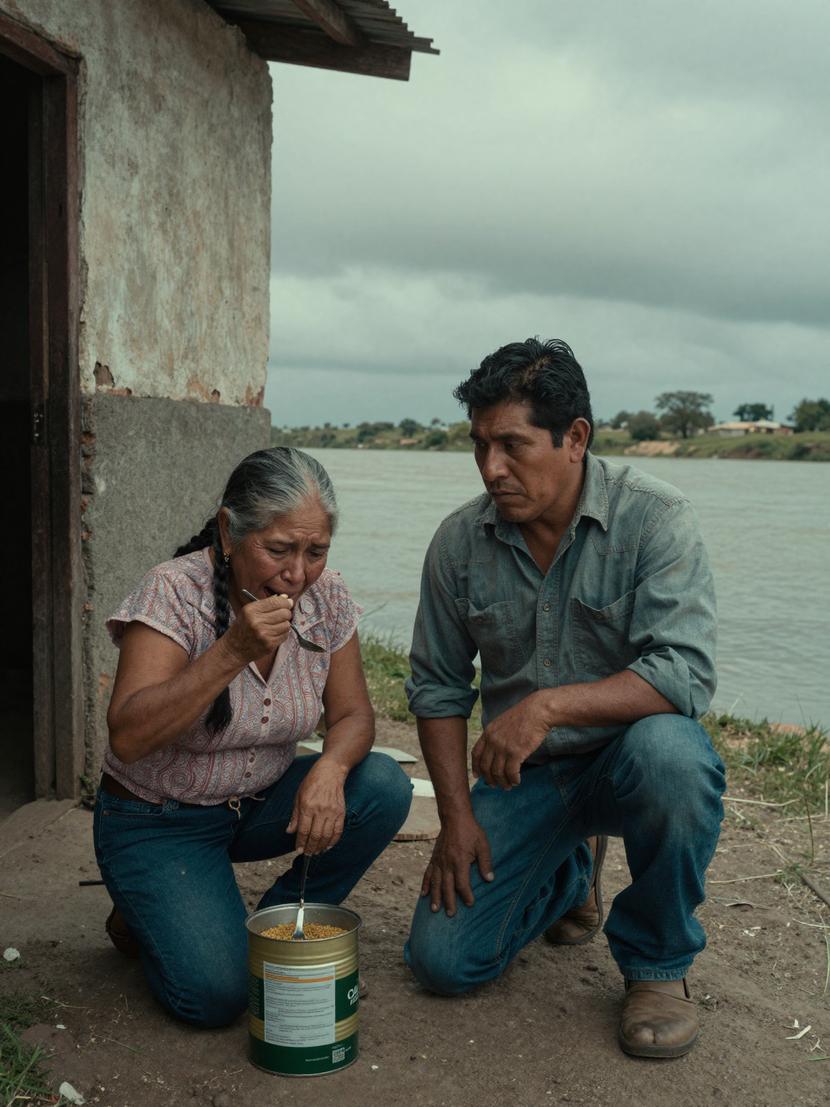
Drawn by a hollow urge, he found himself at the derelict stable by the river. There, seated on inverted empty paint buckets, were his parents.
Before them sat a tin bucket filled not with food, but animal feed.
His mother was eating from it.
The world stood utterly still.
The clang of her spoon against cold metal echoed like a death knell in the broken space. Javier lifted his weary eyes, swimming with shame. Lucía’s shoulders shook with quiet sobs.
“We didn’t want you to worry,” she choked out.
But Dylan saw clearly—this was no act of pride.
This was hunger. This was devastation. This was betrayal.
Kneeling beside them, he clasped their fragile, cold hands. ‘What happened?’ he demanded softly, though his heart shattered with every word.
Carrying the weight of their despair, Lucía revealed the cruel truth. Marina had ensnared them in a web of deception—fake documents, fabricated debts, and threats that struck to the bone: prison for nonpayment. Javier, trapped by fear and hopelessness, signed away everything.
Two weeks later, they were cast out into a raging storm, abandoned by a town that offered no refuge, silenced under Marina’s iron control.
That night, Dylan became their shield. With steady hands, he gathered what little he could—warm clothes, meager food, a promise—and moved them to safety. I will fix this, he vowed.
The following day, he confronted a lawyer. The case seemed a fortress too daunting to breach—until Marina’s own son, Adrián, walked through the door.
“I can’t live with this any longer,” Adrián confessed, pressing a heavy envelope into Dylan’s hands. Inside, irrefutable evidence: hidden recordings, forged signatures, and clear proof of Marina’s malicious schemes.
Everything shifted.
At the town’s vibrant festival, Marina reveled—laughing, drinking, basking in her supposed victory.
Then Dylan arrived. Quiet, unwavering, flanked by the lawyer and the unspoken weight of justice.
The room fell silent as the lawyer played the recordings. Marina’s voice crackled over the speakers, cold and threatening, revealing her own brothers as helpless pawns.
The crowd recoiled. Murmurs grew into outrage. Marina’s facade crumbled; her panic betrayed a soul undone.
Dylan gently set his lottery ticket—the symbol of hope and defiance—upon the table.
“You thought we were powerless,” he said, voice steady as the desert night. “You were wrong.”
Within forty-eight hours, Marina was arrested, charged with fraud and extortion. Her empire of cruelty collapsed like a house of sand.
Dylan brought Javier and Lucía home. The house regained its dignity under fresh paint and loving hands. Valle Verde breathed new life as he built a cooperative, fighting to lift others from poverty’s shadow.
Yet, he left one place untouched—the shattered stable by the river.
“Why keep it?” Javier asked, perplexed.
Dylan’s eyes lingered on the empty buckets.
“So we never forget,” he said, voice thick with resolve. “Family isn’t blood alone… it’s loyalty, courage, and standing together when the world turns cold.”
And as he watched Lucía and Javier laugh softly beneath the lemon tree, the heavy weight of the past began to dissolve, replaced by a fragile, radiant hope.


