
The evening air hung heavy as Adrian moved through the kitchen with an eerie precision that almost convinced me the house might pretend to be normal tonight. He hummed softly, wiping down the counters twice with a strange intensity, setting the dining table with the kind of care reserved for special occasions. Even Lucas, my son, caught the unusual change—Adrian poured him a small cup of apple juice and smiled, a too-bright flash that didn’t quite reach his eyes.
“Look at Dad,” Lucas chuckled, eyes twinkling. “Chef Adrian.”
I forced a smile back, but beneath my calm, a dull ache of unease pulsed. Lately, Adrian wasn’t kinder or gentler, only more measured—like a man tiptoeing around plans I wasn’t meant to hear about.
Chicken and rice sat steaming in front of us, the ordinary, comforting meal a cruel mask for what was coming. Adrian barely touched his portion, eyes flickering incessantly to his phone, face turned down, as if waiting for a signal.
Midway through dinner, a heaviness overtook me. My tongue thickened; my limbs felt like they were sinking beneath a relentless tide. Lucas’s eyelids fluttered as he murmured, “Mom, I’m… sleepy.”
Adrian’s hand landed softly on Lucas’s shoulder, warm but unsettling. “It’s okay, buddy. Just rest.”
Panic sliced through the haze.
I pushed myself up too fast; the room spun violently. My knees buckled beneath me as if reaching for solid ground was a cruel joke. My fingers grasped at the table, but it slipped away, alien and unyielding. The floor rushed toward me, darkness pulling hard.
At that moment, fighting against the tide, I made a decision that saved us—we would pretend.
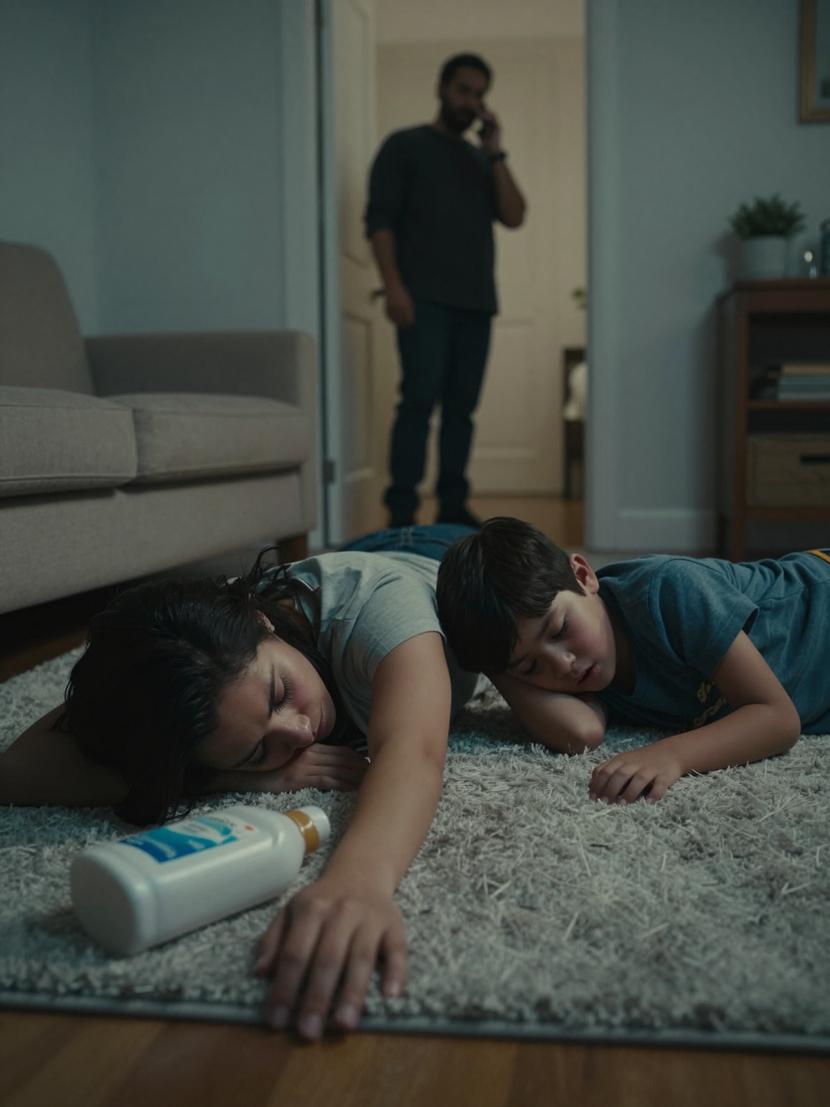
I let my body go limp, like a marionette cut free of strings, but my mind stayed sharp, a blade slicing through the fog. I collapsed onto the rug by the couch, my cheek pressing against the detergent-scented fibers. Lucas’s small form slumped beside me with a faint, scared whimper before falling silent. I wanted to hold him, to scream, to sob—but I dared not move.
I listened.
Footsteps crept close—slow, deliberate, as though Adrian feared waking the very nightmare he created. His shadow swallowed my face, and his shoe nudged my shoulder—a cautious probe.
“Good,” he whispered, voice low and cold.
He grabbed his phone, stepping toward the hallway where his voice lowered, thick with victory and release.
“It’s done,” Adrian said. “They ate it. They’ll both be gone soon.”
My blood turned to ice.
A woman’s voice crackled over the line, sharp and excited. “Are you certain?”
“Yes,” he replied. “Exact dosage. It’ll look like accidental poisoning. I’ll call 911 after… once it’s too late.”
“Finally,” she breathed. “Then we can stop hiding.”
Adrian exhaled deeply, like the weight of years melting away. “I’ll be free.”
The sound of a closet door opening, a drawer sliding, metallic clinks echoed ominously.
He returned dragging something—maybe a heavy duffel bag—pausing over us like a judge passing sentence. His silence closed in on me like a vise.
“Goodbye,” he whispered.
The front door opened briefly, letting in a cold breath of night air, then shut.
Silence swallowed the house.
My heart pounded wildly, thudding against my ribs like a drumbeat too loud to hide.
With a trembling breath, I barely whispered to Lucas, “Don’t move yet…”
Then I felt it: his fingers twitching faintly in mine.
He was still with me.
Lucas squeezed my hand once—weak, frightened—but alive. Relief surged, threatening to break me.
“Quiet,” I breathed, voice cracked but urgent. “Pretend.”
His breathing was shallow, uneven. Whatever Adrian had slipped into our meal hadn’t finished its deadly work—maybe Lucas drank less, spilled some of the juice, or maybe fate was finally tipping toward us.
We stayed still, locked in silence until the house held its breath with us—no footsteps returned, no doors creaked, no keys jangled.
I cracked my eyes just enough to catch the microwave clock glow: 8:42 p.m.
My arms felt like lead weights, but slowly I reached into my back pocket for my phone. The screen lit up, pulse leaping as I dimmed it instantly.
No signal. One faint bar flickered, then vanished.
Of course. The living room was a dead zone.
I dragged myself toward the hallway, pulling with elbows, each motion agony made louder in the silence. Lucas shuffled after me, trembling but resolute.
One bar appeared in the hallway.
I dialed 911.
The call faltered.
Again. Trembling fingers. Again.
Finally, a voice: “911, what’s your emergency?”
“My husband poisoned us,” I whispered. “He’s gone. Lucas is alive, but we need help now.”
The dispatcher’s tone sharpened. “Your address? Are you safe right now?”
“I don’t know if he’s coming back,” I said, voice tight. “He said he’d call later—to cover his tracks.”
“Stay on the line. Emergency services are en route. Can you reach fresh air or a locked door?”
I looked at Lucas—his eyes wide, skin cold to the touch.
“Lucas,” I said gently, “can you stand?”
He tried, knees wobbling. “I feel weird,” he whispered.
“Okay,” I soothed. “We’ll go to the bathroom and lock the door. If you feel sleepy, keep your eyes on me, okay?”
We stumbled down the hall, locking ourselves inside the sanctuary of the bathroom. I turned the faucet on, letting Lucas sip water slowly—careful not to overwhelm. From a long-ago first-aid class, I barely remembered the rule: don’t be a hero with poison—buy time, get help.
The dispatcher questioned me about our dinner, timing, allergies—I answered through the spiral of nausea and ringing in my ears.
Then my phone vibrated—a new, unknown number.
CHECK THE TRASH. PROOF. HE’S COMING BACK.
My stomach twisted in knots. Was this the same woman? A neighbor? Someone watching us all along?
I opened the bathroom cabinet, fingers brushing against a bottle of activated charcoal left from a past stomach bug. Without hesitation, I grabbed it—Lucas’s life wasn’t a gamble.
Far-off sirens pulsed louder, closing in like salvation.
Then, downstairs—the front doorknob rattled.
Adrian was back.
But not alone.
Two sets of footsteps crossed the living room floor, deliberate and sure.
The dispatcher’s voice cut sharp through the panic. “Ma’am, officers are outside. Do not leave your room unless instructed.”
I pressed my palm gently over Lucas’s lips—not to silence him, but to remind him: still. Silent.
The footsteps stopped just beyond the door. A low, unfamiliar voice whispered, “You said they were out.”
“They are,” Adrian replied, cold as ice. “I checked.”
My veins froze—the vicious truth flooding in. Adrian hadn’t returned alone. He brought backup—another to clean the mess and confirm we stayed lifeless.
His shoes halted right outside the bathroom door. For one terrifying moment, I imagined him trying the handle, discovering the lock.
But he never tried.
Instead, he murmured, almost tender, “In a minute, we call. We cry. We say we found them like this.”
His companion chuckled darkly. “Sure the kid won’t wake up?”
Adrian’s voice hardened, sharp as steel. “He ate enough. He’ll be gone.”
Lucas’s eyes brimmed with tears. I held his gaze fiercely—stay with me, not yet. Hold on.
Then, pounding at the front door—urgent, commanding.
“POLICE! OPEN UP!”
Chaos exploded. The stranger cursed. Adrian hissed back.
Drawers slammed. Metal clanged to the floor.
The dispatcher’s calm returned. “They’re inside. Stay put.”
Voices flooded the house, demanding, ordering.
“Sir, step away.” “Hands where we can see.” “Who else is here?”
Adrian’s smooth charade cracked under the weight of reality. “Officer, I called—my wife and son collapsed, I—”
The officer silenced him. “We have a 911 call from your wife. She’s alive.”
Silence—then a sharp intake of breath from Adrian, caught in the act.
I unlocked the bathroom door and stepped out, Lucas by my side, legs trembling but holding.
Officers filled the hallway. One knelt before Lucas, speaking gentle words, while another guided me toward arriving paramedics.
Adrian stood motionless in the living room, hands half-raised, face contorted in a feigned shock. His eyes met mine—no apology, no regret. Only fury.
“You lied,” he spat, the mask slipping.
Paramedics busied themselves—fitting Lucas with an oxygen mask, cuffing my arm, asking what we’d eaten. Watching their focused care, a fragile thread of hope unraveled my fear.
Detectives scoured the trash, just as the mysterious text had warned. Beneath crumpled paper towels, they found a torn pesticide label—a poison Adrian hid “for ants.” Photographs and evidence bags turned horror into irrefutable fact.
Phone records revealed the woman on the call: Isabel Cortez—Adrian’s ex, the ghost he claimed was “ancient history” and “just a friend.”
The stranger? A coworker roped into cleaning the mess.
And the anonymous text? From Mrs. Delgado, our neighbor. She had seen Adrian carrying chemical containers days before, heard his laughter on the phone outside, and chose to risk everything rather than watch us perish quietly.
As the ambulance doors closed and Lucas’s hand gripped mine tighter, I glanced back at Adrian being led away in cuffs. His voice, still laced with arrogance, called after us:
“You should’ve stayed down. Both of you.”
Fear tried to claw back, but another voice echoed within me—Mrs. Delgado’s words:
Now finish it.
The hospital smelled of bleach and quiet machines—sterile, detached. Nothing comforted—the bed, the blanket on Lucas, the steady hiss of oxygen.
Rest eluded me; every restless shift was haunted by Adrian’s controlled smile and the slow beep of the monitors shouting: You’re alive. Stay alive.
Near dawn, Detective Morales returned with a steady presence that tore through my exhaustion.
“We’ve secured your home,” she said softly. “You won’t need to go back anytime soon.”
I nodded, words caught in my throat.
Lucas stirred beside me, fragile but breathing; Detective Morales’s pen hovered.
“You mentioned an unknown texter,” she said. “We traced her.”
My heart jumped. “Who?”
“Mrs. Delgado,” Morales said. “She tends her roses with more courage than most. She wishes to remain anonymous for now—concerned about reprisal.”
Preparation. Such a small word for Adrian’s chilling plan.
“He bought chemicals two months ago, researched doses, maskings, delays,” Morales disclosed. “Used burner texts with Isabel—you know—trying for a clean break; insurance money, no custody nightmares, a fresh slate.”
A cold numbness swept me. Months of plotting, the nights Adrian tucked Lucas in, whispered loving lies.
“Will he get bail?” I asked, voice barely audible.
Morales’s jaw tightened. “Not tonight. Maybe never.”
Her footsteps faded, leaving the room hollow and raw. I clung to Lucas’s wrist—his pulse the only anchor.
Then, my phone buzzed again.
Unknown number.
I’ll testify. Just make sure he can’t hurt anyone else.
My chest tightened. Mrs. Delgado wouldn’t be silent anymore.
With trembling fingers, I typed back:
Thank you. You saved us.
Her reply flashed:
No. You saved yourself. You woke up. You fought. Now finish it.
Her words weren’t about revenge.
They were about survival.
And survival, I realized, isn’t a one-time act.
It’s a fierce choice—over and over.
Two days later, Detective Morales sat with me in an interview room. Lucas was downstairs in pediatrics, coloring creatures that usually burst with life. Today, his drawings were shadowed, heavy with gray.
Morales placed a sealed evidence bag between us. Inside lay a small, cold metal object—Adrian’s key.
“Not to our home,” she said softly. “A storage unit he rented under a fake name.”
I didn’t want to know. But her expression told me dark truths awaited.
The unit smelled of mildew and oil; a lone bulb buzzed overhead as we stepped inside.
Two duffel bags sat against the wall—twins, like the one Adrian lugged that fateful night. One was empty. The other… was filled with nightmares:
– Manuals on undetectable toxins
– Fake IDs with Adrian’s face under various aliases
– Three burner phones
– A notebook with dates, dosages, chilling notes like ‘increase next time’
– A photo of Lucas and me—taken from outside our living-room window
My breath caught. “He was stalking us?”
Morales’s voice dropped. “He tracked your routines. Meal times, outings, sleep.”
The room spun.
She handed me a worn recipe card scrawled in Adrian’s handwriting:
Trial 1 – too bitter
Trial 2 – increase ratio
Trial 3 – perfect
Not recipes for food.
A formula for death.
Nausea washed over me. I fought to keep from collapsing.
“There’s more,” Morales said gently.
She unfolded message threads between Adrian and Isabel. At first, it seemed like rekindling an affair. But then the truth bled through:
“She won’t leave. Thinks marriage can be saved.”
“If she’s gone, no divorce mess. No custody battles.”
“The kid?”
“Can’t stay. He’s her anchor.”
The phrase stabbed me—loving Lucas made me the enemy.
Tears burned my eyes; Morales slid a tissue box my way.
“We’re charging attempted murder of a minor,” she declared. “It seals the case.”
“How long has he been like this?” I whispered.
Morales faltered.
“We found notes predating Lucas’s birth.”
A cold void hollowed me out.
Before Lucas was born—Adrian had plotted my death.
I hadn’t lived with a husband.
I’d been trapped inside a calculated plan.
But I wasn’t the woman on the floor, pretending to sleep.
I was awakened.
Dangerously so.
Six months later, the courtroom whispered cold steel and sterile judgment. The trial lacked theatrics—mostly paper, testimony, and the methodical stripping away of the man who once shared my bed.
Adrian appeared, smaller now, yet his eyes glittered with the same toxic control.
He smiled—a thin, poisonous curve—as he took his seat.
“My attorney warned me,” I whispered, “Don’t look at him unless you have to.”
But I did. Once. Because to defeat a monster, you must face him fully.
The prosecution dismantled every lie: the storage unit, messages, recordings, recipe card, pesticides, duffel, and the call I overheard.
Mrs. Delgado testified anonymously behind a protective screen, voice trembling yet unyielding.
When the defense painted Adrian as overwhelmed or confused, Detective Morales produced his meticulous notebook.
The courtroom fell silent.
No one accidently documents three years of poison experiments.
Then came my moment.
Sweaty palms, a tight throat, but a steady voice told the truth—the meal, the dizziness, the fall, the call, the locked bathroom, the terror, Lucas’s tiny fingers clutching mine.
When I whispered the words, “Don’t move yet,” I saw jurors recoil as if feeling my own fear.
Adrian never flinched.
Just stared like I was a problem he could still fix.
Knees trembling, I stepped down. My attorney caught my arm. “You did it,” she murmured.
But it wasn’t over.
Three days later, the verdict:
Guilty on all counts.
First-degree attempted murder.
Attempted murder of a child.
Conspiracy.
Premeditation.
Adrian sat frozen, jaw clenched—the mask cracking.
As officers led him away, he glanced at me one last time.
“You should’ve stayed down. Both of you.”
For a heartbeat, fear clawed deep.
Then Mrs. Delgado’s words surged back:
Now finish it.
Survival wasn’t just enduring.
It was defiance.
Lucas and I stepped into the sunlight, too bright, too pure after the darkness.
His small hand found mine, steady and familiar.
“Are we safe now?” he asked.
I met his eyes, seeing the weight of our journey there.
“We’re safer than ever,” I said softly.
Not safe.
But safer.
Because monsters don’t vanish behind bars.
But neither do those who survive them.


