
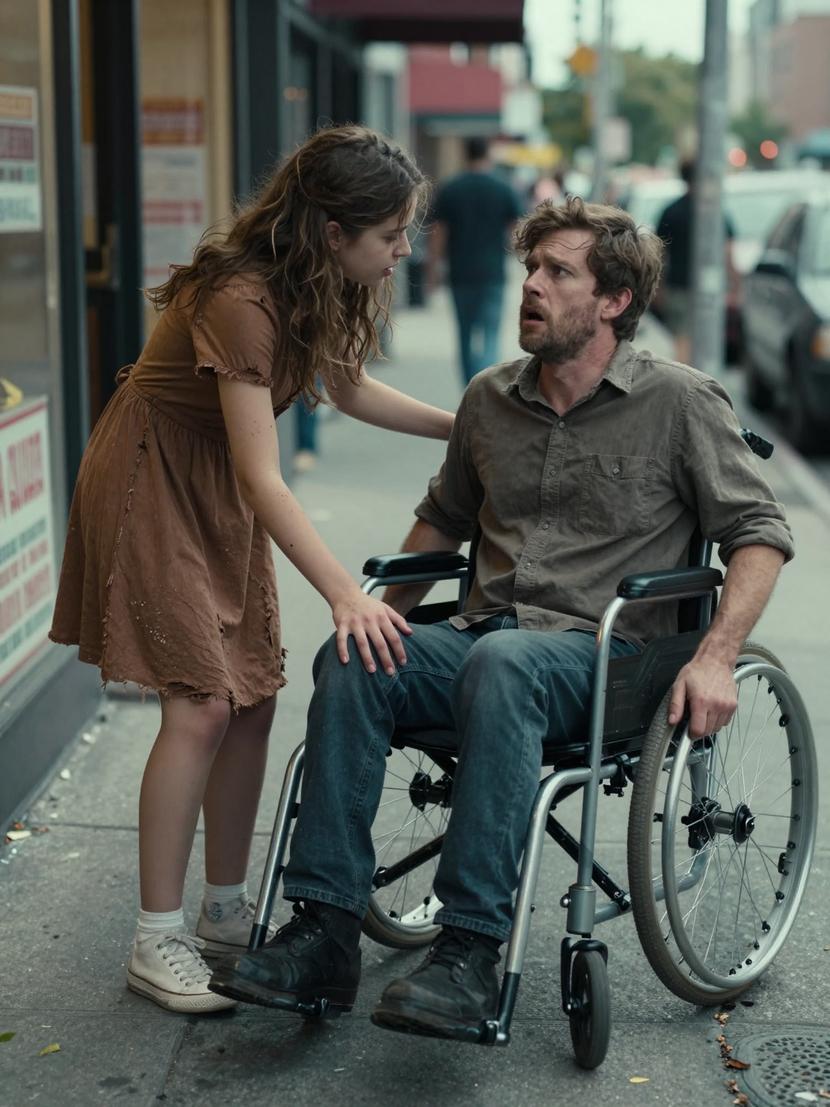
Invisible. That’s how Isabel existed on the bustling sidewalks of Chicago—an apparition in tattered clothes and dust-blackened bare feet. Her brown dress hung loosely off one shoulder, and her tangled hair veiled eyes that shouldn’t have held such quiet certainty. She was no older than thirteen, yet no one truly saw her; passersby slid past like she was a shadow cast by the towering city.
She stopped in front of a man in a wheelchair. David Collins was twenty-nine, but the deep furrows etched into his face made him seem wearier, older than his years. His wheelchair was stationed outside a closed deli on Elmwood Avenue, a cardboard sign leaning against the wheel whispering: “Disabled. Anything helps.”
David had learned the brutal truth of invisibility—no one looked him in the eye. Occasionally, coins whispered into his cup; food was rarer still. Words? They never came.
So when a soft voice brushed against his ears, he thought hunger and desperation were playing tricks on his mind.
“If you give me food,” Isabel said, voice low, “I can make your legs work again.”
David blinked, disbelief sharpening his tired gaze. Cruelty was common. Sarcasm too. But hope? Hope hung impossibly in this quiet girl’s calm eyes.
“You really mean that?” he croaked, voice rough from disuse.
Her lips curved—not wide, not playful, but an intimate, knowing smile. “Yes.”
David scoffed bitterly. “Kid, even doctors couldn’t fix me.”
She tilted her head gently. “Because they never listened.”
A shiver traveled down David’s spine—a sudden chill that sliced despite the afternoon’s warmth. Against every instinct, he reached into his bag and pulled out half a turkey sandwich—his sole meal for the day. His fingers trembled, then extended it toward her.
Isabel took the offering reverently. “Sit straight,” she instructed softly.
David frowned. “What?”
“Sit up. Please.”
With hesitation, he obeyed.
One small, dirt-smudged hand pressed on his knee.
Then—pain ignited, sharp and electric, surging through his legs.
David gasped, clutching the wheelchair’s wheels. “Hey—what are you—”
Isabel leaned closer, her lips barely moving in a whisper drowned by city noise.
And then pain dissolved.
Silence. Then warmth, spreading through limbs numbed so long they’d almost ceased to exist.
His breath hitched, voice trembling. “I—I felt something.”
Isabel retreated, fading back into the crowd. “I’ll come back tonight. If you still want to walk.”
David sat frozen, heart thundering against his ribs.
Was it hunger? Hope? A cruel illusion? Or had a fragment of impossible magic just grazed his shattered life?
That night, sleep abandoned David. Rain tapped a restless rhythm against the window of his cramped studio apartment. Doctors had sentenced him to paralysis–a spinal injury from a freeway accident, declared permanent. They told him to surrender.
Yet something in Isabel had reignited a flicker within him.
At precisely 9:47 p.m., a soft knock echoed.
His heart seized. Visitors were a myth.
He wheeled to the door. Standing there, dry despite the rain, was Isabel—her torn dress clinging like a memory, calm eyes steady and unwavering.
“You came,” he whispered.
“You fed me,” she smiled. “That matters.”
She stepped inside, scanning the bare room—no distractions, just a mattress on the floor.
“You lost more than your legs,” Isabel said quietly.
David swallowed hard. “Who are you?”
No answer. Only a silent kneel before him, hands resting on his knees.
“Stand,” she commanded softly.
A bitter laugh escaped him. “I can’t.”
“You can. You’re just afraid.”
Fear crashed over him—fear of falling, failing, believing again. Then pain returned—this time alive, pulsing with promise.
Toes twitched. Calves clenched.
His eyes snapped open. “Oh God.”
“Now,” Isabel urged, voice resolute. “Stand.”
With a shuddering cry, David pushed against the wheelchair’s arms.
Legs wobbled violently, then, against all odds, held firm.
Three seconds. Then knees buckled, sobs breaking free.
He laughed and wept, fingers trembling as they explored limbs he thought lost forever.
Looking up, Isabel was already stepping back, hand on the doorknob.
“Wait!” he cried. “Who are you? Please don’t go.”
She paused, eyes soft. “My name doesn’t matter. What you do now—that’s everything.”
And she vanished.
Morning light spilled into David’s world—he walked. Not far, not yet steady, but undeniable.
Doctors called it a miracle. Reporters whispered unexplainable. Social media roared.
But David knew better.
He searched for Isabel, through streets and shadows.
Days slipped into weeks.
No sign.
Until one night at the public library, an old newspaper clipping shifted his breath to ice.
“LOCAL GIRL, 13, DIES SAVING CHILD IN HIT-AND-RUN.”
The photo stole the warmth from his chest.
Same eyes. Same smile. Same torn dress.
She had died two years before his accident.
David sank back, stunned into silence.
Then his eye caught the article’s final whisper:
“Witnesses say the girl whispered something before she passed.”
Closing his eyes, David heard it clearly now—a fragile echo of hope:
“You’re not done yet.”
He folded the paper, rose steady and strong.
Outside, Chicago pulsed onward—unaware.
But somewhere beyond the bustling crowds, David knew Isabel walked beside him, barefoot and smiling.


